

Our next dive of the trip takes us to the eastern reef of Koh Tachai, only a few hundred meters from the famous Koh Tachai Pinnacle. We anchor close to the island and enjoy the view of crystal turquoise water glowing in the shallows. After gearing up, we enter the dinghy and move toward the island, ready to drop in over the top of the reef.
Descending the Shallows
This dive is one of the most relaxing dives on our itinerary. The reef is long, calm, and usually has very little current, so at most we enjoy a gentle drift. It’s the ideal change of pace after the exhilarating action at Koh Tachai Pinnacle during our previous dive.
We visit this site as an alternative to the Pinnacle — ideal for those who prefer an easier, shallower dive with plenty to see. Even without the intensity of deeper sites, there’s still lots of activity here, from reef fish waking up for the day to larger species cruising along the sandy edge.
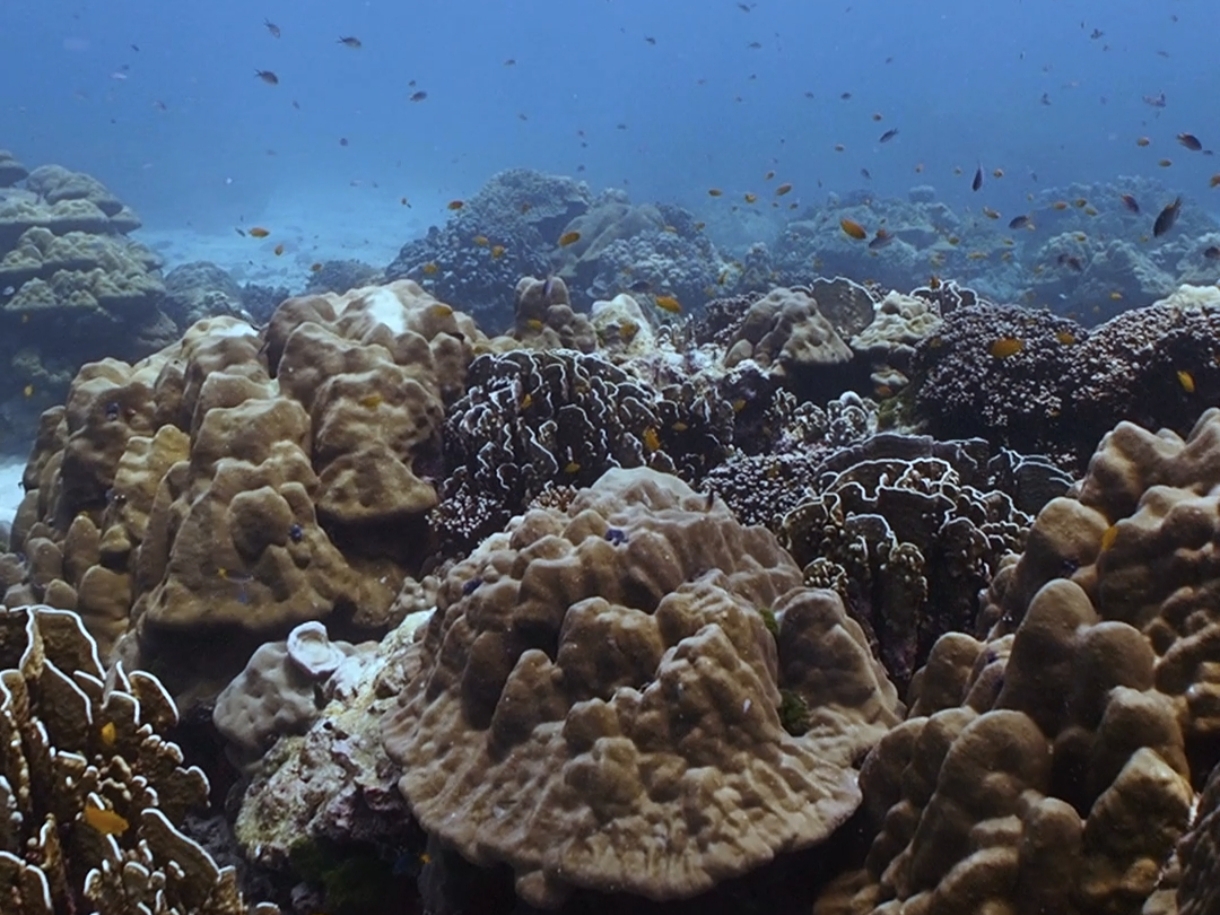
As I start my dive, the shallows open below me, revealing an extensive reef. Hard coral colonies here are among the healthiest in the entire Similan Islands National Park, and they glow under the afternoon sun.
I drift forward and explore the corals. Each colony intertwines with its neighbours, forming structures that look centuries old. Large plates of Montipora overlap like stacked shelves, while branching staghorn corals create dense thickets along the slope. Boulder corals and massive porites domes rise between them, adding height and texture to the reef. As I move deeper, the corals break into scattered bommies, each surrounded by bright white sand. Colours pop around me as a swirling school of butterflyfish moves ahead, guiding my line toward the reef’s edge.
The Reef’s Edge
I scan the sandy bottom that begins around 16 metres for hidden critters as a light right-shoulder current nudges me forward.
The sandy flats at Koh Tachai Reef are great for spotting camouflaged hunters. A ripple of movement catches my eye just above the seabed. A cuttlefish hovers there, shifting from mottled brown to soft beige in a blink.
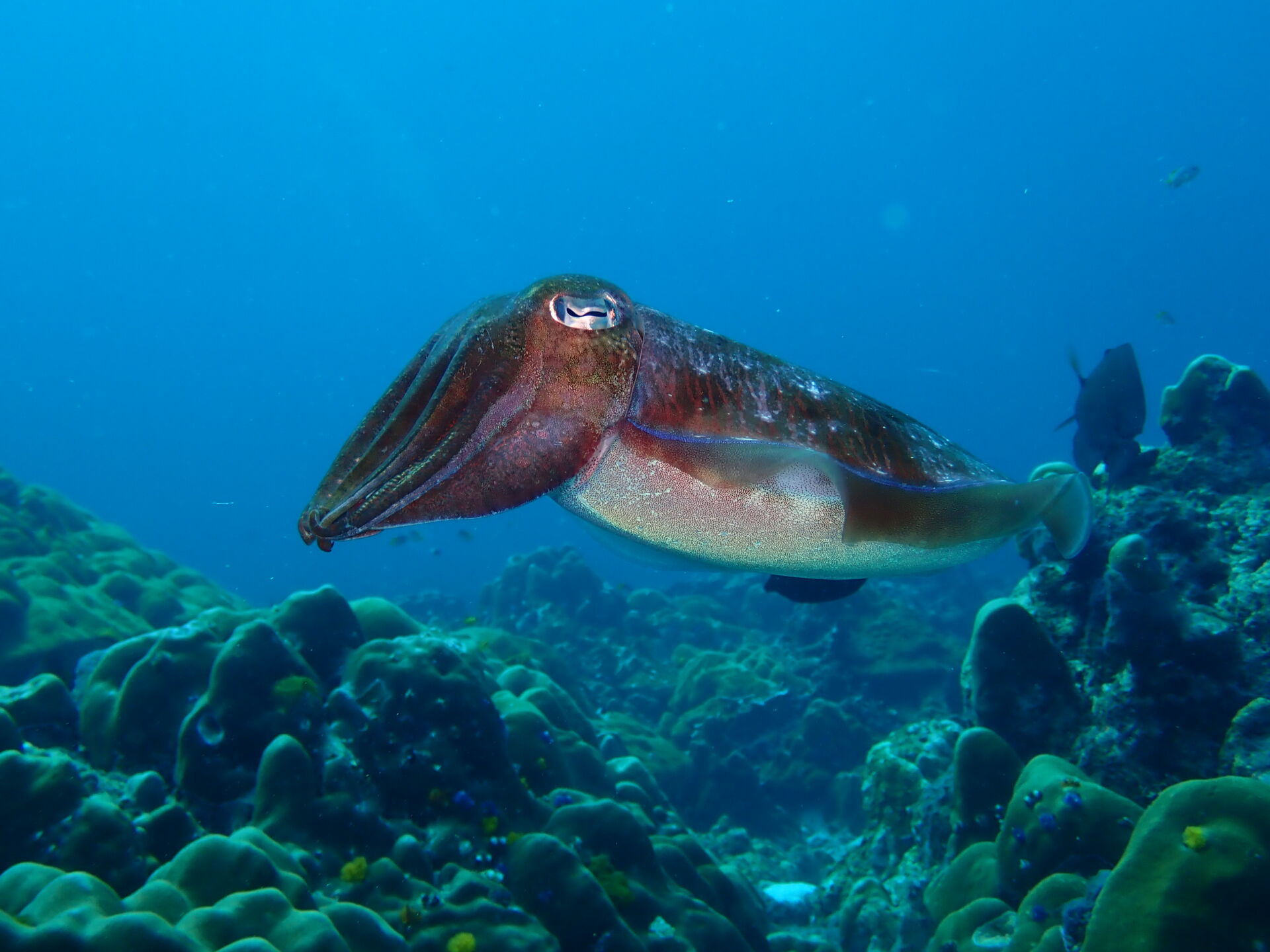
Cuttlefish are common in the Similan Islands and often patrol these open sandy areas for small fish and crustaceans. This one holds perfectly still, its tentacles tucked in tight while gentle colour waves pulse across its skin.
Cuttlefish are masters of camouflage and communication. They use thousands of tiny pigment cells to change colour faster than any other animal. These shifts help them hide, signal to other cuttlefish, or confuse prey before striking. They also have excellent vision and can track movement with precision, even in low light. Despite their soft bodies, cuttlefish are agile hunters and intelligent cephalopods, capable of problem-solving and quick, coordinated escapes when threatened.
As I continue to glide over the seafloor, a peacock flounder shifts colour as it glides away, almost disappearing again within seconds. Flounders are expert camouflagers, flattening themselves against the seabed while their two upward-facing eyes rotate independently to watch for threats.
Coral Gardens
We begin to shallow up, drifting back toward the coral gardens where the scenery becomes even more beautiful. As we drift along, a huge school of fusiliers sweeps past in perfect unison. They twist and reform as they move, creating shifting walls of silver and yellow.
Fusiliers are fast-moving planktivores that feed in the water column, and their streamlined bodies let them react instantly to changes around them. They school tightly for protection, using rapid turns and coordinated movements to confuse predators. Many species mix together here including yellowback, neon, and goldband fusiliers, each adding their own flash of colour to the reef.
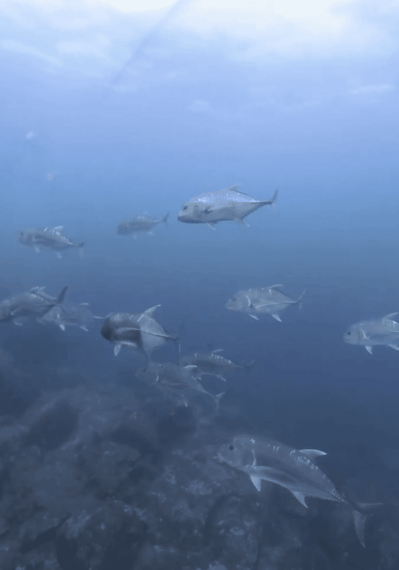
Suddenly, the fusiliers twist and scatter in sharp bursts of motion. Their behaviour shifts instantly, signalling a predator close by. A flash of silver breaks the pattern, and then a school of blue trevallies charges through. A lone pickhandle barracuda follows behind them, drawn by the vibrations and chaos. It moves with slow confidence, its eyes scanning for any late stragglers. The fusiliers dart away in a wave of colour as we all watch the scene unfold. Even on the calmest dives, the ocean can open up without warning. All we need to do is hover and observe.
Shallow Surprises
I shallow up as we approach the southeastern corner of the island. The current increases slightly as it sweeps around Koh Tachai.
The topography changes here. The coral gardens thin out, replaced by granite boulders stacked at the island’s curve. I hover in silence and look out into the blue. This area is a known nursery for young blacktip reef sharks, so I wait, hoping for a glimpse. And sure enough, one appears, coming straight towards me with a curious look.

Blacktip reef sharks are one of the most common reef sharks in the Similan Islands, and they thrive in shallow, warm waters. Juveniles often stay close to the coastline, using bays and fringing reefs as natural nurseries. These areas offer shelter and abundant small fish, making them safer places to grow.
They are easily recognised by the dark markings on their fins and their slim, athletic shape. Blacktips are curious but cautious, relying on quick movements and sharp vision to avoid threats. They mainly hunt small reef fish and crustaceans, often patrolling the shallows or circling bommies, especially at dusk and during the night. They are important predators that help balance fish populations on the reef.
The shark turns away, passing all the divers before disappearing in the distance. Nothing beats a curious shark encounter! Typically sharks in the Similan islands are quite skittish, but the young black tips here have grown used to divers and are known to be more inquisitive. So it’s always worth looking out into the blue on this dive site!
To improve your chances of spotting a shark, move slowly and stay close to the reef, using small ravines or coral formations as cover. Look far into the blue and scan for quick, smooth movements. Stay still when possible, avoid sudden kicks, and keep your profile low. The calmer you are, the more likely a shark is to stay curious rather than disappear.
Back to the Shallows
We spend the rest of the dive turning back toward the island, left shoulder to the reef, gliding over shallow coral gardens. It’s one of the most spectacular views on our entire itinerary.
Large lettuce corals spread out like layered fans. More staghorn corals branch across the seafloor in wide thickets. Small clusters of fire coral add even more texture, creating a living mosaic across the reef. Reef fish dart between the structures, lighting up the landscape with constant motion.
A flicker of movement catches my eye inside the corals. A snowflake moray eel peeks out, its white, yellow, and black pattern glowing against the reef.
Snowflake morays are typically small, often under a meter, which makes their bold pattern even more striking. Their bodies are covered in irregular white patches mixed with yellow spots, each one outlined by dark bands. The markings break up the outline of their body, helping them blend into the mixed textures of coral rubble, sponge growth, and shadows.
This type of pattern is a form of disruptive camouflage. Predators struggle to recognise their true shape because the contrasting colours scatter the eye. In complex coral gardens, the moray can almost disappear unless you catch the exact angle of its head.
I drift slowly and take it all in. This is the reason I dive. Calm moments in the shallows, watching the underwater world pass by.
Soon it’s time to end the dive. This has been a peaceful dive full of colour, life, and soft currents. It’s the perfect chance to connect with the ocean and reset your mind.
Like what you read? share it with your friends!
Next Up on Our Journey
We sail further north and leave the Similan Islands National Park behind. Another island chain awaits us, offering new topography, new species, and new adventures. Stay tuned as our journey continues.
Want to read more? Take a look at our latest posts!
- How Coral Restoration Works: From Fragment to Reef
- Sea Turtles in the Similan Islands: Feeding, Nesting and Reef Life
- Tourism and the Similan Islands: Protection or Pressure?
- Our Oceans Under Pressure: What Is Really Happening Beneath the Surface?
- DiveRACE Safety Series: Marine Life & Environmental Awareness
Related Articles
-
Mergui Archipelago with DiveRACE
The Mergui Archipelago, located in southern Myanmar, is one of Southeast Asia’s…
-
Eat. Sleep. Dive. INFLATABLE FUN!
Diving isn’t the only way to enjoy the waters around Thailand. On…
-
Giant Trevallies at Koh Tachai Pinnacle
Koh Tachai Pinnacle is a top dive site in Thailand, famous for…