
From the surface, the ocean looks endless. It stretches beyond the horizon and feels untouchable. For many people, it still represents power, mystery, and resilience.
But beneath the surface, the ocean tells a more complicated story.
As divers in the Andaman Sea, we see what most never witness. Reefs bursting with colour and movement, but also coral that has bleached and recovered, fishing line wrapped around reef structures, and subtle changes in fish density that only become obvious when you’ve dived the same sites for years.
The ocean is still extraordinary, but it is undeniably under pressure. It’s not collapsing overnight. It is changing gradually, often quietly. And those changes matter.
Understanding what is happening below the surface is the first step toward protecting it.
Climate Change and Rising Sea Temperatures
One of the most significant pressures on the ocean is climate change. The ocean absorbs more than 90% of the excess heat trapped by greenhouse gases in the atmosphere (1. IPCC, 2021). As a result, marine ecosystems are warming at an accelerating rate.
Coral bleaching is one of the clearest signs. Even a temperature rise of 1–2°C above seasonal norms can trigger coral bleaching. During bleaching events, corals expel the symbiotic algae (zooxanthellae) that provide them with their colour and energy. What remains is a pale, ghostly skeleton beneath transparent tissue.

For example, the Andaman Sea has already experienced several coral bleaching events linked to unusually high sea temperatures. A major event occurred in 2010, when prolonged periods of elevated sea temperatures caused widespread bleaching across Thailand’s Andaman Sea, including reefs in the Similan and Surin Islands. Another significant global bleaching event followed in 2016, driven by a strong El Niño and record ocean heat. During this time, reefs across Southeast Asia experienced severe heat stress, and many shallow coral systems struggled to recover. Since then, recurring marine heatwaves in recent years have continued to place pressure on coral reefs throughout the region.
But bleaching is not immediate death. Corals can recover if temperatures return to normal quickly. However, repeated or prolonged heat stress weakens their resilience. Recovery becomes harder, growth slows, and mortality increases.
In recent years across the Andaman Sea, we have seen bleaching events affect shallow reef systems. Some sites recover well, especially in protected areas with strong water flow. Others struggle, particularly where additional pressures exist.
Ocean Acidification and Extreme Weather Events
Rising temperatures are not the only issue. The ocean also absorbs carbon dioxide from the atmosphere, which increases acidity. Since the Industrial Revolution, ocean acidity has increased by approximately 30% (2. NOAA). This weakens coral skeleton formation and affects shell-building organisms such as molluscs and plankton, which form the base of the marine food web.
In addition, extreme weather patterns across Asia have become increasingly unpredictable. Stronger monsoon systems, unseasonal storms, and prolonged periods of heavy rainfall are no longer rare events. Warmer ocean temperatures provide additional energy for storm systems, intensifying rainfall and wave action. While storms are a natural part of marine ecosystems, their growing intensity places additional strain on already stressed reefs.
In the Andaman Sea, powerful storm surges can physically break branching corals and shift entire sections of shallow reef. After heavy rainfall, runoff from land carries sediment, nutrients, and pollutants into coastal waters. Visibility drops. Fine sediment settles over coral polyps, reducing their ability to photosynthesise. Nutrient-rich runoff can also fuel algal blooms, which compete with coral for space and light. When storms coincide with warming seas, recovery becomes even more challenging. Reefs that might once have rebounded quickly now face multiple pressures at the same time.
And yet, resilience still exists. In areas with reduced local pressures, reefs show remarkable recovery potential. This is why local action matters, even within a global crisis.
Industrial Fishing: The Largest Direct Pressure on Marine Life
While plastic pollution dominates headlines, industrial fishing represents the largest removal of life from the ocean.
According to the UN Food and Agriculture Organization, 37.7% of global fish stocks are currently overfished, meaning they are being harvested at biologically unsustainable levels (3. FAO, 2022). Many others are exploited at their maximum sustainable limit.
Since 1950, global marine fish catch has increased more than four times. However, in many regions, catch per unit effort has declined, meaning more effort is required to catch fewer fish.
Large predatory species have been particularly affected. Studies estimate that populations of large oceanic fish have declined by around 90% since the mid-20th century in some regions (4. Myers & Worm, 2003).
When top predators disappear, the balance of the ecosystem shifts. This disruption cascades down the food chain. When predators decline, mid-level species may increase, which can then reduce populations of herbivorous fish. Without herbivores grazing algae, coral reefs become overgrown and less resilient.
In protected areas such as the Similan Islands, the difference is visible underwater. Schools of snapper and trevally move in dense formations. Reef sharks still patrol cleaning stations. Pelagic species appear seasonally. The reef feels structured and dynamic.
In contrast, diving in less regulated waters, including parts of Myanmar, reveals a different pattern. Coral structures can still be beautiful. Macro life may be abundant. Yet the density of large schooling fish and top predators is often noticeably lower. The ecosystem feels quieter in terms of biomass. This contrast highlights the impact of regulation and enforcement.
Destructive Fishing Techniques
Not all fishing methods are equal.
Bottom trawling, one of the most widespread industrial methods, involves dragging weighted nets across the seabed. This technique can destroy coral, sponge, and seagrass habitats that have taken decades or centuries to form. The UN estimates that bottom trawling disturbs millions of square kilometres of seabed annually.
Bycatch is another major issue. Approximately 9.1 million tonnes of marine life are discarded each year as unintended catch (5. FAO, 2022). This includes sharks, manta rays, turtles, dolphins and juvenile fish.
Ghost nets — lost or abandoned fishing nets — continue trapping marine animals long after being discarded. The UN Environment Programme estimates that abandoned fishing gear makes up nearly 10% of marine plastic pollution by volume.
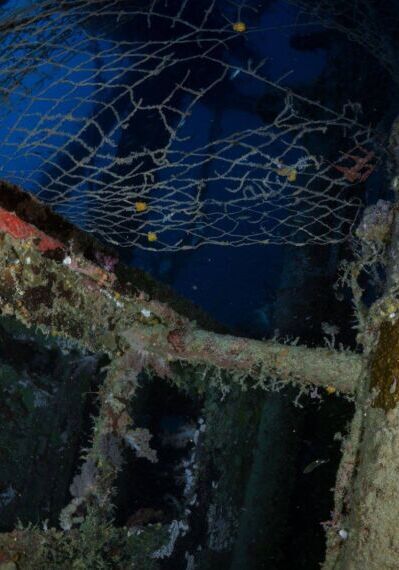
This problem is not only happening in distant oceans. Recently, park rangers in the Similan Islands removed a large ghost net that had become entangled on the reef. Nets like these can drift for months or even years before becoming trapped on coral structures. Once caught, they continue to trap fish, sharks, and other marine life while also breaking fragile coral colonies as waves move the net back and forth. This highlights the important role that marine park authorities and conservation teams play in protecting reef ecosystems. Most ghost nets are probably never found.
Dynamite fishing is another highly damaging fishing method, shattering entire sections of reef structures instantly. While it produces short-term catch, it leaves long-term devastation. Although illegal in many countries, enforcement can be inconsistent.
A commonly overlooked factor is government subsidy. Many large industrial fleets rely on fuel subsidies and financial support to remain profitable. This enables vessels to fish farther offshore and for longer periods, increasing pressure on already stressed stocks. Without these subsidies, some forms of large-scale fishing would not be economically viable.
Small-Scale Fisheries: Sustainable but Vulnerable
Fishing is not inherently the problem. Coastal communities have depended on it sustainably for generations. The issue lies in scale, technology, and lack of effective regulation. It is important to distinguish between industrial fishing and small-scale coastal fisheries.
Small-scale fisheries account for roughly 40% of global fish catch and employ over 90% of people working in marine capture fisheries (5. FAO, 2022). These communities often rely on traditional methods, seasonal knowledge, and localised fishing grounds.
Historically, many coastal communities fished in ways that allowed stocks to replenish. Gear was selective. Effort was limited. Fishing pressure was geographically contained.
However, even sustainable communities are now affected by industrial fleets operating offshore.
When large vessels deplete migratory stocks or overexploit shared waters, coastal fishers experience reduced catch close to shore. Fish that once supported local food security and income become scarcer.
In parts of Southeast Asia, small-scale fishers report travelling farther and spending longer at sea to maintain previous catch levels. This increases fuel costs and reduces profitability, creating economic strain.
The issue is not fishing itself. It is scale, regulation, and equity. Protecting small-scale fisheries using sustainable methods often aligns with protecting marine ecosystems.
Plastic Pollution: The Visible Symptom
Plastic pollution is often the most visible sign of ocean distress. Images of floating debris and entangled wildlife are powerful and confronting.
An estimated 8–11 million tonnes of plastic enter the ocean each year (6. UNEP). Over time, sunlight, wave action, and physical abrasion break larger plastic items into increasingly smaller fragments known as microplastics. These particles can persist in the marine environment for decades and are now found in marine organisms at nearly every trophic level, from plankton to the large fish that we consume.
Microplastics are easily consumed by plankton, fish, and other marine organisms, allowing them to move through the food chain. Recent research has even detected microscopic plastic particles embedded within coral tissue and skeletons, where they can interfere with feeding and energy processes. What begins as a discarded bottle or fishing line can ultimately become part of the reef ecosystem itself, illustrating how difficult it is to remove plastic once it enters the ocean.
While diving, we occasionally encounter fishing line caught on coral heads or fragments of net lodged between reef structures. These are small reminders of a much larger global issue.
It is important, however, to understand proportion. A significant amount of marine plastic originates from fishing activity itself, including lost nets and gear. Plastic waste from land-based sources also contributes heavily, particularly in regions with limited waste management infrastructure.
Plastic pollution is serious and requires systemic change. Yet it is one piece of a broader puzzle of ocean pressure.
Pollution Events, Oil Spills, and Untreated Waste
Not all ocean impacts are gradual. Some are sudden.
Recently, an oil spill from a sunken cargo vessel reached beaches in Phuket. While the visible contamination was concentrated along the shoreline, events like this highlight how quickly industrial accidents can affect marine environments.

Our coral restoration site in Phuket is not far from where contamination was reported. Even when direct damage is limited, such events create uncertainty. Oil can coat coral surfaces, reduce light penetration, and disrupt delicate reef ecosystems. Young coral fragments are particularly vulnerable.
Beyond oil spills, untreated wastewater and runoff from coastal development also impact reefs. Nutrient-rich waste increases algal growth. Excess algae competes with coral for space and light. Sediment runoff can smother coral polyps and block sunlight essential for photosynthesis.
These pressures rarely act alone. Climate stress combined with pollution reduces coral resilience further. The ocean often absorbs these impacts quietly, but accumulation matters.
Reasons for Hope
Despite these pressures, there are strong reasons for optimism.
Marine protected areas have shown clear ecological recovery when effectively enforced. Shark sanctuaries demonstrate how quickly predator populations can rebound. Sustainable fisheries management has improved stocks in some regions.
Community-led conservation initiatives are expanding. Scientific understanding of coral resilience is improving. Restoration techniques continue to evolve.
Most importantly, the ocean retains extraordinary regenerative capacity. When pressure is reduced, life returns.
As divers, we witness both decline and recovery. We see reefs that struggle. We also see sites bursting with life, colour, and movement. The difference often lies in management and human behaviour.
What Divers and Travellers Can Do
Protecting the ocean does not require perfection. It requires awareness and intentional choices.
Support marine parks and protected areas. Choose operators who follow responsible diving practices. Maintain good buoyancy control and avoid contact with reef structures. Reduce reliance on single-use plastics where possible. Be mindful of seafood consumption and seek sustainably sourced options.
Equally important is sharing knowledge. Conversations influence behaviour. Awareness drives change. The ocean may appear vast and indestructible from above. Beneath the surface, however, it is sensitive, dynamic, and deeply interconnected.
At DiveRACE, we believe diving should inspire both curiosity and responsibility. We promote safe, respectful diving that protects fragile reef ecosystems and encourages a deeper understanding of the ocean. We are also leading our own coral restoration project in Phuket, created as a way for us to give back to the ocean. Learn more about our project and how you can get involved here.
What we choose to do on land and at sea shapes what future generations of divers will see below. And that future is still ours to influence.
References:
- IPCC (2021). Sixth Assessment Report: The Physical Science Basis.
- NOAA. Ocean Acidification Overview.
- FAO (2022). The State of World Fisheries and Aquaculture.
- Myers, R.A. & Worm, B. (2003). Rapid Worldwide Depletion of Predatory Fish Communities. Nature.
- FAO (2022). The State of World Fisheries and Aquaculture.
- UNEP (2021). From Pollution to Solution: Global Assessment of Marine Litter and Plastic Pollution.
Related Articles
-

The Vanishing Wrecks of the South China Sea
Wrecks have a special pull on divers. They’re time capsules, artificial reefs,…
-
MV DiveRACE Class X
INTRODUCTION We are excited to present our latest liveaboard project – MV…
-
Thank You Class E.
Dear Friends, We want to express our heartfelt thanks to everyone for…