
From the moment you enter the water in the Similan Islands, there is a quiet sense of anticipation. Visibility stretches far into the blue, while granite boulders frame the reef. Life moves in every direction, yet some encounters stand out more than others.
Then, without warning, a sea turtle appears, gliding effortlessly past. Calm, unhurried, and completely at home, it often feels untouched by your presence.
Encounters like this define diving in the Andaman Sea. They are not guaranteed, but they are always memorable. The Similan Islands, protected as part of Mu Ko Similan National Park, offer one of the best chances in Thailand to see them. Healthy reefs, combined with protection and management, create the right conditions for turtles to thrive.
As a result, understanding their behaviour adds depth to every sighting.
Species Found in the Similan Islands
Two species of sea turtles are seen most often in the Similan Islands, green turtles and hawksbill turtles. While they share the same environment, they use the reef in different ways. This is why divers often encounter them in different areas.
Green turtles are larger and have a more rounded shell. They are often seen cruising slowly across reef tops or resting on sandy patches. Although they are known for feeding on seagrass, they also graze on algae in reef environments. Because of this, they adapt well to the Similan Islands despite limited seagrass beds.
Hawksbill turtles are smaller and closely linked to coral-rich areas. Their pointed beak allows them to reach into crevices and feed on sponges. This behaviour is important, as it prevents sponges from outcompeting coral. As a result, hawksbill turtles are often seen weaving through coral bommies, carefully feeding along the reef.
Other species, such as olive ridley and leatherback turtles, pass through the wider Andaman Sea. However, sightings in the Similan Islands are rare and usually offshore.
Feeding and Their Role on the Reef
Sea turtles are not just passive visitors. Instead, they play an active role in maintaining reef health. Their feeding behaviour helps keep the ecosystem in balance.
Hawksbill turtles control sponge populations, which is essential for coral growth. Without them, sponges can spread quickly and take over available space. By feeding selectively, they allow corals to grow and recover.
Green turtles contribute in a different way, but the impact is just as important. By grazing on algae, they prevent it from covering coral surfaces. This helps maintain space for coral to thrive, especially in areas under environmental pressure.
For divers, watching a turtle feed can feel calm and effortless. However, it is also a reminder that every movement plays a role in a much larger system.
Nesting and Life Cycle in the Andaman Sea
Although turtles are most often seen underwater, their life cycle begins on land. Across the Andaman coast, including Phang Nga, Phuket, and the Surin Islands, turtles return to sandy beaches to nest. These nesting areas are critical to their survival.
Female turtles return to the same region where they were born, a behaviour known as natal homing. After laying their eggs, they cover the nest and return to the ocean. Weeks later, hatchlings emerge and make their way to the sea. This journey is one of the most vulnerable stages of their life.
Hatching
After an incubation period of around 45 to 60 days, hatchlings begin to emerge from their nests. This usually happens at night, when sand temperatures drop and conditions are safer. Emerging under darkness helps reduce the risk of predators, while also protecting them from the heat of the sun.
Journey to the Sea
Once on the surface, hatchlings instinctively move towards the brightest horizon. In natural conditions, this is the open ocean, reflecting moonlight and starlight. They also use the slope of the beach and the sound of waves to guide them in the right direction. This journey, although only a short distance, is one of the most critical stages of their life.
However, this natural navigation can easily be disrupted. Artificial lights from torches, phones, boats, or nearby buildings are often brighter than the ocean horizon. As a result, hatchlings can become disoriented and move inland instead of towards the sea.
This has serious consequences. Disoriented hatchlings may end up on roads, in vegetation, or exposed areas where predators are more common. Many die from exhaustion, dehydration, or predation before ever reaching the water.
For this reason, light management on nesting beaches is extremely important. Conservation groups often use red-light filters when necessary, as turtles are less sensitive to this wavelength. More importantly, avoiding the use of bright lights entirely helps ensure hatchlings can follow their natural instincts safely to the ocean.
Only a small number survive to adulthood. Because of this, every adult turtle seen on a dive represents years of survival. It also highlights the importance of protecting both reefs and nesting beaches.
Where to See Turtles in the Similan Islands
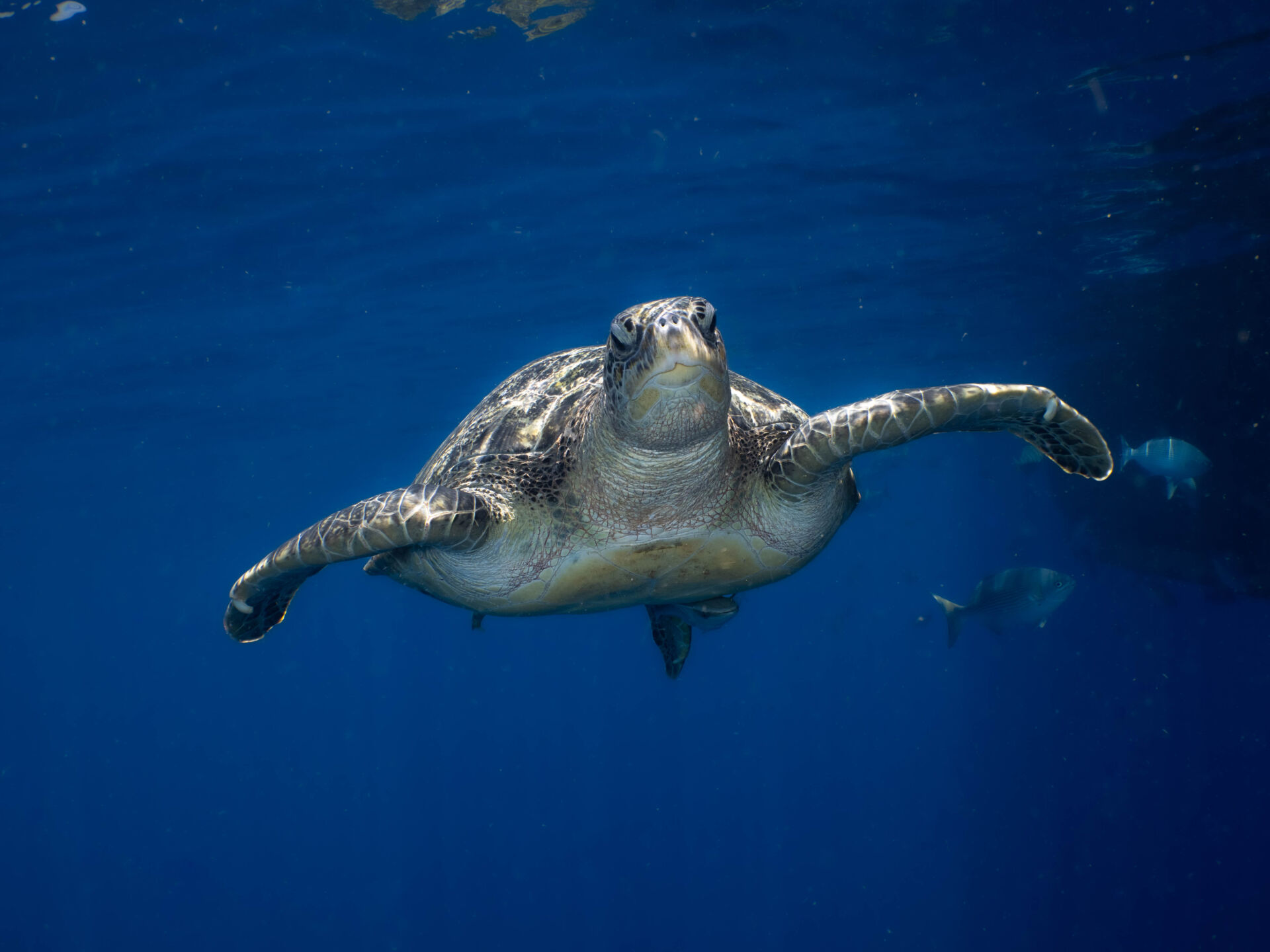
Turtles can appear on almost any dive, yet some sites offer more consistent encounters. West of Eden is known for its healthy coral and frequent hawksbill sightings. The structure of the reef provides ideal feeding areas.
Elephant Head Rock offers a different environment, with stronger currents and larger topography. Here, green turtles are sometimes seen passing through the blue. These encounters can feel more dynamic, depending on conditions.
Sheltered areas such as Hideaway Bay also provide reliable opportunities. These calmer sites allow turtles to rest and feed without strong currents. However, nothing in the ocean is guaranteed, which is part of what makes each sighting special.
Tourism Impacts on Sea Turtles
Tourism plays an important role in protecting areas like the Similan Islands. However, it also brings challenges, especially for species like sea turtles that rely on calm, predictable environments. While many interactions are harmless, repeated disturbance can begin to change natural behaviour over time.
One of the most visible impacts comes from feeding turtles from boats. Although it may seem like a way to create closer encounters, it can condition turtles to associate boats with food. As a result, they may approach vessels more frequently and lose their natural caution. This increases the risk of injury and disrupts normal feeding patterns. For this reason, feeding marine life is not allowed on DiveRACE trips.
Boat traffic is another concern, particularly in areas with high activity. Turtles need to surface regularly to breathe, which puts them at risk of accidental boat strikes. Even minor injuries can affect their ability to feed, dive, or avoid predators. In busy conditions, this becomes a growing pressure on local populations.
There are also more subtle effects linked to diver behaviour. Approaching too closely, chasing for photos, or blocking a turtle’s path can cause stress and alter natural movement. Over time, repeated disturbance may lead turtles to avoid certain areas, even if those areas are important feeding grounds.
That said, responsible tourism can also have a positive impact. Well-managed dive operations, clear guidelines, and educated divers all help reduce pressure on marine life. When done correctly, tourism creates awareness, supports conservation funding, and encourages protection of these environments.
In the Similan Islands, the balance between access and protection is ongoing. As divers, small choices in behaviour make a significant difference. Respecting wildlife ensures that turtle encounters remain natural, both now and in the future.
Conservation in the Andaman Sea
Sea turtles across the Andaman Sea face ongoing challenges. These include habitat loss, plastic pollution, and accidental capture in fishing gear. In addition, climate change is affecting nesting beaches and hatchling survival.
One of the most exciting developments in recent years is the work being done by Andaman Turtle Watch. They use photo identification to track the behaviour and movements of individual turtles across the region. This is still a relatively new approach in the Andaman Sea, yet the database is growing quickly through daily submissions from divers, guides, and guests.
Each turtle can be identified by the unique scale pattern on its face. For a full identification, clear images of both the left and right side are needed. Once submitted, these images are matched against the database to confirm whether the turtle is already known.
If a turtle has not been recorded before, you have the opportunity to name it. However, if it has already been identified, you can access information about that individual. This may include where it has been seen before and how it moves between sites.
Andaman Turtle Watch works closely with the Department of Marine and Coastal Resources (DMCR). The data collected helps support wider conservation efforts and improves understanding of turtle populations in the Andaman Sea.
For divers, this creates a unique opportunity to contribute directly to marine research. A simple photo, taken with care and respect, can become part of a much larger conservation story.
Government Efforts
The Department of Marine and Coastal Resources also contributes through rescue and rehabilitation efforts. Marine national parks, including the Similan Islands, provide further protection. However, conservation still depends on responsible tourism and diver behaviour.
In the Similan Islands, access to certain areas is also managed to support conservation. Islands 1–3 have been closed to the public since 2018, with authorities stating this is to protect sensitive ecosystems and known turtle nesting beaches. Limited detailed information has been publicly released, so the full impact of these closures is not always clear to visitors and operators.
Diving with Respect
Seeing a sea turtle underwater is always a privilege. However, how we behave around them matters. Maintaining distance is essential, as close interaction can cause stress.
Divers should avoid chasing, touching, or blocking a turtle’s path. Good buoyancy control is equally important, as it protects both the reef and the animals that depend on it. By staying aware and controlled, divers can minimise their impact.
In the end, we are visitors in their world. Respectful diving ensures these encounters remain possible for the future.
Experience It for Yourself
There is something unforgettable about seeing a sea turtle in its natural environment. The movement is effortless, the behaviour is calm, and the moment feels completely genuine. These encounters stay with you long after the dive ends.
If you want to explore the Similan Islands and experience this for yourself, join us aboard MV DiveRACE Class X. With access to some of Thailand’s best dive sites, every trip offers the chance to witness marine life at its best. And if you are lucky, a turtle encounter may become one of the highlights of your journey.
Related Articles
-

The Vanishing Wrecks of the South China Sea
Wrecks have a special pull on divers. They’re time capsules, artificial reefs,…
-
MV DiveRACE Class X
INTRODUCTION We are excited to present our latest liveaboard project – MV…
-
Thank You Class E.
Dear Friends, We want to express our heartfelt thanks to everyone for…