
Coral reefs are not built overnight. They grow slowly, layer by layer, shaped by time, stability, and life itself. When a reef is damaged, recovery can take decades. In some cases, it may not recover at all without support. That is where active coral restoration plays a role. It does not replace nature. Instead, it helps restart processes that would otherwise take far longer to return.
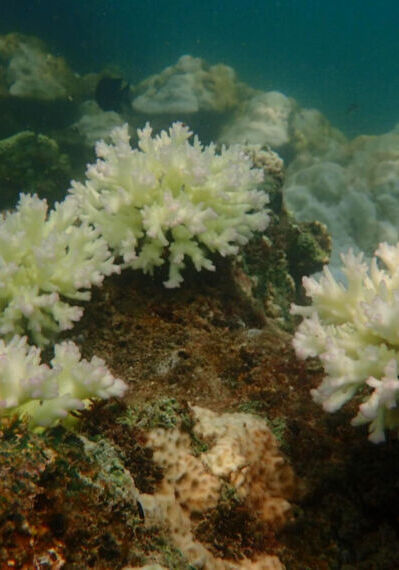
At DiveRACE, our restoration work focuses on giving reefs the structure and conditions they need to rebuild. Our coral restoration site in the south of Phuket, Thailand, was carefully selected for this reason. The area has consistent current flow, which delivers nutrients essential for coral growth. It is also characterised by barren, bleached rubble, a sign that this was once a healthy reef. While this unstable substrate prevents natural recovery, it provides a suitable base for installing our structures.
The goal is not just coral growth. It is to create a functioning reef ecosystem again, where marine life returns and natural balance is restored.
Why We Use Coral Fragments
One of the most effective ways to restore coral is through fragmentation. Many coral species, especially fast-growing ones like Acropora, naturally reproduce this way. In the wild, storms or strong currents can break pieces off a colony. If those fragments land in a stable position, they can continue growing into new colonies.
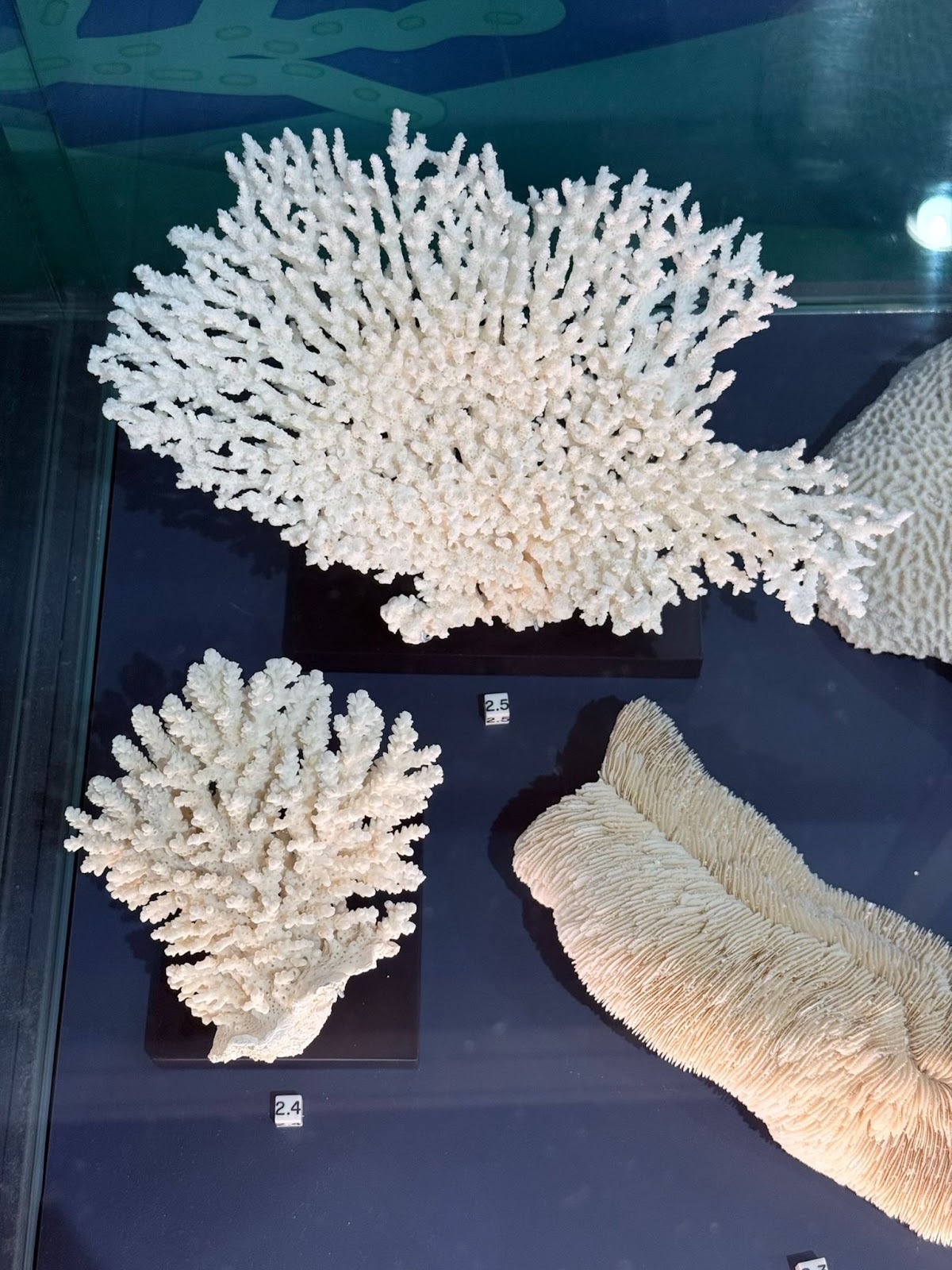
We work with this natural process. Carefully selected fragments are collected from donor colonies or naturally broken pieces. This ensures no unnecessary damage is caused to healthy reefs.
Acropora is often used because it grows quickly and creates complex structures. These branching corals provide shelter for fish and invertebrates. They are often among the first to bring life back to a degraded area. Alongside this, we also use submassive species. These grow more slowly, but they add strength and long-term stability to the reef.
This combination is important. Fast-growing species rebuild structure quickly, while slower species reinforce it over time. Together, they create a more resilient reef system.
We primarily work with what is naturally available in the surrounding area. This includes fast-growing Acropora, as well as some submassive species. These slower-growing corals fit well into the joints of the Super Star structures, adding strength and helping to build a more stable reef over time.
Building Stability with ‘Super Stars’
For coral fragments to survive, stability is everything. Loose rubble shifts constantly, especially in areas affected by waves or currents. Without a solid base, fragments are easily buried, damaged, or overturned.

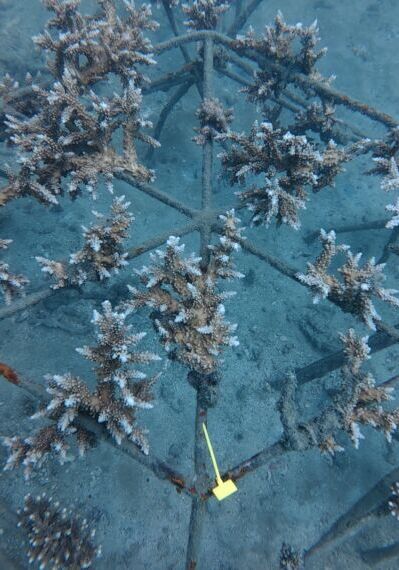
To solve this, we install our custom-built ‘Super Stars’. These are one-metre steel structures designed to stabilise the seabed. Each structure is carefully welded by our team and later positioned and hammered securely into place at our restoration site.
Once installed, they act as a fixed foundation in an otherwise unstable environment. This gives coral fragments a reliable surface to attach and grow.
The design also creates small gaps and elevation. These features improve water flow and reduce sediment build-up. Both are critical for coral health.
A common question is what happens to the structures over time, especially as they are made from steel. To support coral growth, the frames are coated with marine sand, creating a more natural substrate for attachment while also helping to slow the rate of corrosion.
Even as the structure weathers, the coral continues to grow and strengthen. Over time, the colonies expand and fuse together, forming a stable framework of their own. At this stage, the reef becomes increasingly self-supporting, with less reliance on the original structure.
What Happens After a Coral Fragment Is Attached?
After installation, coral fragments are attached to the structures using cable ties. These are trimmed down carefully, ensuring minimal excess material. Over time, as the coral grows, it begins to cover the attachment points.
Eventually, the coral fully encrusts over the ties and bonds directly to the structure. At this stage, the artificial support becomes part of the reef itself.
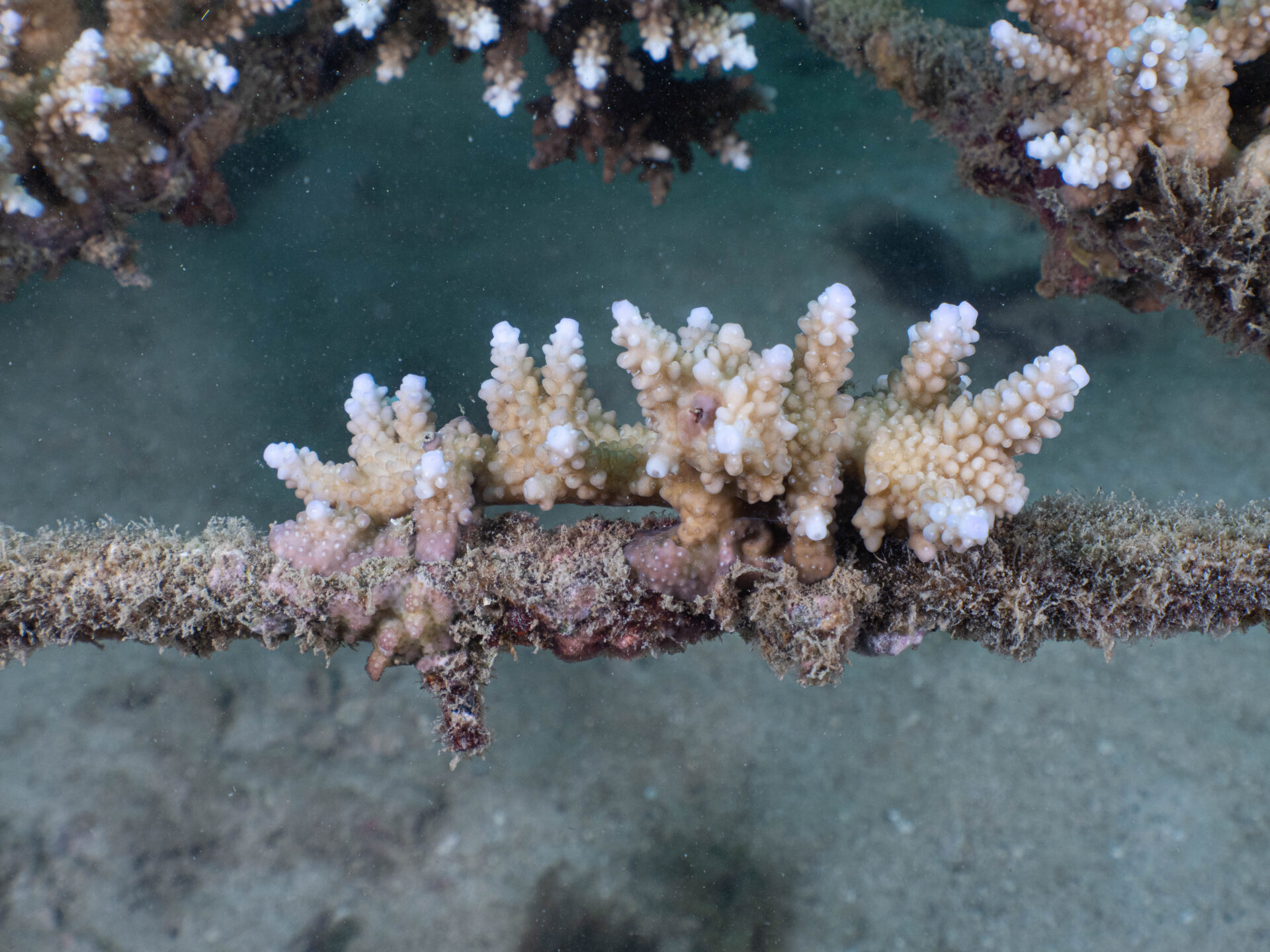
Growth does not happen evenly. Some fragments adapt quickly, while others take longer. White or pale tips are often visible during this stage, which can sometimes be mistaken for bleaching. In reality, this is a sign of active growth. These lighter areas occur where the coral is rapidly producing new skeleton. The living tissue at the tip is thin, and the symbiotic algae that give coral its colour have not yet fully developed in these newly formed sections.
As a result, the underlying white calcium carbonate skeleton is more visible. Over time, as the tissue thickens and the algae population increases, these tips darken and match the rest of the colony. This process is a strong indicator that the coral is healthy and actively expanding.
As colonies expand, something even more important begins to happen. Nearby corals of the same species start to fuse together. This natural process strengthens the overall structure. Instead of isolated colonies, a connected reef framework begins to form.
From Coral to Ecosystem
Coral growth is only part of the story. A reef is not defined by coral alone. The real measure of success is the return of marine life.
As structure develops, small fish begin to appear. These early inhabitants use the coral for shelter and protection. Over time, larger schools follow. With them come predators, hunting along the reef edges.
Maintenance species also return. Parrotfish graze on algae, helping keep coral surfaces clean. Cleaner fish establish stations, supporting the health of other species.
This shift marks a critical transition. The reef is no longer just growing. It is functioning.
Healthy reefs rely on this balance. Without fish, algae can quickly dominate and smother coral. With a full ecosystem in place, natural processes begin to regulate the environment again.
Why Coral Needs Ongoing Care
Restoration does not end once corals are installed. In many ways, that is just the beginning.
Regular maintenance is essential, especially in the early stages. Algae can grow quickly and compete with young coral. If left unchecked, it can limit growth or even cause mortality. Our team carries out routine cleaning to keep surfaces clear.
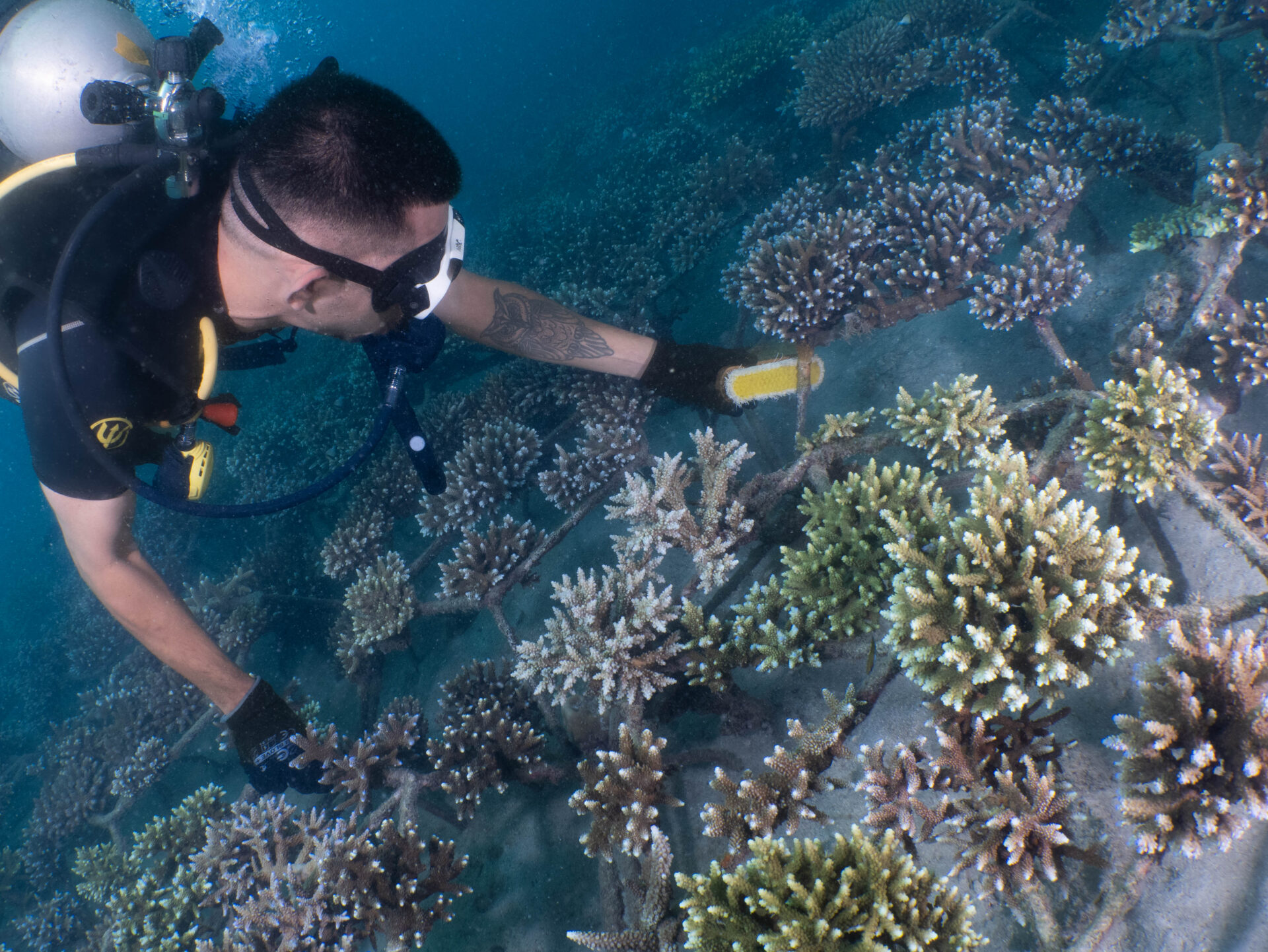
This includes scrubbing away algae, removing dead fragments, and replacing them where needed. We also monitor for coral predators, such as crown-of-thorns starfish, which can cause significant damage if left unmanaged.
We continue to monitor coral health and growth over time. This includes checking attachment points, documenting changes, and tracking survival rates.
If fragments are damaged or fail to attach, they can be replaced. This ensures the site continues to develop as intended. Over time, as the reef becomes more established, the need for intervention decreases, and natural processes begin to take over.
From Fragment to Reef
What starts as a single fragment is only the first step. With stability, care, and time, those fragments grow into colonies. Colonies connect, strengthen, and expand. Marine life returns, and the reef begins to function as a living system again.
Coral restoration is not an instant solution. It is a long-term commitment. However, when done correctly, it can accelerate recovery and rebuild ecosystems that would otherwise struggle to return.
Every structure installed, every fragment attached, and every fish that returns is part of that process. And over time, what was once damaged can become a thriving reef once again.
How You Can Get Involved
Coral restoration is a long-term effort, and every step forward depends on continued support. While our team manages the installation, monitoring, and maintenance, this project is not something we do alone.
There are several ways to be part of it. We welcome donations that directly support the expansion of the site. This can include financial contributions or essential materials used in the restoration process. Every structure installed and every fragment secured is made possible through this support.
Beyond that, we are working towards opening the site to visitors, volunteers, and educational workshops. This will allow you to see the project first-hand, understand how restoration works in practice, and actively contribute to the process. Whether it is assisting with maintenance, learning about coral growth, or simply experiencing the site in the water, these opportunities are designed to connect people more closely with the reef.
Coral restoration is not just about rebuilding ecosystems. It is also about building awareness, responsibility, and a deeper connection to the ocean.
Learn more about our coral restoration project here and follow us on Instagram and Facebook. Every bit of support helps, and every contribution plays a role in building a thriving reef.
Related Articles
-

Climate Change & Corals: How Extreme Weather and Warming Seas Shape Our Reefs
In recent years, Southeast Asia has experienced increasingly unpredictable and severe weather…
-
Corals in Thailand: How You Can Help with DiveRACE
When people talk about scuba diving in Thailand, they almost always mention…
-
Acropora Corals in Thailand: The Science Behind Our Restoration Work
Why We Use Acropora Corals in Our Thailand Restoration Project If you’ve…