
The north-west side of Island number 9 hides one of the most dramatic sites in the Similan Islands National Park: Christmas Point. Its reputation comes not only from the towering granite boulders but also from the array of marine life that thrives among them, making it one of the most memorable dives in the Similans.
This dive site was among the first to be discovered around the islands. Over time, the origin of its name has become a little blurred, with different dive centers offering varying explanations. Some name it after Christmas tree worms, but these are found all over the Similan Islands. The one that makes the most sense to us is that Christmas Point has a way of delivering unexpected encounters — almost like surprise gifts in the form of pelagic marine life…
As we approach the dive site, shallow boulders break the surface. Their rounded tops force the waves to split and swirl as currents meet at the corner of the island. These conditions give the site a sense of movement even before we enter the water. We drop in on the south side, rolling back from the dinghy not far from the shallow rocks. The rocks serve as a visual reference while descending, helping us keep our orientation.
Descent into the Boulders
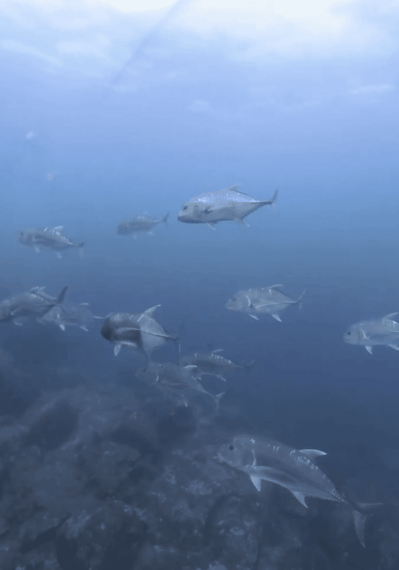
Visibility in the shallows is often excellent, and I descend slowly, watching schools of reef fish weave between the rocks below. Small groups of butterflyfish graze on coral patches, while clouds of fusilier dart in unison each time predators like tuna or trevally sweep past. The granite formations look impressive even at this depth, and I can already see darker shapes of larger boulders that lie deeper.
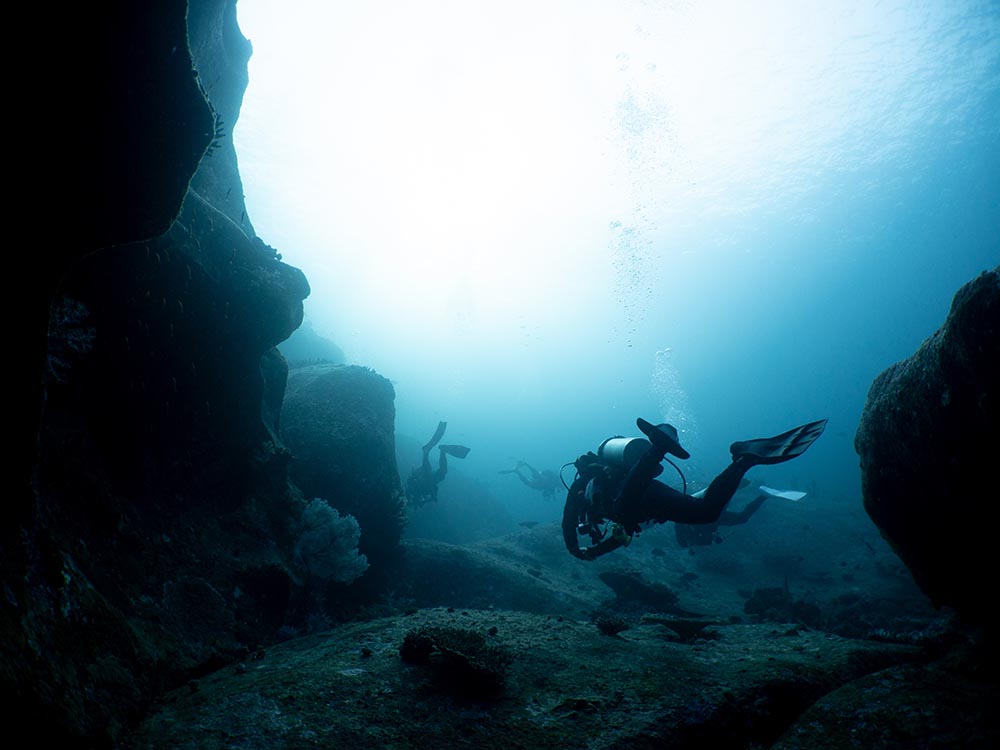
We head straight toward those deep boulders, and as we descend the light fades slightly. At around twenty meters, a cold band of water washes across my body. It’s the thermocline, a phenomenon common at Christmas Point because of the deeper waters surrounding the edge of the island chain. These layers of different temperature water not only reduce visibility but can also shift the current. We should stay close to the bottom or close to the rocks to avoid most of the strength.
Sometimes the thermocline is even visible as the colder water below meets the warmer water above, appearing as wavy, blurry patterns shimmering through the water column. The temperature difference is usually two or three degrees, though during some thermoclines it can drop even further. It’s an interesting feeling — I pause, holding my body in the warmer water above, while reaching my hand into the shimmering water to feel the cooler layer below.
Garden Eels in the Sand
The thermocline guides us around the deeper boulders. Leaving the walls behind, we begin to explore the sandy patches that are sheltered at their base. Here, the seafloor is carpeted with a colony of garden eels. They rise from their burrows like long blades of white grass, each one swaying in unison with the movement of the water. Garden eels rarely leave their sandy holes, feeding instead on plankton that drifts past in the current. The moment I drift too close, they vanish instantly, only to slowly reappear once I stop and hover still.
The best way to approach them is with patience — keeping your movements slow, maintaining neutral buoyancy, and hovering at a respectful distance. Sudden fin kicks or getting too close will send the entire colony slowly slipping back into their burrows. For photographers, garden eels can be a rewarding challenge. A zoom lens or a macro lens with good reach works best, allowing you to frame them tightly while keeping enough distance that they feel comfortable to emerge.
The Maze of Swim-throughs
We turn back toward the boulders and continue with our right shoulders to the reef, following the maze of overhangs and passages that Christmas Point is known for. Shallowing slightly, I stop to scan the delicate branches of a gorgonian sea fan. These large, fan-shaped corals filter plankton from the current and provide perfect camouflage for small creatures. With patience, I sometimes spot a ghost pipefish swaying among its branches. Their camouflaged bodies are almost invisible unless the light hits them just right.
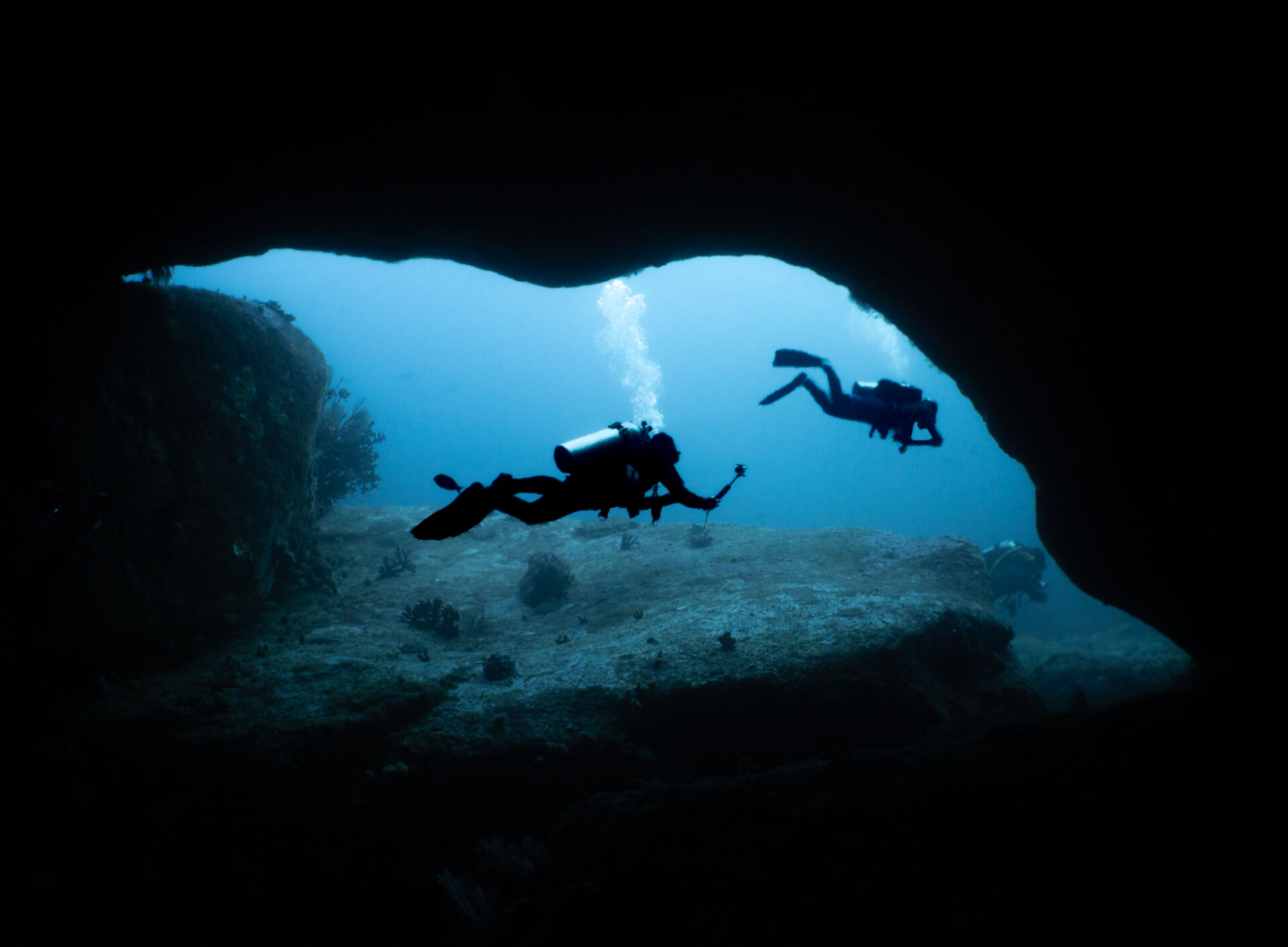
A tunnel of light opens up in the distance, the entrance to one of the site’s most famous swim-throughs. It’s wide enough for divers to enter one by one, but not so wide that we can be careless. I hover at the entrance, then glide through slowly, making sure not to touch the walls or disturb the coral that clings to the granite.
Above me, pockets of air trapped in the rock reflect our silhouettes, shimmering like mirrors as our bubbles rise to join them. These air pockets may look tempting, but they are not safe to breathe. The air is stagnant, trapped for many years, so the oxygen has long since been depleted while carbon dioxide has built up to dangerous levels. They can even contain other harmful gases released from the granite rock and as a result of decomposition. I continue to the exit; emerging into the light on the other side always feels like passing into a different world.
Encounters with Moray Eels
This dive begins to feel like a game of discovery. More swim-throughs appear, each one with its own character — some narrow and short, others longer and opening up to the surface above before the next swim through begins. Among the rocks I spot movement: the thick body of a giant moray eel. These eels are the largest of their kind in the region, capable of growing up to three meters long. They are commonly found at all the dive sites in the Similan islands as well as Christmas Point. With mottled brown skin and jaws lined with sharp teeth, they can look threatening. Yet the constant gaping of their mouths is simply how they breathe, pumping water over their gills.
A Cautionary Tale
One of the most infamous incidents in the Similan Islands involved a giant moray known locally as Emma. In April 2005, a diver named Matt Butcher attempted to hand-feed her a sausage. Feeding marine life was a common practice at the time but is now strictly prohibited in the national park. Mistaking his thumb for food, Emma lunged and clamped down with Incredible strength. Morays don’t just bite with their outer jaws — they also use a second set of pharyngeal jaws, hidden deep in the throat, which shoot forward to pull prey inside. With a violent head shake and that secondary bite, the diver’s thumb was detached instantly.
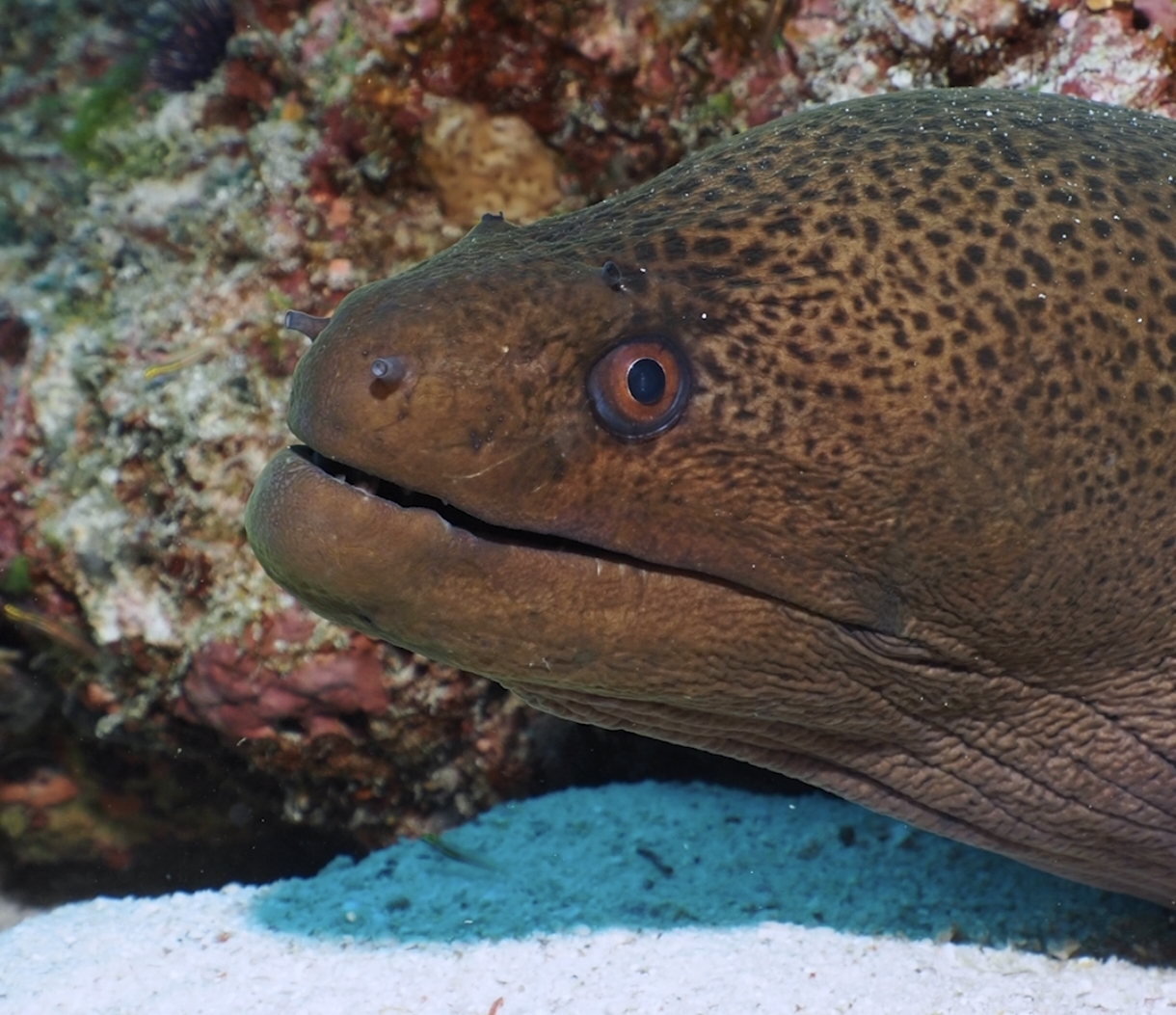
News of the accident spread quickly and it became so notorious that it was later featured on the television show River Monsters. It remains a warning that feeding wild animals, no matter how “friendly” they seem, can lead to disaster. Moray eels are not naturally aggressive, but with poor eyesight and a reliance on smell, they can easily mistake fingers for food when too close.
I watch from a distance as the giant moray rests in its hole. They often share their space with cleaner shrimp and wrasse that move boldly in and out, feeding on parasites in an incredible act of trust. It’s a reminder that looks can be deceiving. They are not aggressive unless provoked, and are actually quite shy towards divers!
Life in the Blue
As we shallow up toward the tops of the boulders, the view opens up. From here I can look out into the blue, scanning for larger visitors that often patrol this point. Schools of chevron barracuda sometimes appear, holding in the current with barely a flick of their tails. Their elongated bodies and sharp jaws give them a predatory presence, but rather than chase, they prefer to ambush, darting forward in sudden bursts of speed. Solitary great barracuda also glide past on occasion.
Eagle rays sometimes sweep gracefully across the dive site. Their wings move in a gentle rhythm as they pass the boulders. And if fortune is with us, an oceanic manta ray may appear, especially around the northern point of the island. Mantas are seasonal visitors to the Similans, but when they arrive, they often frequent Christmas Point’s shallows, circling effortlessly above the rocks while divers look on in awe.
Ending the Dive
As the dive nears its end, we rise toward the top of the reef. Here, hard corals and smaller reef fish bring a final burst of color. Moorish idols pick delicately at the coral, while bannerfish and parrotfish cruise by, completing the picture of life that thrives in this corner of the Similan Islands.
One thing to remember about Christmas Point is its exposed location on the north-west tip of the island. The site often catches the wind, which can create larger waves and make the return to the boat more challenging. We ascend to the surface to end our dive; in these conditions it’s best to inflate your BCD fully at the surface and keep your mask and regulator in place until you are safely in the dinghy. Staying calm, conserving energy, and waiting for the boat to approach is always safer than struggling against wind and waves.
Christmas Point leaves me with the same feeling every time — a mixture of adventure and serenity. From the sudden chill of the thermocline to the hypnotic sway of garden eels, from the intimidating jaws of a giant moray to the effortless glide of a manta ray, the dive is filled with contrasts that keep me coming back.
Like what you read? share it with your friends!
Next en route on board MV DiveRACE Class X:
Next up, we head further north in the Similan Islands National Park to an island that feels like a world of its own…
Want to read more? Take a look at our latest posts!
- How You Can Support Coral Restoration (Even if You Don’t Dive)
- Dive Computers Explained: What Divers Really Need to Know
- Tiger Tail Seahorses at Richelieu Rock: Knowing Where to Look
- How to Tell the Difference Between Healthy, Stressed and Dead Coral
- Decompression Sickness: How I Approach Safer Diving on a Liveaboard
Related Articles
-

Mergui Archipelago with DiveRACE
The Mergui Archipelago, located in southern Myanmar, is one of Southeast Asia’s…
-
Eat. Sleep. Dive. INFLATABLE FUN!
Diving isn’t the only way to enjoy the waters around Thailand. On…
-
Giant Trevallies at Koh Tachai Pinnacle
Koh Tachai Pinnacle is a top dive site in Thailand, famous for…