
A practical guide to choosing the right underwater videography setup — before your next liveaboard trip.
The Similan Islands are one of Thailand’s most iconic dive destinations. Wide granite boulders, schooling fish, vivid reef scenes, and the occasional pelagic encounter. It’s the kind of place that makes you want to film everything.
But here is the question most divers ask before they board a liveaboard: What camera should I bring?
The honest answer is: it depends entirely on YOU.
Before looking at gear, ask yourself a few things. Why do you want to film underwater? Who is the footage actually for? Are you capturing personal memories, building a social media presence, or aiming for cinematic production quality? How experienced are you underwater, and how comfortable are you managing a rig while maintaining buoyancy on a reef?
Your answers matter far more than any spec sheet.
The Four Camera Categories — And Who Each One Suits
1. Smartphone Housings: The Easiest Entry Point
Systems like DiveVolk allow you to use your actual phone underwater, touchscreen and all. For casual creators and travelling divers, this is an increasingly practical starting point. Modern smartphones perform surprisingly well in bright tropical conditions — perfect for the Similans’ daytime reef dives.
Ask yourself: Am I mainly filming for personal memories or social media, and do I want the simplest possible setup?
The trade-offs are real though. Low-light performance is limited, battery drains faster underwater, and your phone is at risk. For many divers, it is a great first step — but not a long-term solution.
2. Action Cameras: Small, Simple, and Surprisingly Capable
Action cameras are where most divers start, and for good reason. They are compact, lightweight, easy to manage underwater, and produce impressive 4K footage straight out of the camera.
Top picks:
- DJI Osmo Action 5 Pro (US$420 Diving Combo) — Excellent image quality, strong low-light, outstanding stabilisation. Currently one of the best action cameras for underwater video.
- Insta360 X5 (US$565 + US120 for housing) — 360-degree capture that lets you reframe footage later. Unique perspectives for travel content and social media.
Ask yourself: Do I want to stay mobile, travel light, and keep things simple? Am I filming fast-moving dives, current, or pelagic action?
Action cameras are ideal for beginners, travelling divers, social media creators, and anyone who wants footage without the complexity. On a liveaboard like DiveRACE, where multiple dives happen each day in varying conditions, an action camera keeps things manageable and fun.
Less ideal for: Cinematic productions, professional wildlife footage, or advanced colour grading, macro stuff (unless paired with macro lens).
3. Compact Cameras: More Control, More Versatility
Compact systems sit between action cameras and full professional rigs. They offer manual controls, better sensors, and — crucially — compatibility with wet lenses that can be swapped underwater during a dive.
Top picks:
- Olympus TG-7 (~US$450–700 + housing) — Legendary for macro. Tiny subjects like nudibranchs and pygmy seahorses come alive with these cameras. Add a wet wide-angle lens and reef scenes improve dramatically.
- Sony RX100 Series (~US$800–1,400 + housing) — Excellent image quality for both photo and video. Fast autofocus and strong colour performance. A respected stepping stone before moving into mirrorless systems.
Ask yourself: Do I want to film both macro subjects and wide reef scenes? Am I interested in photography as well as video? Am I willing to manage a slightly larger setup for better creative control?
The Similan Islands offer both extremes, sweeping reef walls and intimate macro critters, which makes compact systems a natural fit. The ability to switch wet lenses between dives is genuinely useful here.
Less ideal for: Pure video smoothness straight out of the camera (action cameras often win here), or fully cinematic productions.
4. Mirrorless and DSLR Systems: Professional Quality, Serious Commitment
This is where underwater videography becomes a different discipline entirely. Larger sensors, interchangeable lenses, exceptional low-light performance, and full creative control. These are the systems behind documentaries, commercial productions, and high-end YouTube channels.
Popular options include:
- OM System / Olympus mirrorless (~US$900–2,500 body) — Compact for mirrorless, excellent stabilisation, strong macro, and smaller travel-friendly housings. A favourite among liveaboard creators.
- Sony Alpha series (~US$2,200–4,000 body) — Widely regarded as one of the strongest full-frame options for underwater video. Outstanding in low light and autofocus tracking.
- Nikon Z series / Canon R series (~US$1,600–3,800 body) — Both offer excellent image quality and reliable autofocus. Canon is often chosen for its colour science; Nikon for sharpness and natural tones.
Ask yourself: Am I producing content professionally or for a serious YouTube channel? Do I have strong buoyancy control and experience managing a large rig? Am I prepared to invest significantly in housing, ports, lights, and accessories?
The full cost of a professional underwater system — housing, dome ports, video lights, arms, and accessories — can easily reach US$10,000–20,000 or more. That investment requires both financial commitment and the diving skills to use the rig safely near reefs. Also, divers need to determine what kind of video they are taking so that they can use the appropriate lens for the job (eg. wide angle subjects or macro subjects)
Ideal for: Serious filmmakers, professional content creators, and experienced divers ready to commit to the craft.
The Camera Is Only Part of the Story
Regardless of which system you choose, good underwater footage comes down to more than equipment. Buoyancy, patience, awareness of marine life behaviour, and an eye for composition will always matter more than which camera is in your hands.
A confident diver with an action camera will consistently outfilm a nervous diver with a US$15,000 rig.
Most underwater creators progress naturally — from action cameras to compact systems to mirrorless — as their skills and creative goals develop over time. There is no rush, and no wrong starting point.
Film It in the Similan Islands
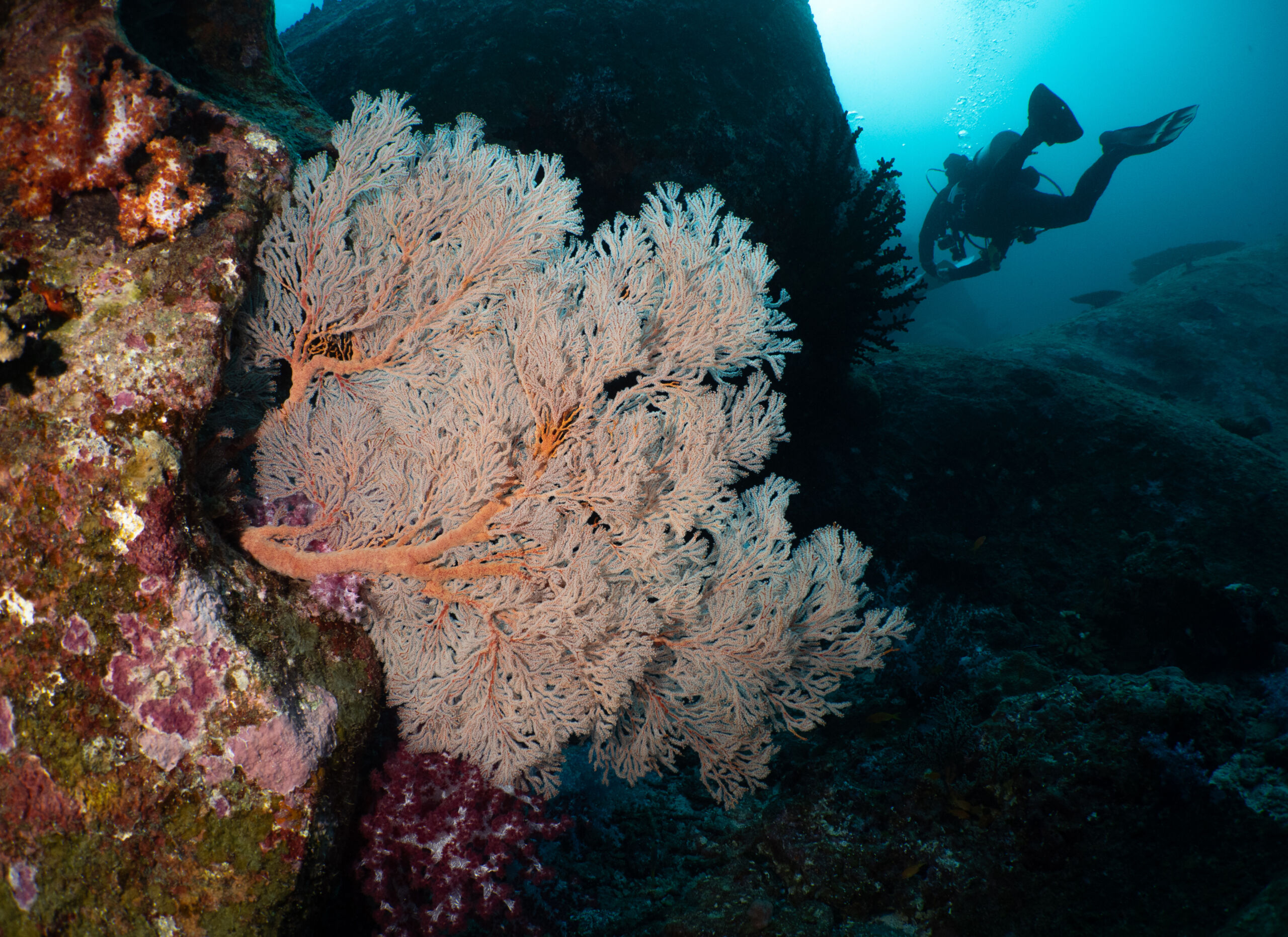
The Similan Islands offer something for every type of underwater creator. Macro lovers will find endless subjects in the shallows. Wide-angle shooters will find sweeping reef scenes and boulders draped in soft corals. Pelagic divers might encounter mantas, whale sharks, or open-water action.
Liveaboard diving gives you more time underwater, access to remote sites, and the flexibility to film at the best times of day. With MV DiveRACE Class X coming soon, dedicated camera preparation areas and practical gear spaces are being built into the vessel from the ground up — because serious underwater creators need serious onboard support.
So, Which Camera Is Right for You?
Go back to those first questions. Why are you filming? Who is it for? How do you dive?
For divers who want simplicity and flexibility, an action camera is the perfect starting point.
If creative control and macro subjects interest you most, a compact system offers plenty of versatility.
And for those chasing cinematic quality with the skills to support it, mirrorless is the way to go.
The best underwater camera is not the most expensive one. It is the one that suits how you dive, what you want to create, and makes you excited to get back in the water.
Ready to film the Similan Islands? Book your DiveRACE liveaboard trip and experience one of Thailand’s most iconic underwater environments for yourself.
Related Articles
-

Improve your Buoyancy: A Comprehensive Guide – Part 1
A thorough understanding and practical application of buoyancy is crucial for safe…
-
Improve your Buoyancy: Part 2 – Weights
A thorough understanding and practical application of neutral buoyancy is the most…
-
Improve your Buoyancy: Part 3 – BCD Use
A thorough understanding and practical application of neutral buoyancy is the most…