
The morning greets us with a beautiful sunrise as we sail towards the east side of Similan Island number 9. We are looking for a cluster of tall trees that tower over the canopy on the outskirts of the island’s rainforest. These trees mark the drop of our next dive site in the Similan Islands – Three Trees – named after three distinctive trees that stick out among the vegetation on the island.
I backroll from the dinghy into the shallow reef that wraps around the island. The visibility is crystal blue as the early morning sun rays beam through and illuminate the reef. It’s such a beautiful sight; butterflyfish, angelfish and schools of glass fish dance across the reef. At times, though, the water here can take on a greenish tint. Being the northernmost island of the Similan Islands and close to deeper waters, island number 9 is more exposed to thermoclines. These cooler upwellings can shift the clarity and color of the water in an instant.

Three Trees is one of the most relaxing dive sites in the Similan Islands. The reef begins shallow at just three meters, sloping gradually deeper as dense coral gives way to sandy stretches dotted with bommies. This site is usually dived as a gentle drift, with a constant current flowing either north to south or vice versa. Most of the time it’s calm and easy, but if the current strengthens, divers should take extra care. Stay close to the reef instead of drifting into the blue, and if conditions become too strong, it’s always safer to ascend and end the dive early rather than risk being swept away from the island.
Over the Craters
The current is mild today, so we head straight for the deeper boulders. They rise from about 23 meters, breaking from the sand and dropping into darker depths on the far side. But before reaching them, we must cross an open sandy plain. It looks calm at first glance, but the seabed here tells another story…
The sand is pitted with craters. These are the nests of triggerfish, mostly yellowmargins and some titans, and they can be fiercely protective during nesting season. In many parts of the world, these fish are notorious for chasing divers and other fish away. As I look over the seabed, I notice that some of the nests are empty. Others have two triggerfish patrolling the borders.
To many new divers who are unaware of what they look like – let me explain. Triggerfish are a diverse family of reef fish, with over 40 recognized species worldwide and several commonly seen in the Similan Islands. They are easy to identify by their oval, laterally compressed bodies, small mouths with strong teeth, and the unique dorsal “trigger” spine that can lock upright for defense. Coloration varies widely between species, from the bright blue hues of the redtooth triggerfish to the bold patterns of the clown triggerfish. Despite these differences, most share the same unmistakable profile and behavior, making them one of the most recognizable groups of reef fish. Triggerfish are close relatives of and look very similar to filefish – also called leatherjackets – but they belong to a different family. Triggerfish have a stocky, oval body, while leatherjackets are slimmer with a more elongated profile and muted colours.

Navigating Triggerfish Territory
We begin to weave between the nests to get to the other side, being careful to avoid their territory. What is super interesting about their nests, is that their territory doesn’t extend laterally from the nest, but actually upwards towards the surface in a cone-like shape. The trick is simple: stay close to the seabed and never swim directly above a nest.
If a triggerfish becomes aggressive, the best response is to stay calm and swim away at a steady angle. Never ascend directly above a nest. Instead, move horizontally and keep your fins between you and the fish. Most encounters are short-lived, and giving the triggerfish space quickly ends the situation.
Thankfully for us in the Similan Islands, we very rarely encounter issues with titan or yellow margin triggerfish. Even whilst nesting the triggerfish seem mostly unbothered with our presence as we respectfully navigate around them.
Exploring the Boulders
We arrive at the boulders unscathed. Rising from the sand, the shallower granite rocks are cloaked in soft corals and gorgonian sea fans. Glassfish swirl in shimmering clouds, moving as one whenever a predator darts past. I drop a little deeper, hoping to find what often hides here…
This is a very popular place for congregations of Kuhl’s maskrays, often missed by dive groups on this dive site. They typically gather in the sand around the boulders from around 27 meters and deeper — a place perhaps chosen to avoid the triggerfish above. They are relaxed but alert as I approach, ready to move if I get too close.
I spot a colony of garden eels nearby. Their thin bodies stretch out of the burrows, swaying with the current like a patch of long, white grass. The moment I get closer they vanish back into the sand, leaving only small holes behind. – will save more information for next blog
Also common around here are white tip reef sharks resting in the sand between the boulders. We make our way around, looking in the cracks and overhangs with our torches for small critters and juvenile fish hiding. Checking my NDL, it’s time to shallow up.
Coral Bommie Ecosystems
We make our way back over the triggerfish territory at the other end of the boulders, heading towards the shallower reef. As we pass the craters, I begin to jump between the vibrant coral bommies scattered at the base of the reef around 15 – 20 meters deep. Each one is it’s own mini-aquarium: glass fish fringe the edges, hiding juvenile fish within.
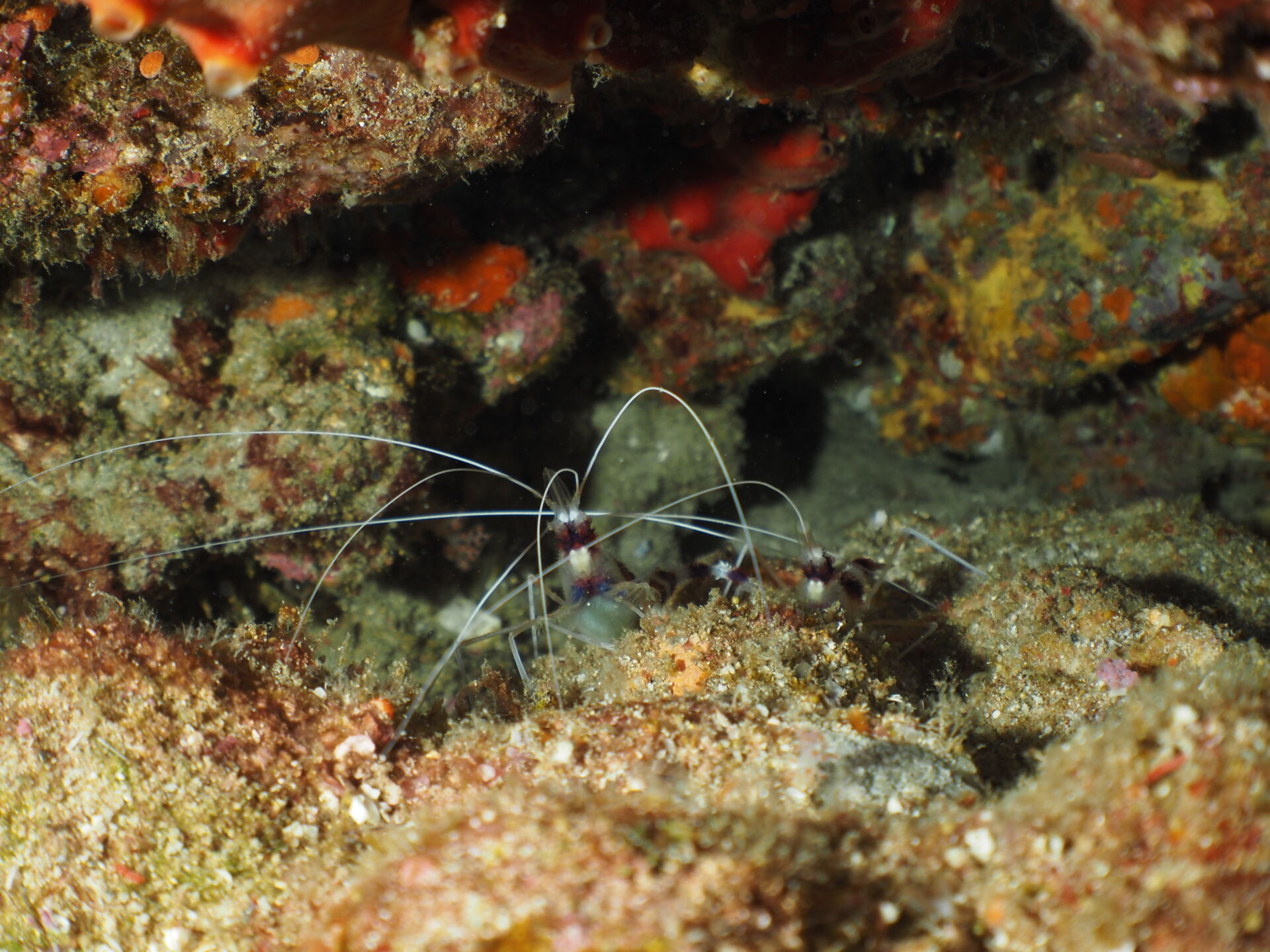
I pause to watch a fascinating example of symbiosis. Cleaner shrimp wave their antennae from sheltered crevices, advertising their services to passing reef fish. Parrotfish, groupers, and even moray eels hover patiently as the shrimp pick away parasites and dead skin. It’s a perfect partnership — the shrimp get an easy meal while the fish enjoy a free health check.
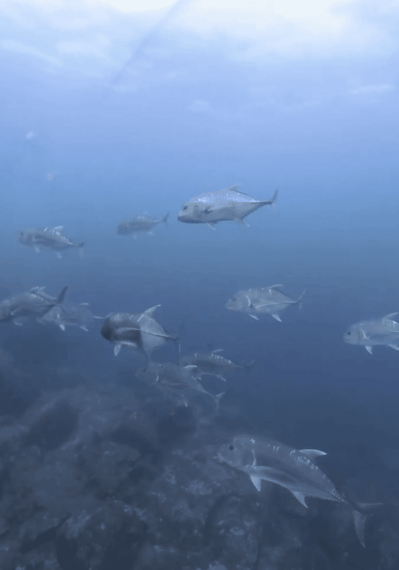
I look out into the blue. As we are at the edge of the main Similan islands formation, it’s common to see larger fish pass by here: huge schools of fusilier and barracuda, dogtooth tunas, eagle rays and even larger pelagics can be seen passing in the distance.
Patrolling the Shallows
We begin to head shallower to explore the dense coral reef that fringes the island. Branching corals create a lattice of protection for reef fish. Damselfish dart between them, while Christmas tree worms spiral back into their burrows at the slightest movement. It’s a beautiful sight towards the end of the morning dive; as the sun begins to rise higher, the colours become more vivid before the sun dips over the island.
It’s also possible to see ghost pipefish here at Three Trees, swaying together in the soft corals. But in some parts of the reef the coral has become sparse, with sections broken down into rubble. It’s a reminder of both the reef’s beauty and its vulnerability.
Again, I keep an eye out for larger fish. This is a great place to encounter hawksbill sea turtles, especially in the morning as they wake up for their morning graze. It’s also a popular area for Napoleon wrasse, a large species of fish that are typically inquisitive and like to investigate groups of divers.
The guide sends up the SMB as we ascend to the top reef. Drifting in the shallows, we complete our safety stop among shimmering schools of glassfish and dancing sun rays. The reef at Three Trees leaves us with both calm and excitement, a reminder of how varied each dive here in the Similan Islands can be. Yet this journey is far from over…
Like what you read? share it with your friends!
Next en route on board MV DiveRACE Class X:
Just around the corner, another site awaits — with new currents, new landscapes, and new stories to tell beneath the waves.
Want to read more? Take a look at our latest posts!
- Can Corals Adapt to Climate Change Fast Enough?
- How Liveaboard Diving Changes the Way You Dive the Similan Islands
- Ghost Pipefish in the Similan Islands: Where and How to Find Them
- How You Can Support Coral Restoration (Even if You Don’t Dive)
- Dive Computers Explained: What Divers Really Need to Know
Related Articles
-

Mergui Archipelago with DiveRACE
The Mergui Archipelago, located in southern Myanmar, is one of Southeast Asia’s…
-
Eat. Sleep. Dive. INFLATABLE FUN!
Diving isn’t the only way to enjoy the waters around Thailand. On…
-
Giant Trevallies at Koh Tachai Pinnacle
Koh Tachai Pinnacle is a top dive site in Thailand, famous for…