
Are moray eels dangerous to divers? Despite their intimidating appearance, moray eels are generally shy, non-aggressive predators that spend most of their lives hidden within coral reefs. In Thailand’s Similan and Surin Islands, they are among the most frequently encountered reef predators and play an important role in maintaining healthy reef ecosystems.
Their reputation, however, tends to precede them. The image of a moray eel — mouth open, teeth exposed, body hidden — has long been associated with danger. This perception has been reinforced over time by isolated incidents. This includes a well-known case in the Similan Islands many years ago, where a diver reportedly lost part of a finger after placing a hand too close to a feeding moray. While such events are extremely rare, they have shaped how many divers interpret what is, in reality, a highly specialised and largely non-aggressive predator.
Understanding moray eels in the Similan Islands requires stepping back from that instinctive reaction. Let’s take a look more closely at their biology, behaviour, and ecological role within the reef.
Diversity Across the Similan Reefs
The Similan and Surin region supports a notable diversity of moray eel species, each adapted to slightly different niches within the reef structure. While they may appear similar at first glance, differences in size, colouration, and behaviour reflect distinct feeding strategies and ecological roles.
The giant moray (Gymnothorax javanicus) is the most recognisable and frequently encountered species. Reaching lengths of over three metres, it occupies larger crevices and overhangs, often in areas with consistent current flow where prey is more abundant. Its mottled brown pattern provides effective camouflage against the reef, allowing it to remain concealed until an opportunity presents itself.
The white-eyed moray (Gymnothorax thyrsoideus) is also one of the most commonly encountered species in the Similan Islands. Smaller and more slender than the giant moray, it is often seen in shallower reef areas. Its purple and yellow mottled skin and pale white eyes makes it easy to identify. It is also more active during the day, occasionally moving between reef gaps in search of small fish and crustaceans.
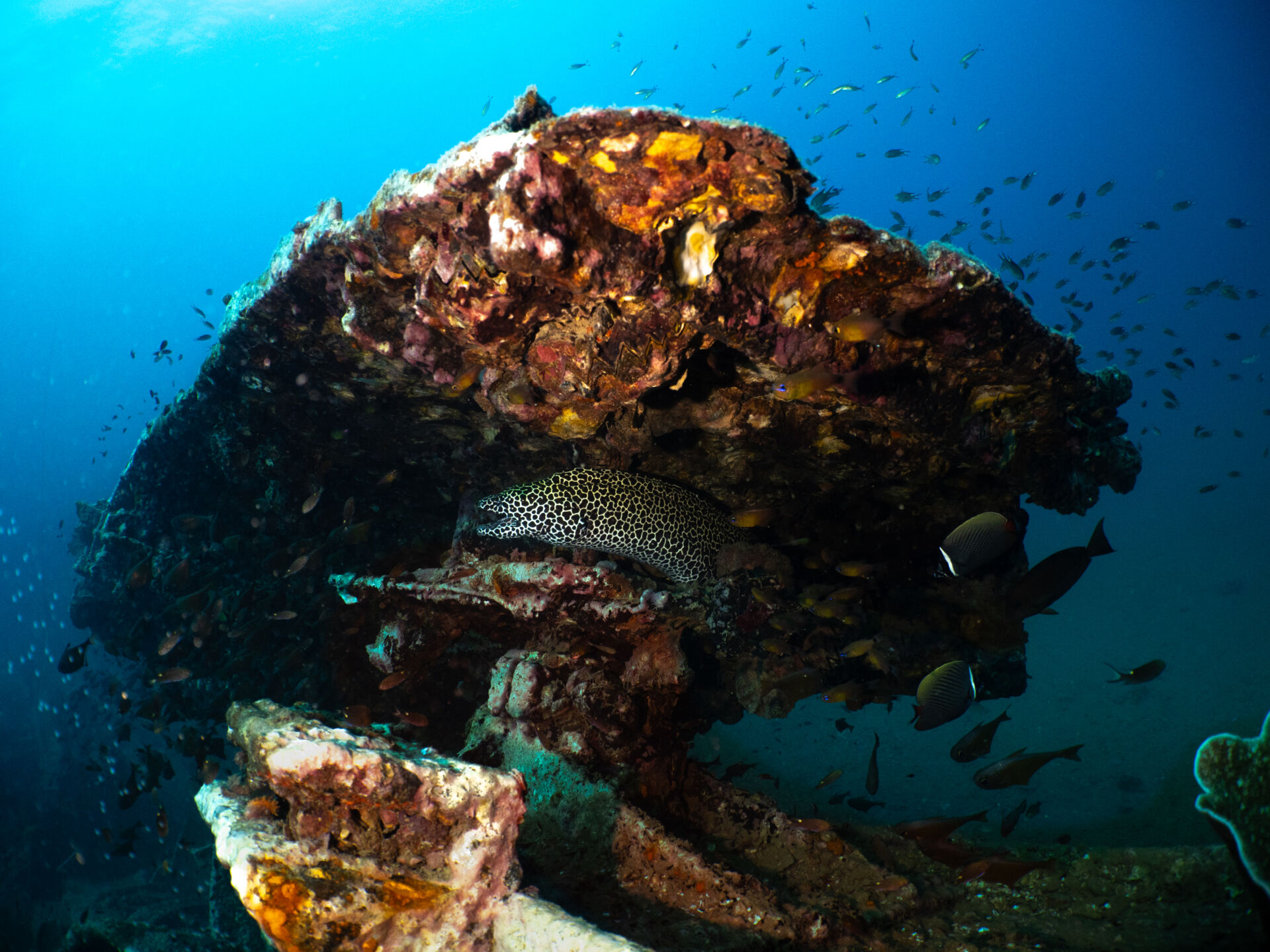
Equally striking is the honeycomb moray (Gymnothorax favagineus). Its bold, black and pale yellow honeycomb pattern makes it one of the most visually distinctive species in the region. Despite its size, it is typically more reclusive, remaining deep within reef structures during daylight hours.
More illusive species
In contrast, the fimbriated moray (Gymnothorax fimbriatus) is more commonly encountered on shallower reef slopes and sheltered areas. It tends to be more active during low light conditions, emerging further from its shelter as hunting opportunities increase.
Not all morays in the Similan Islands are fish specialists. The zebra moray (Gymnomuraena zebra), easily identified by its banded pattern and blunt teeth, feeds primarily on hard-shelled invertebrates such as crabs and sea urchins. This dietary difference reduces competition with other moray species and highlights the functional diversity within the group.
Smaller species, including the snowflake moray (Echidna nebulosa), are also present but often overlooked. They occupy tighter reef spaces and contribute to the same ecological processes on a smaller scale.
Together, these species form an important component of the reef’s predatory network, operating largely out of sight but exerting consistent pressure on prey populations.
Anatomy Built for Ambush
Moray eels are highly specialised ambush predators, and much of their behaviour is shaped by anatomical adaptations that differ significantly from most reef fish. Their elongated bodies allow them to navigate complex reef structures with precision, while their reduced fins enable them to move through narrow crevices where larger predators cannot follow.
One of the most misunderstood aspects of their behaviour is the constant opening and closing of the mouth. This is not a threat display, but a respiratory necessity. Morays lack the ability to pump water over their gills in the same way as many other fish, so they must actively move water through their mouths to breathe.
More remarkable, however, is their feeding mechanism. Moray eels possess a second set of jaws, known as pharyngeal jaws, located within the throat. When prey is captured, these jaws extend forward to grasp it and pull it deeper into the digestive tract. This adaptation allows morays to secure prey in confined spaces, where suction feeding would otherwise be ineffective.
Their teeth reflect their diet. Species that target fish tend to have long, sharp teeth designed for gripping slippery prey. Crustacean feeders like the zebra moray have shorter, more robust dentition suited for crushing.
Combined, these features make moray eels highly efficient hunters within the structural complexity of coral reefs.
Behaviour, Diet, and Hunting Strategy
Moray eels are primarily nocturnal hunters, although some species will feed opportunistically during the day. At night, they emerge from their shelters and move across the reef in search of prey, relying heavily on their sense of smell rather than vision.
For many divers, this behaviour becomes more apparent during night dives, when moray eels are far more active. Night diving is an interesting part of the RAID Explorer 30 course available on board MV DiveRACE, learn more here. These dives build confidence in low-light conditions while revealing a different side of the reef. It is often here that morays leave their shelters and move more freely across the reef.
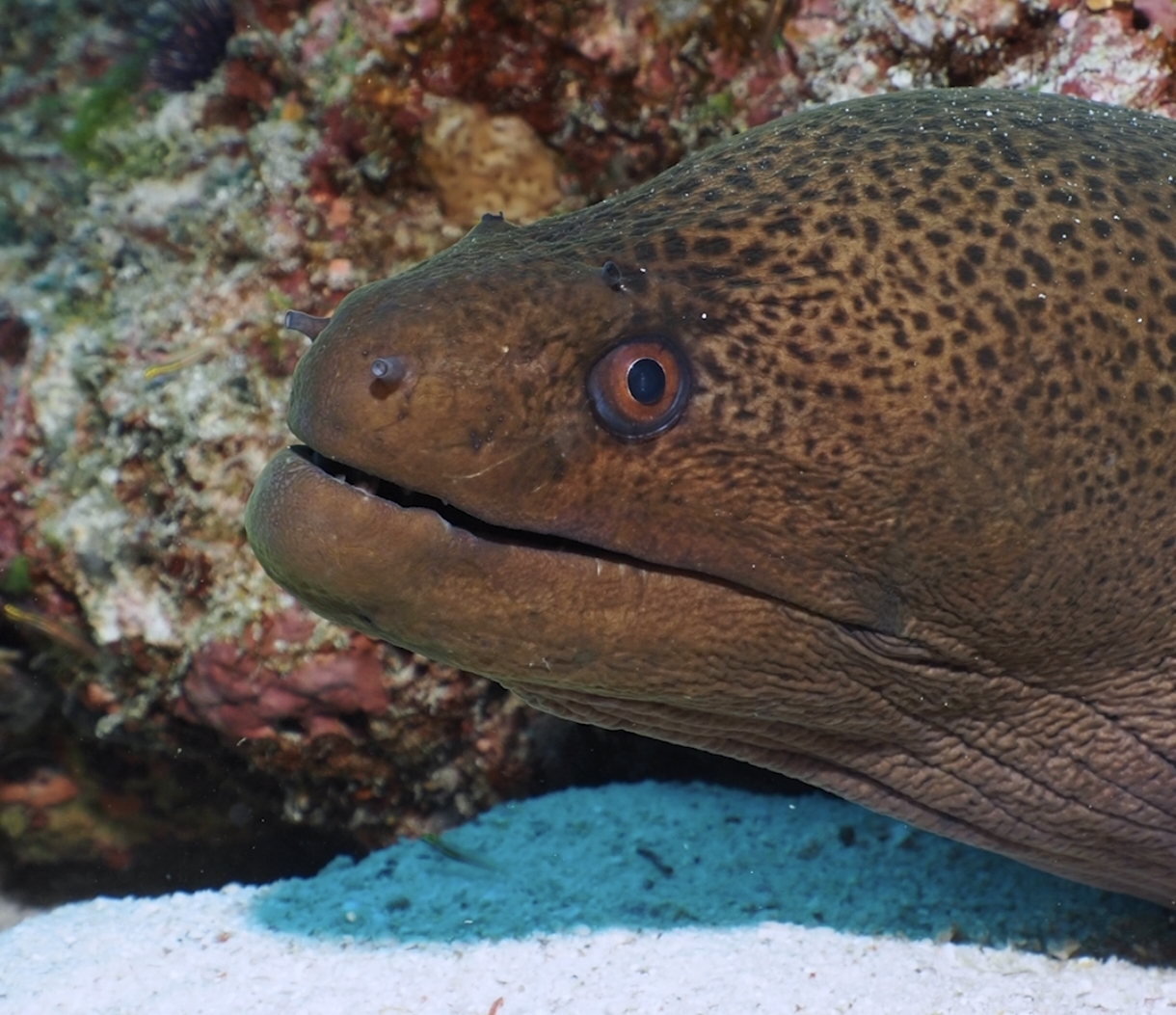
Their diet consists mainly of fish, cephalopods, and crustaceans, depending on the species. Rather than pursuing prey over distance, morays rely on ambush. They position themselves within the reef and strike with speed when an opportunity arises.
In some cases, morays have been observed hunting cooperatively with other predators, such as groupers. The grouper signals the moray, which then enters crevices to flush out hidden prey. They have also been known to use diver’s torch light during night dives to hunt. This behaviour demonstrates a level of interspecies interaction that is still not fully understood but highlights the complexity of reef ecosystems.
Despite their predatory efficiency, moray eels are not aggressive toward divers. Most remain within their shelters during daylight hours, observing rather than reacting. Bites typically occur only when a moray feels threatened or mistakes a hand for food, particularly in areas where feeding has conditioned them to associate divers with prey.
A Reputation Shaped by Misunderstanding
The story of the diver who lost part of a finger in the Similan Islands continues to circulate, often without context. Incidents like this are almost always the result of direct interaction, such as attempting to feed or touch the animal. Moray eels have poor eyesight but an acute sense of smell, and a moving hand can easily be mistaken for prey at close range. You can read about this incident here.
It is important to recognise that these events are exceptionally rare, especially when compared to the number of safe encounters that occur daily across the region. In most cases, morays will retreat further into the reef if approached too closely.
Their defensive behaviour is predictable and avoidable. Maintaining distance, avoiding sudden movements near their heads, and never attempting to feed them are simple measures that eliminate nearly all risk.
How Do You Dive Safely Around Moray Eels?
Encountering a moray eel in the Similan Islands is almost inevitable, but how you approach that moment defines the experience. While their appearance can feel intimidating at first, their behaviour is generally predictable and non-aggressive when given space.
The constant opening and closing of the mouth is often misunderstood as a warning display. In reality, this is simply how morays breathe, pumping water over their gills in the absence of a more efficient mechanism. Once you understand this, the interaction becomes far less confrontational.
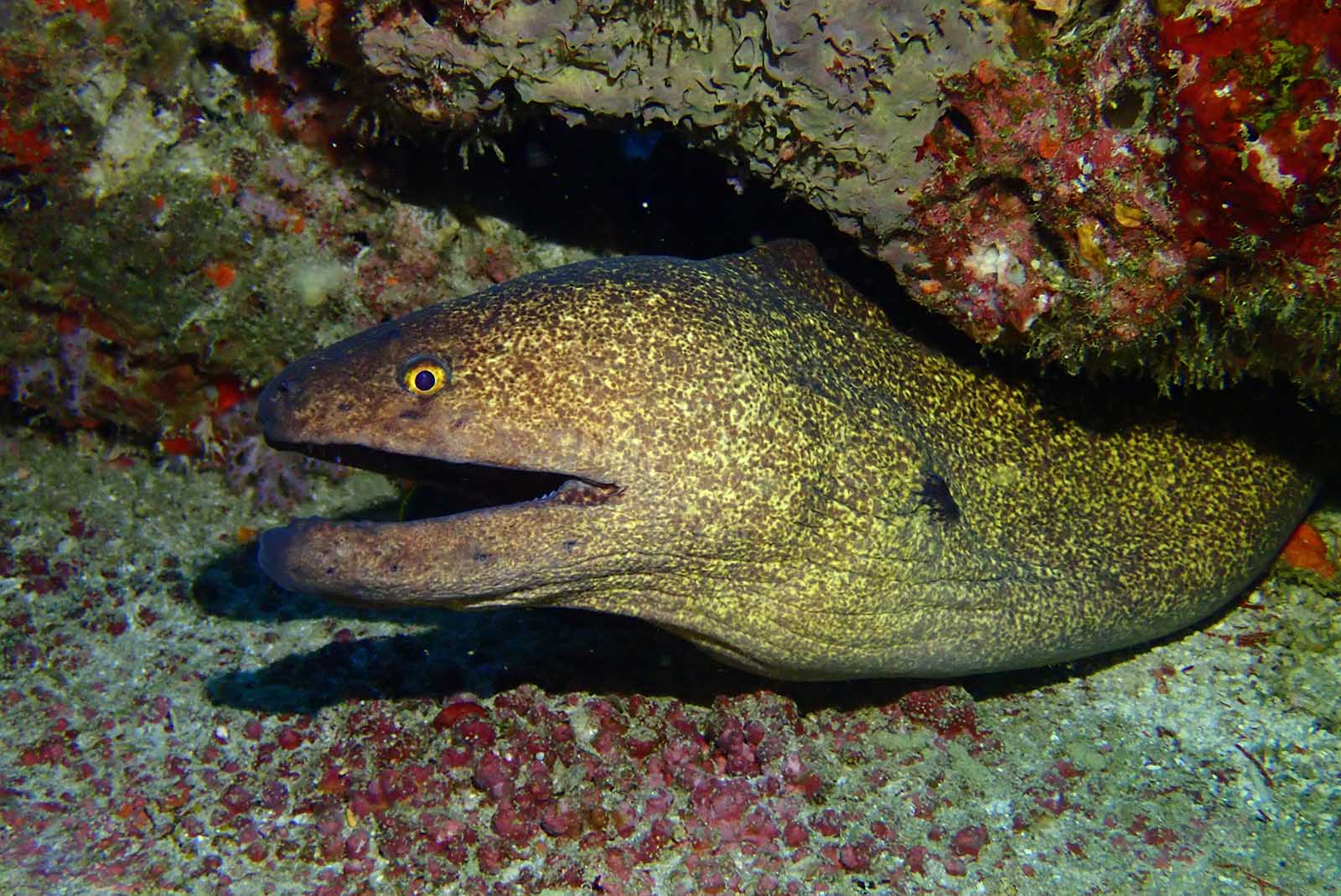
Respecting distance is the most important factor. Morays rely heavily on smell and have relatively poor eyesight, which means a hand placed too close to their head can easily be mistaken for prey. This is where most incidents originate, particularly in areas where marine life has been fed.
A calm and controlled approach allows for far better encounters. Hovering slightly above or to the side of the reef, rather than directly in front of the eel, reduces any sense of intrusion. At the same time, maintaining good buoyancy prevents accidental contact with the reef or the animal itself.
It is also worth paying attention to body language. A relaxed moray will remain partially exposed, observing without retreating. If it withdraws deeper into the reef, that is a clear indication that you are too close.
Like much of diving in the Similan Islands, these interactions are best when unforced. Moray eels do not need to be approached closely to be appreciated. Given space, they offer a far more natural and rewarding encounter. One that reflects their true behaviour rather than a defensive response.
The Role of Morays on a Healthy Reef
Beyond their appearance and reputation, moray eels play an important ecological role within the Similan reef system. As mid-level predators, they help regulate populations of smaller fish and invertebrates, contributing to the overall balance of the ecosystem.
By occupying crevices and reef cavities, they also influence how prey species use these spaces, creating a dynamic that shapes reef behaviour on a broader scale. Their presence is often an indicator of a structurally complex and functioning reef, where sufficient shelter and food sources are available.
On healthy reefs, such as those found throughout the Similan Islands, morays are not dominant, but they are constant. They are part of the underlying system that supports more visible marine life, operating quietly within the structure of the reef itself.
Moray eels can be found across almost every dive site in the Similan and Surin Islands, although certain locations offer more consistent encounters.
On the Boonsung Wreck, resident honeycomb and white-eyed morays are commonly seen between the structure and surrounding rubble.
At West of Eden and throughout the Similan and Surin Islands, giant morays are more frequently encountered within deeper reef crevices and current-exposed areas.
Richelieu Rock offers some of the most diverse sightings, with fimbriated morays often visible among the dense reef structure. White-eyed morays, however, are by far the most widespread and can be found across nearly all sites, often in shallower reef sections and coral gaps.
Explore more of these dive sites linked above and plan your trip with MV DiveRACE Class X on our website.
A Different Perspective Beneath the Surface
Spend enough time diving in the Similan Islands, and your perception of moray eels begins to shift. What initially appears threatening becomes familiar, even predictable. You start to recognise individual behaviour, preferred hiding spots, and subtle differences between species.
They are no longer just faces in the reef, but active participants in it.
Moray eels are not reef guardians in the traditional sense, nor are they the dangerous predators they are often made out to be. They are specialised, efficient, and essential — perfectly adapted to a role that is easy to overlook but impossible to replace.
Understanding them changes how you see the reef as a whole. Encounter them for yourself by joining us on a trip on board MV DiveRACE Class X. Book here now.
Related Articles
-

The Vanishing Wrecks of the South China Sea
Wrecks have a special pull on divers. They’re time capsules, artificial reefs,…
-
MV DiveRACE Class X
INTRODUCTION We are excited to present our latest liveaboard project – MV…
-
Thank You Class E.
Dear Friends, We want to express our heartfelt thanks to everyone for…