
How long does coral restoration take? Coral restoration is measured in years, not weeks or months. At the DiveRACE coral restoration site in Phuket, every coral fragment contributes to rebuilding a reef that is designed to last.
Coral reefs, including those in Thailand’s Andaman Sea, form over decades to centuries. Hard corals grow slowly, layer by layer, building the limestone structures that define a reef. What we see today is the result of long-term accumulation, shaped by currents, temperature, and ecological balance.
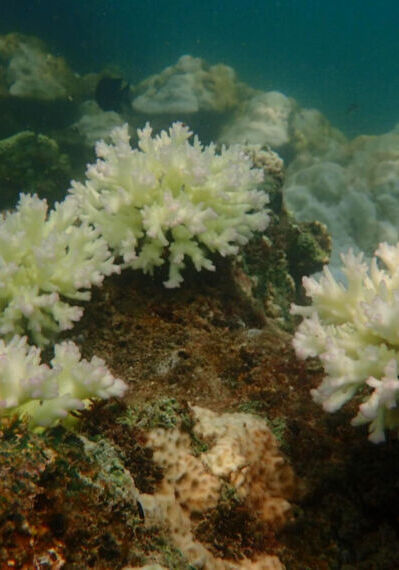
When reefs are damaged, whether by bleaching, physical impact, or environmental stress, that structure is lost far faster than it can be rebuilt. Restoration does not replace that instantly. It works to support the same natural processes that created the reef in the first place.
At the DiveRACE coral restoration site in Phuket, the focus is on helping these damaged areas recover. Changes happen gradually, and mostly out of sight. What was once unstable rubble is now beginning to form structure. Small fragments are developing into colonies. Marine life is returning in increasing numbers.
This is not rapid transformation. It is controlled, consistent growth, aligned with how reefs have always formed.
Building From Fragments
Coral restoration is the process of helping damaged reefs recover by supporting natural coral growth, improving habitat structure, and encouraging marine life to return. The foundation of our project relies on coral fragmentation. Instead of transplanting large colonies, smaller pieces are carefully selected from healthy donor corals. These fragments are then used to seed new growth across the site.
This method reduces stress on donor colonies and allows for scalable restoration. However, it also means growth begins at a much earlier stage. Every fragment must establish itself before it can expand.
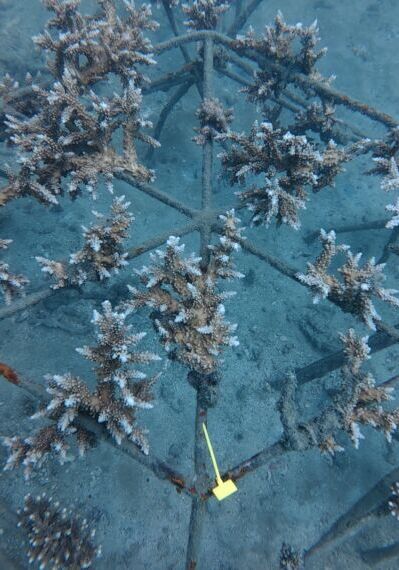
At DiveRACE, these fragments are secured onto steel structures known as “Super Stars.” Each structure is around one metre in size and is secured by interlocking into one another, with long stakes at strategic corners hammered into the seabed. This creates stability in areas that would otherwise shift with currents.
Fragments are attached using cut-down cable ties, with all excess plastic removed. Over time, the coral begins to encrust the structure and attach permanently. Once this happens, the artificial support becomes far less important.
From that point, the coral grows as it would on a natural reef. Starting from fragments may seem slower, but it allows corals to establish stronger foundations from the beginning.
Why plastic cable ties? Isn’t that counter productive?
Fragments are attached using cut-down cable ties, with all excess plastic removed. This method is widely used in coral restoration, particularly in large-scale projects where consistency and reliability are critical.
Cable ties are not a perfect solution, but they remain one of the most effective tools currently available. They are low cost, which is essential when working with thousands of fragments. At the DiveRACE site alone, over 3,700 coral fragments have been installed, and material choice quickly becomes significant at that scale.
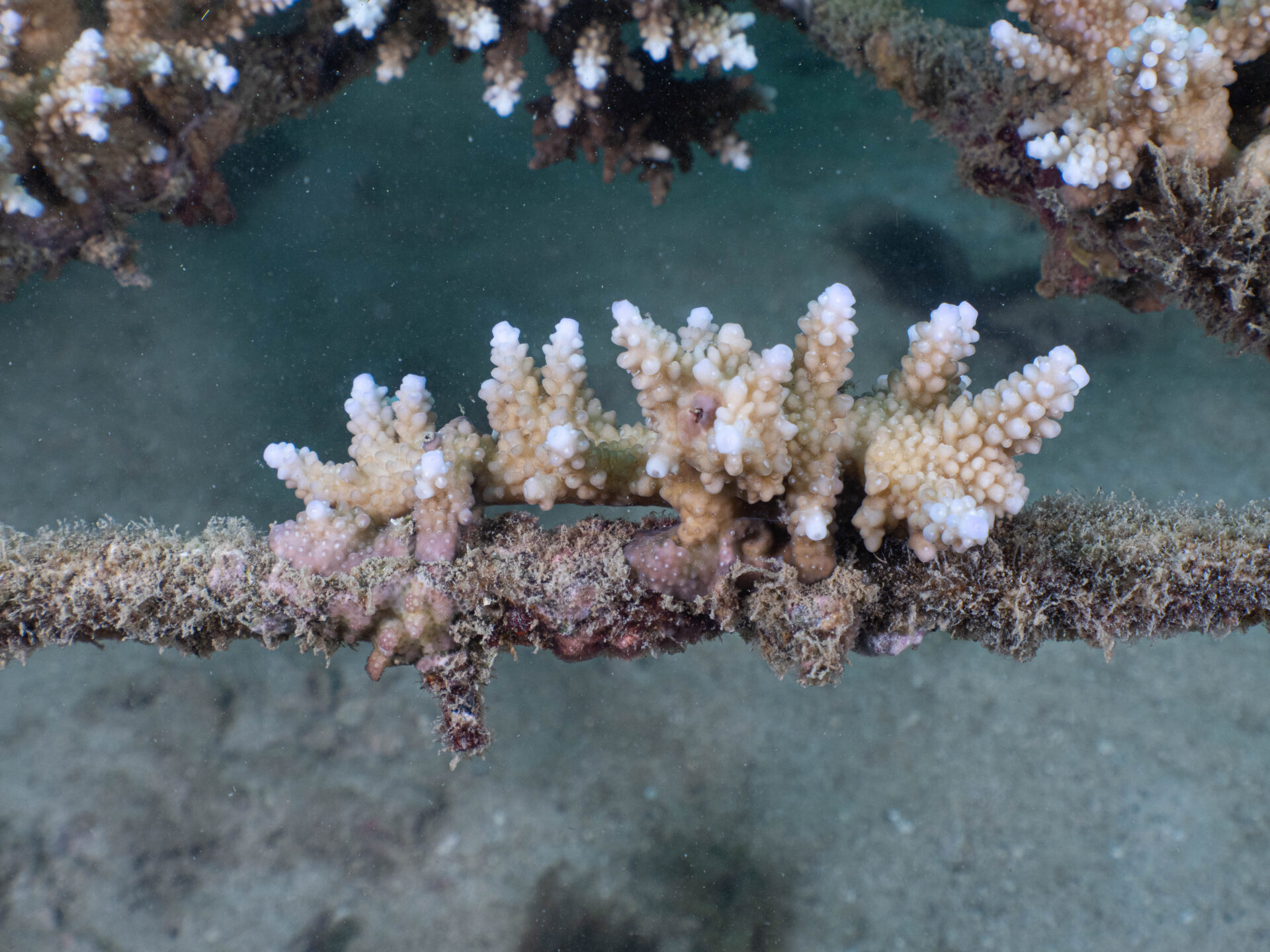
They also provide a high level of reliability during the most important stage of growth. In the first few months, fragments must remain completely stable to survive. Cable ties offer a secure attachment with a low risk of dislodgement, even in areas with consistent current.
Durability is another key factor. They maintain their strength throughout the critical attachment period, typically around four to six months. This allows the coral time to encrust naturally onto the structure and secure itself without relying on the tie long-term.
There is growing discussion around the environmental cost of plastic use in restoration projects. Research continues to explore alternative attachment methods, including biodegradable materials and cement-based solutions. However, many of these options currently fall short in either durability, cost, or ease of use at scale.
For now, cable ties remain a practical compromise. They allow restoration efforts to expand while maintaining a high success rate in early coral survival. As better solutions emerge, methods will continue to evolve, but current decisions are made based on what delivers the most effective results in real conditions.
Why Acropora Plays a Key Role
A large portion of the project focuses on Acropora species. These branching corals are known for their relatively fast growth and complex structures. They are often responsible for creating the three-dimensional habitat that many reef species depend on.

However, “fast-growing” is a relative term. Even under ideal conditions, Acropora grows at a measured pace. A few centimetres per year is considered healthy progress.
Growth is often most visible at the tips. These white or pale edges indicate active calcification. This is where the coral is extending its skeleton and forming new branches.
Over time, these branches begin to spread outward. As neighbouring fragments grow, colonies of the same species may fuse together. This creates larger, more stable formations that are better suited to withstand environmental stress.
Even with faster-growing species, this pace ensures stable skeletal development rather than fragile expansion. It is this steady development that allows these structures to become durable over time.
The Role of Submassive Corals
While Acropora provides structure, it is not the only focus. The project also incorporates submassive coral species. These corals grow in thicker, more rounded forms and develop at a slower rate.
Although less visually striking at first, they offer important long-term benefits. Their dense structure makes them more resistant to breakage and physical damage. They also tolerate environmental fluctuations more effectively.
By combining branching and submassive species, the restoration site develops both complexity and resilience. This balance is essential for creating a reef that can sustain itself over time.
It also reflects the diversity found on natural reefs, rather than relying on a single coral type. These slower-growing corals reinforce an important principle: resilience takes longer to develop, but lasts far longer.
Creating the Right Conditions
Location plays a critical role in coral restoration success. The DiveRACE site in Phuket was carefully selected based on several environmental factors. One of the most important is consistent current flow.
Water movement delivers nutrients and helps prevent sediment from settling on coral surfaces. It also supports gas exchange, which is essential for coral health.
The original seabed consisted largely of loose rubble, likely the result of past reef damage. This type of substrate is unstable and unsuitable for natural coral settlement. But it also gave us an idea that in the past, this particular area supported coral growth.
By introducing fixed structures, the project creates a stable base for growth. Over time, the corals themselves begin to stabilise the area further. As they expand, they bind the substrate and reduce movement across the seabed.
This transformation takes time, but that measured development is what allows the reef to rebuild on a solid and lasting foundation.
Maintenance and Reality
Coral restoration is not a “set and forget” process. It requires regular maintenance and monitoring. Without intervention, algae and sediment can quickly overtake young corals.
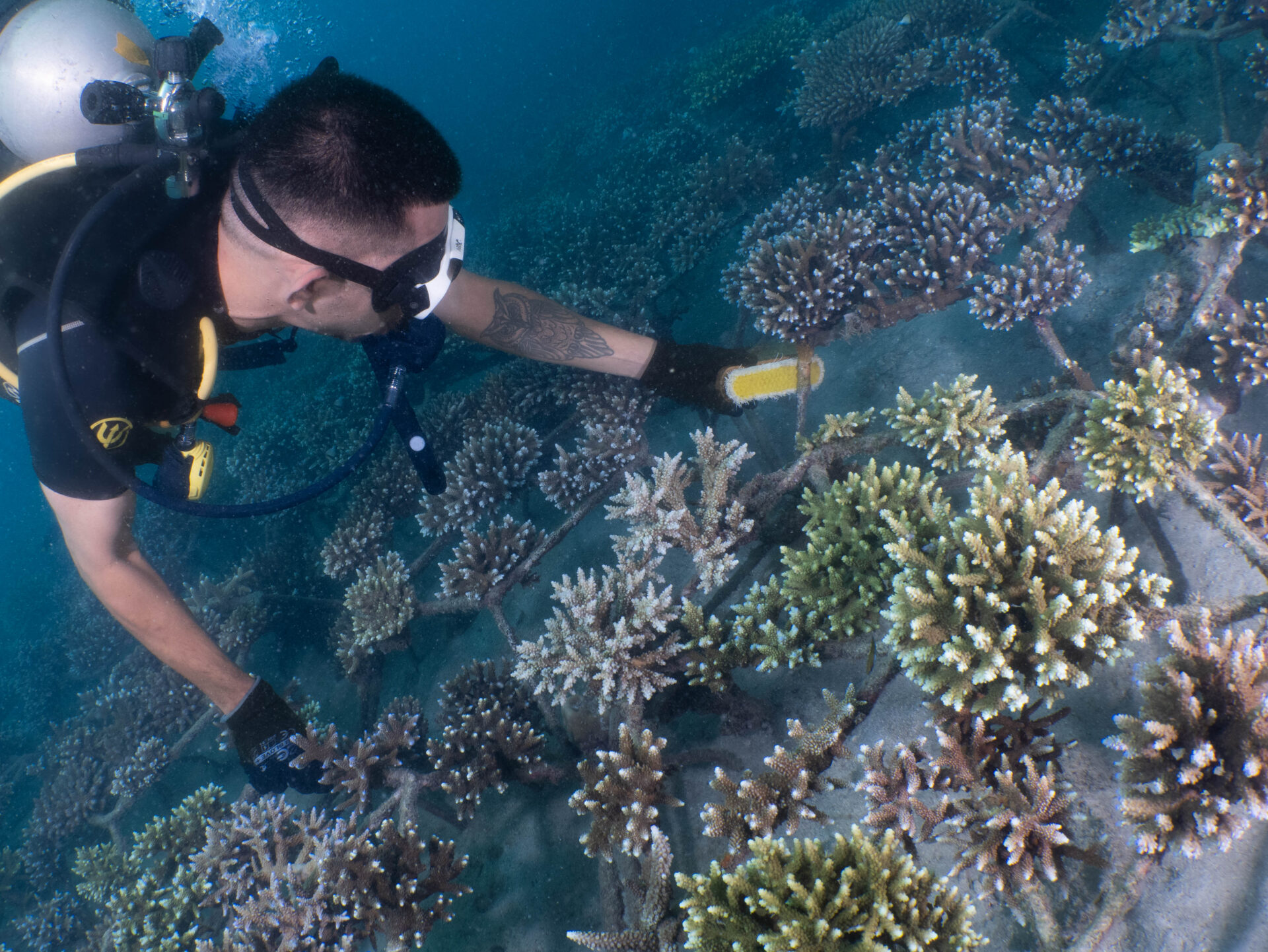
At the DiveRACE site, ongoing maintenance includes cleaning, repositioning fragments, and removing competing growth. This ensures that corals continue to receive sufficient light and nutrients.
Not every fragment survives. Some are lost to environmental stress, predation, or competition. These losses are expected and are part of the process. New fragments are introduced to replace those that do not survive. Over time, the overall structure continues to expand despite these setbacks.
This gradual process, including setbacks, is what ultimately builds a more resilient reef. It is consistency, rather than speed, that drives long-term success.
Signs of a Recovering Reef
As the coral structure develops, marine life begins to return. This is actually the most rewarding stage of the process. Small reef fish are usually the first to appear, followed by larger schools and more complex interactions.
Predators and cleaning species begin to re-establish themselves. Behavioural patterns become more consistent. The reef starts to function as an ecosystem, rather than just a collection of corals. These changes do not happen immediately. They develop alongside the coral growth and depend on habitat complexity.
At DiveRACE, this progression has become increasingly visible. The site has expanded significantly, both in size and in ecological activity.
This recovery takes time, but that progression is what allows a true ecosystem to form, rather than a temporary or artificial result seen in other locations.
Why Slow Growth Is a Good Sign
It is easy to assume that faster restoration would be better. However, rapid growth without stability often leads to failure. Corals that are not properly established are more likely to break, detach, or die.
Strong attachment, balanced growth, and ecological integration all require time. These factors cannot be rushed without compromising long-term success.
Natural reefs take decades to form. Restoration cannot replicate that instantly. Instead, it works alongside natural processes to rebuild structure in a way that lasts.
This approach leads to more durable and self-sustaining reefs. It is not a limitation, but the reason restoration succeeds.
Looking Ahead
The DiveRACE coral restoration project continues to expand. What began as a relatively small area has grown into a developing reef system. The long-term goal is not just expansion, but ecological stability.
Future plans include increasing site coverage, improving species diversity, and continuing regular maintenance. There is also a growing focus on education and involvement.
Coral restoration challenges the idea that meaningful change must be immediate. It shows that some of the most important progress happens over time, often without obvious signs at first.
Want to be part of our restoration project? Contact us for more information.
Related Articles
-

Climate Change & Corals: How Extreme Weather and Warming Seas Shape Our Reefs
In recent years, Southeast Asia has experienced increasingly unpredictable and severe weather…
-
Corals in Thailand: How You Can Help with DiveRACE
When people talk about scuba diving in Thailand, they almost always mention…
-
Acropora Corals in Thailand: The Science Behind Our Restoration Work
Why We Use Acropora Corals in Our Thailand Restoration Project If you’ve…