
The ocean stretches endlessly before us as we sail toward the northwest tip of Similan Island #7. Below, mostly hidden from view, lies Deep Six — a dive site within the Similan Islands National Park where the granite rock formation of the island plunges into blue and continues to the sand far beneath.
It’s also a popular snorkelling spot, with a shallow reef that offers plenty to see for those who aren’t diving. Resident green and hawksbill sea turtles are known to swim over to the boats moored here. Sadly, their curiosity is encouraged by people feeding them which disrupts their natural behaviour and puts them at risk of boat-related injuries. At DiveRACE, we encourage guests not to feed the turtles — but even without a handout, they often come by for a closer look.
I roll in from the dinghy and descend into the calm waters of Deep Six’s sheltered north bay. It’s the perfect starting point, offering protection from the current, before venturing into the deeper reaches of the site.
Searching for Rays
Our dive guide leads the way, a dark silhouette against the fading light, drawing us left-shoulder along the reef toward the outer sands where larger marine life rests between hunts. I begin scanning for the sleek outlines of whitetip reef sharks, or the unmistakable shape of a stingray half-buried in the sand — more often than not, the Kuhl’s maskray.

Kuhl’s maskrays are often mistaken for the more famous blue-spotted stingrays, but they’re a different species entirely. Instead of the neon-blue spots scattered across their back, Kuhl’s maskrays have smaller, more subtle blue markings. The most notable difference, and the origin of the name, is the brown colouration around the eyes and spiracles of the Kuhl’s maskray that resemble a mask — which the blue-spotted stingray lacks. Kuhl’s maskrays also have a larger, more angular disc (body) and blue-spotted stingrays have a smaller, circular disc. While blue-spotted stingrays are more common in shallow reef environments, the Similan Islands — and Deep Six — tend to favour the Kuhl’s maskray, which prefers the sandy bottoms near deeper reef and boulder structures.
These stingrays are also a familiar sight around our DiveRACE Foundation coral restoration site in Phuket. The sandy patches surrounding the ‘Super Stars’ (our specifically-designed structures holding coral fragments) provide the perfect resting place for Kuhl’s maskrays between feeding trips. Divers visiting the site often spot them lying still with just their eyes peeking out from the sand, blending seamlessly with their surroundings. While they’re not the main focus of our restoration work, seeing these rays return regularly is a good indicator of a healthy, balanced ecosystem forming around the restoration site.
To the Rocks
We drift along the sand until the faint outlines of massive boulders begin to rise in front of us, their faces fringed with gorgonian sea fans and soft corals in shades of pink, orange, and purple. My eyes adjust to the shadows as I search each crevice for hidden life — transparent cleaner shrimp waiting for their next client, spiny lobsters wedged into rocky corners, and tiny juvenile fish sheltering from the open water.

The current picks up as we approach the outer corner of the island. The underwater topography funnels the flow of water around the point, accelerating it much like wind through a narrow pass, especially during tidal changes. In these conditions, divers need to stay close to the reef or boulder formations, using the contours of the rocks as shelter from the flow. Maintaining good buoyancy control and horizontal trim and staying aware of your position relative to the group and dive guide are essential to avoid being swept away.
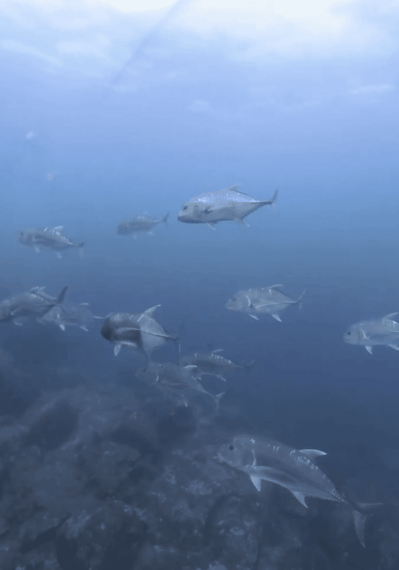
Something looms ahead in the distance. An even larger boulder isolated from the others. As we swim over, the water above explodes with movement as huge schools of fusiliers stream past with the current. They weave effortlessly between us, darting around our bubbles in a rush of colour, as we look out towards the blue for eagle rays, dogtooth tunas, or even larger visitors passing by.
Exploring the Swim-Throughs
We turn back toward the main boulder formations, checking our NDL to begin our ascent. The boulders closer to the Island provide more shelter from the current than the outskirts. Entering a labyrinth of granite rock, we weave between towering walls and smaller rocks arranged in seemingly impossible stacks. The site feels like an underwater playground, every turn revealing a new overhang, ledge, or hidden tunnel.

The boulders here vary in size. Some are as large as buildings, others small enough to be perched on top of each other, and are arranged in a way that makes the whole area feel otherworldly. These structures are a sanctuary for juvenile reef fish, who dart between cracks to avoid the predators patrolling the edges.
Soon, we reach one of the larger swim-throughs — a short tunnel formed naturally between the boulders. The guide begins to lead us through, checking first that we are comfortable. It takes careful buoyancy control and trim to pass through without disturbing the beautiful corals and sponges that cling to the walls. For those who prefer more space, it’s always possible to skirt around the outside and rejoin the group on the other side just a few meters later — just be sure to communicate with your guide and buddy.
Hidden Life Between the Granite
I keep an eye out for moray eels lurking in the cracks, and for banded sea kraits — highly venomous yet generally docile sea snakes — weaving effortlessly through the maze of boulders. Sea kraits are fascinating creatures; unlike most sea snakes, they can survive both in the ocean and on land, coming ashore to rest and lay eggs. Their bold black-and-white bands and elegant movements make them an unmistakable sight, but they pose no threat unless provoked. It’s always advised when observing or photographing marine life that they are given a clear exit to escape the encounter if they are uncomfortable.

We rise onto the shallows of the boulders, which stretch all the way to the surface and connect to the island itself. I take a moment to enjoy the view from the top, admiring the granite rocks cascading out into the deep against the bursts of sun rays parting through the surface. Doing our safety stop near the boulders or at the shallow reef while deploying the SMB early enables the boat crew to standby for pick up. The Similan Islands, especially Deep 6, are a hotspot for young green and hawksbill turtles, so we keep scanning the surface, hoping for a curious one to glide down and join us for the final minutes.
Our tanks run low, and with the island now just above us, it’s time to surface. Deep 6 has offered everything from big pelagic encounters to intricate reef life, and the dramatic granite topography is nothing short of spectacular.
Like what you read? share it with your friends!
Next en route on board MV DiveRACE Class X:
Next, we’ll travel a little further north of Deep Six to explore a stunning boulder pinnacle in the Similan Islands National Park, rising from the depths and promising a whole new perspective on the Similan Islands’ underwater world.
Want to read more? Take a look at our latest posts!
- Thailand’s Sunscreen Ban: What You Need to Know to Avoid the 100,000 THB Fine
- Corals in Thailand: How You Can Help with DiveRACE
- Dive With Us in The Similan Islands: #7 Koh Bon
- Climate Change & Corals: How Extreme Weather and Warming Seas Shape Our Reefs
- Dive With Us in The Similan Islands: #6 Christmas Point