
In recent years, Southeast Asia has experienced increasingly unpredictable and severe weather events — flooding, prolonged heavy rainfall, and shifting monsoon patterns. These are not isolated incidents; they are part of a wider trend linked to global climate change. While the human impacts are immediately visible, including homes damaged and livelihoods disrupted, the consequences of climate change for coral reefs and the communities that depend on them are equally devastating, though often less visible at first glance.
Climate Change and Extreme Weather in Southeast Asia
Climate change intensifies the global water cycle. Warmer air holds more moisture, leading to heavier rainfall and more frequent flooding. Southeast Asia, with its densely populated coastlines and reliance on seasonal monsoon rainfall, is especially vulnerable to these changes.
According to the Intergovernmental Panel on Climate Change, the region has seen a marked increase in extreme precipitation events (1. IPCC, 2021). Thailand, Vietnam, Indonesia, and the Philippines regularly experience devastating floods, disrupting agriculture, fisheries, infrastructure, and tourism — the very backbone of coastal economies.

(Photo: Sunthorn Kongwarakom via Bangkok Post)
In 2025, Southeast Asia has already faced multiple climate-driven floods. In August, heavy monsoon rains linked to Tropical Storm Kajiki inundated Thailand’s Chao Phraya River basin, displacing thousands (2. Bangkok Post, 2025). Not long after, in early September, Tropical Storm Nongfa hit northern, northeastern and central Thailand (3. Nation Thailand, 2025). Flooding has affected provinces all across Thailand.
In Indonesia, severe floods hit Sumatra and Java earlier this year, followed most recently by flash floods in Bali last week, which forced evacuations and damaged infrastructure (4. The Jakarta Post, 2025). Authorities have linked the severity of these floods to unusually intense monsoon downpours, consistent with broader climate-driven trends across the region.
How Extreme Weather Affects Coral Reefs
While corals are most often associated with threats from rising sea temperatures and bleaching, extreme weather adds another layer of stress. Together, these impacts of climate change place coral reefs under cumulative pressure:
Sedimentation and runoff: Heavy rainfall and flooding wash soil, pollutants, and nutrients into coastal waters. Excess sediment smothers corals, blocking the sunlight needed by their symbiotic algae for photosynthesis. Nutrient overloads from soil and human waste can also trigger algal blooms, which outcompete corals (5. Fabricius, 2005).
Freshwater influx: Sudden surges of freshwater from rivers reduce salinity near reefs. Corals are highly sensitive to salinity changes, and prolonged exposure can weaken or kill colonies (6. Junjie et al., 2014).
Physical damage: Stronger storms and wave surges can break apart reef structures, leaving them vulnerable to erosion and colonization by algae.
Cumulative stress: When combined with elevated sea surface temperatures, these events reduce corals’ resilience, making recovery from bleaching or disease outbreaks far more difficult.
What Does This Mean for Coral Reefs in Thailand?
Beneath the surface of Thailand lie some of the most biologically diverse ecosystems on Earth. Coral reefs here provide the foundation for marine life, sustain fisheries, and protect coastlines. Yet they are under increasing threats from climate change, including one largely invisible force: rising sea temperatures. This global challenge is already reshaping the future of reefs in Thailand and across the tropics.

The oceans surrounding Thailand — the Andaman Sea to the west and the Gulf of Thailand to the east — play a critical role in regulating regional climate and supporting some of the country’s most biodiverse ecosystems. Like the global ocean, these seas absorb the majority of excess heat trapped by greenhouse gases, with more than 90% of this heat taken up worldwide (1. IPCC, 2021).
In Thailand, long-term monitoring has shown that sea surface temperatures have steadily increased over recent decades. On average, the Andaman Sea and Gulf of Thailand have warmed by 0.11–0.15°C per decade since the 1980s, mirroring global ocean trends (7. NOAA, 2023; DMCR, 2020). While this rate may appear minimal, even small increases are enough to push coral reef ecosystems beyond their thermal limits.
The Effects of El Niño on Thailand’s Reefs
This vulnerability has been highlighted during El Niño years, when regional seas often experience anomalously high temperatures. For example, the 2010 El Niño event drove widespread bleaching across the Andaman Sea, with reports of coral mortality exceeding 50% in shallow reef areas (8. Phongsuwan & Chansang, 2012). A similar pattern occurred during the 2016 global El Niño, when sea temperatures in both the Gulf of Thailand and the Andaman Sea spiked, triggering another major bleaching episode.
These repeated events demonstrate that corals in Thailand are already living at the edge of their tolerance. Rising baseline temperatures, combined with periodic El Niño-driven spikes, leave little room for recovery without intervention.
Why Elevated Temperatures Are Critical for Corals
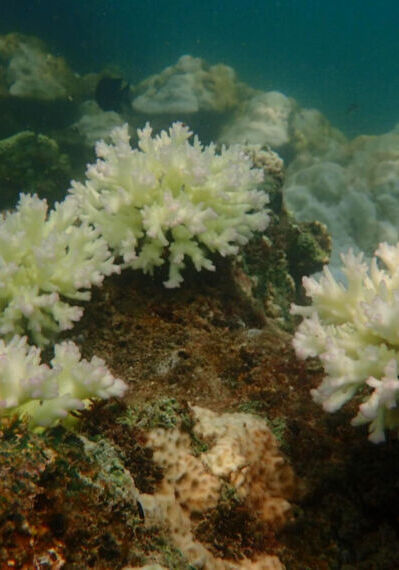
Corals exist in a finely balanced symbiosis with microscopic algae called zooxanthellae. These algae provide energy to corals through photosynthesis, supporting both growth and reef-building. When water temperatures rise beyond a narrow range, corals undergo physiological stress and expel the algae — a process known as coral bleaching.

Bleached corals are not dead, but they are severely weakened. Without their primary food source, they are far more vulnerable to disease and mortality. If heat stress persists, large sections of reef can collapse, leaving behind barren skeletal frameworks (9. Hughes et al., 2017). The beige-white colour of their empty skeletons is a sign of their fragility.
Cumulative Damage
While rising sea temperatures remain the most direct driver of coral bleaching in Thailand, it rarely acts alone. Climate change brings a combination of stressors that compound one another. For corals already weakened by bleaching, the added pressure can tip the balance from recovery to mortality.
Ocean Upwelling Cycles
Climate change is also disrupting the natural cycles that oceans depend on. A striking example came from the Gulf of Panama in 2025, where scientists documented the first-ever collapse of the seasonal upwelling cycle after more than four decades of monitoring (10. PNAS, 2025). Normally, strong trade winds from December to April drive cold, nutrient-rich water to the surface, cooling seas, fueling plankton blooms, supporting fisheries, and even shielding corals from heat stress. But in 2025, weakened trade winds caused the cycle to fail completely.
Without this upwelling, Panama’s coastal waters stayed warmer and less productive. Satellite data confirmed dramatically low chlorophyll levels, meaning the normal plankton bloom never arrived. That collapse rippled through the food web, threatening fisheries and leaving corals more exposed to bleaching.
This event is not just local. Upwelling zones worldwide — in Panama, Peru, West Africa, and the Arabian Sea — are some of the most productive ocean systems on Earth, supporting both biodiversity and coastal economies. A disruption in any one system signals how vulnerable all are to shifting climate patterns. If climate change weakens or suppresses these natural rhythms more often, the consequences will be global: destabilized fisheries, reduced marine productivity, and higher risks of coral bleaching.
For Thailand, where reef health is already tied to delicate seasonal cycles such as monsoons and ocean currents, the Panama collapse is a reminder: climate change doesn’t just warm oceans — it can unravel the natural processes that reefs and communities rely on.
These cumulative impacts reduce the resilience of entire reef systems. Even when corals survive a single event, their ability to recover after repeated disturbances becomes increasingly limited (11. Ban et al., 2014).
The Human Connection
The decline of coral reefs under climate pressure has direct consequences for human livelihoods in Thailand.
Fisheries: Coral reefs are nurseries for many of Thailand’s key fish species. Communities in Phang Nga, Phuket, Krabi, and Surat Thani rely on these fisheries for daily protein and income (12. Bell et al., 2013). When corals die, fish populations shrink as they lose their protection and food sources. Small-scale fishers lose their catch, and coastal families lose both food and income. Large scale fisheries are forced to venture further out from shore as stocks become depleted, potentially increasing the likelihood of illegal fishing within National Parks.
Tourism: Diving and snorkeling are vital pillars of Thailand’s economy. According to the Tourism Authority of Thailand (TAT), reef-related marine tourism contributes over USD 2 billion annually. The Similan Islands, Phuket and Koh Tao attract hundreds of thousands of visitors each year. Tourists come for vibrant corals and marine life. When reefs degrade, tourism revenue falls. Dive operators, hotels, and restaurants all suffer.

Coastal protection: Healthy reefs act as natural breakwaters. They absorb up to 97% of wave energy (13. Ferrario et al., 2014). In Thailand, reef decline has worsened erosion in Phuket, Phang Nga and Krabi, especially during storm surges that now reach further inland. Without reefs, coastal villages, and beaches and hotels face higher risks of flooding and damage.
Cultural heritage: Reefs are tied to Thailand’s identity. Fishing villages have long depended on coral ecosystems for food and trade. Local folklore, spiritual practices, and boat blessings often connect directly to the sea. The loss of reefs weakens these cultural traditions and severs ties between people and their marine environment.
What Can You Do to Help Fight Climate Change?
Protecting coral reefs in Thailand is not only the job of governments and conservation groups. Everyone can and should help.
1. Be a responsible diver or snorkeler – Practice buoyancy control. Never touch or stand on corals. Avoid stirring up sediment on the seafloor. Use reef-safe sunscreen.
2. Reduce single-use plastics – Plastics entering rivers end up in the sea, damaging corals and harming marine life. Carry reusable bottles and bags.
3. Support eco-conscious businesses – Book with dive operators, hotels, and tours that prioritize sustainability and marine conservation.
4. Support Coral Restoration – Restoration projects can help reefs recover from cumulative stress and regain resilience.
DiveRACE’s Role in Coral Restoration
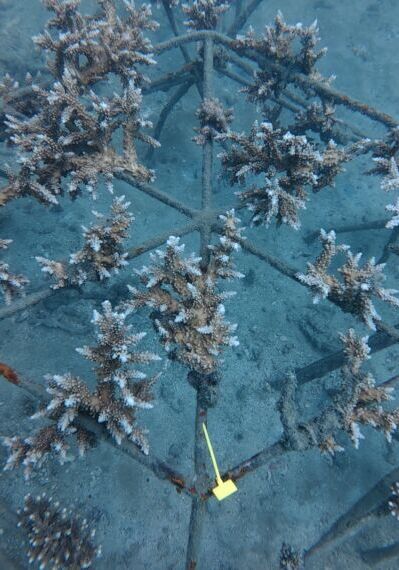
At DiveRACE, we are committed to being part of the solution. In Phuket, our team has begun restoring a reef site that was destroyed by past coral bleaching and reduced to rubble.

To rebuild this ecosystem, our team builds and installs “Super Star” reef structures, which provide a secure base strong enough to withstand waves and storms. Once in place, we attach coral fragments to these structures, allowing them to grow and form new reef habitat. The project is carried out in partnership with the Department of Marine and Coastal Resources (DMCR), and our team monitors and maintains the site while continuously expanding the restoration area.
Everyone plays a part in fighting climate change. You can too! Check out our coral restoration project here and find out how you can get involved.
For those that would like to join us to learn more, please contact us via email — [email protected]
References
1. IPCC (2021). Climate Change 2021: The Physical Science Basis.
2. Bangkok Post (2025). Monsoon rains trigger widespread floods in central Thailand.
3. Nation Thailand (2025). Thailand braces for heavy rain as Tropical Storm Nongfa approaches.
4. The Jakarta Post (2025). Heavy rains cause flooding across Sumatra and Java.
5. Fabricius (2005). Effects of terrestrial runoff on corals and reefs.
6. Junjie et al. (2014). Impacts of sedimentation on coral reefs.
7. NOAA (2023). Climate Change: Ocean Heat Content and Carbon Uptake.
8. Phongsuwan & Chansang (2012). Reef-wide coral bleaching in the Andaman Sea, Thailand.
9. Hughes et al. (2017). Global warming and recurrent mass bleaching of corals.
10. PNAS (2025). Unprecedented suppression of Panama’s Pacific upwelling in 2025.
11. Ban et al. (2014). Multiple stressor interactions and effects on coral reefs.
12. Bell et al. (2013). Tropical Pacific fisheries and climate change.
13. Ferrario et al. (2014). Effectiveness of coral reefs for coastal hazard reduction.
Related Articles
-

Climate Change & Corals: How Extreme Weather and Warming Seas Shape Our Reefs
In recent years, Southeast Asia has experienced increasingly unpredictable and severe weather…
-
Corals in Thailand: How You Can Help with DiveRACE
When people talk about scuba diving in Thailand, they almost always mention…
-
Acropora Corals in Thailand: The Science Behind Our Restoration Work
Why We Use Acropora Corals in Our Thailand Restoration Project If you’ve…