

Anticipation builds as we sail towards the next dive site in our itinerary. The Surin Islands begin to fade into the horizon as we cross the calm, open ocean towards the mainland. Here, a very special dive site awaits. The world-renowned Richelieu Rock.
As part of the Surin Islands National Park, Richelieu Rock sits isolated in open water. It lies roughly 10 nautical miles east of the Surin Islands and around 25 nautical miles from mainland Thailand. Far enough to feel remote, yet close enough to be dived in a single, unforgettable day.
We slow to a stop, carefully assessing conditions and choosing our approach. We are the first boat here this morning, having dived the Surin Islands early to arrive ahead of the crowds. Richelieu Rock is one of the most popular dive sites in the region, and on a busy day, dozens of boats can arrive, sometimes putting more divers in the water than fish.
Because of this, timing matters. By shifting our first dive of the day earlier, we usually avoid overlapping drops with other liveaboards. Coordinating entry times allows us to enjoy Richelieu Rock the way it should be experienced: Fewer bubbles. More wildlife. More magic.
The History of Richelieu Rock
Richelieu Rock rises in isolation from the open waters of the North Andaman Sea. Its remote position has shaped both its history and its reputation. The site is a horse-shoe-shaped limestone pinnacle, formed over millions of years and shaped by tectonic movement and erosion into its present form.
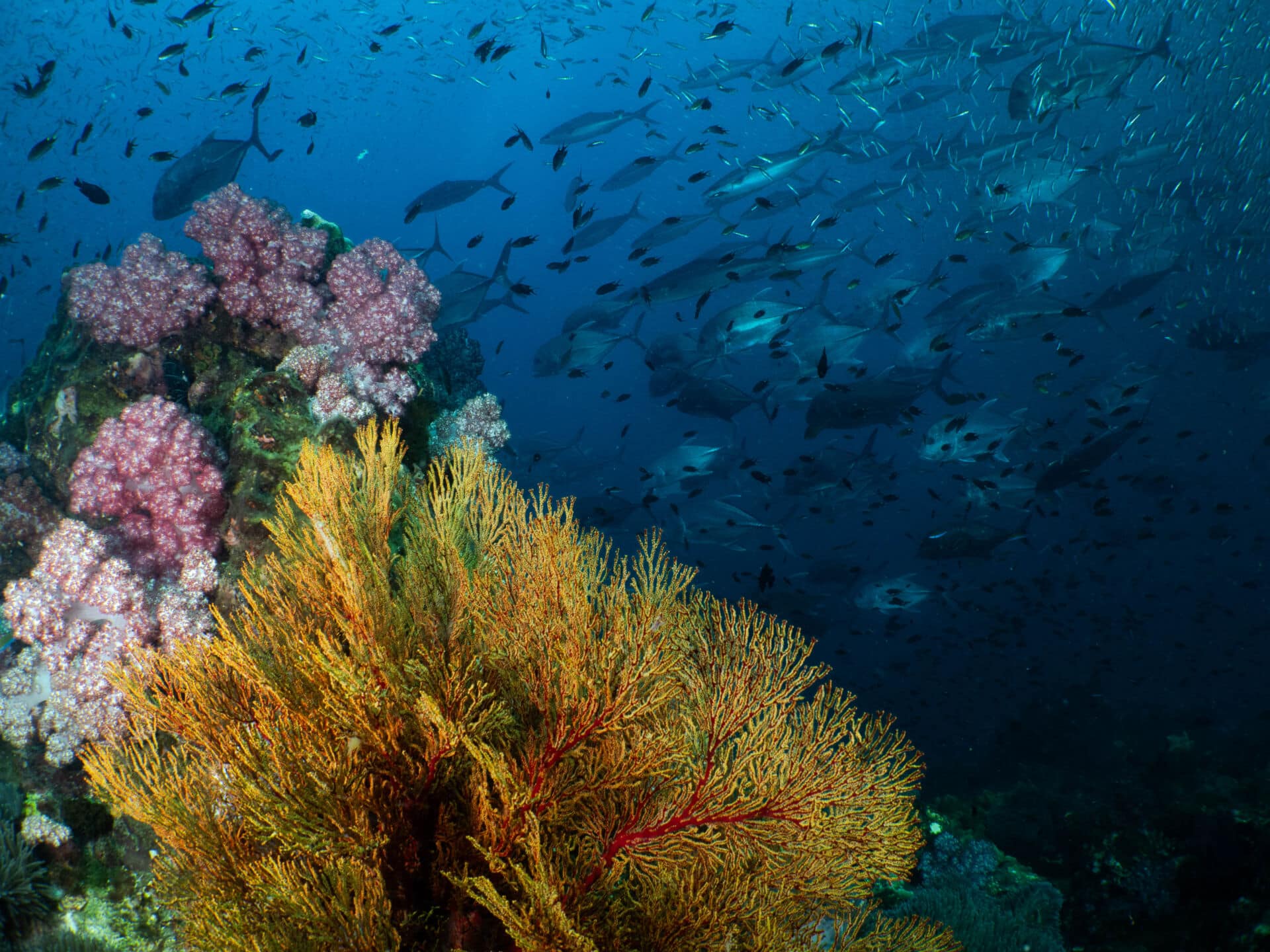
At low tide, its shallowest point breaches the surface by about 1 metre. At high tide, it is fully submerged. From there, the rock slopes steeply down to depths of 25–30 metres. Scattered around the main structure are large limestone blocks: These fragments likely broke away over time, settling deeper on the seabed. Today, they form an extension of the reef.
The origin of Richelieu Rock’s name has long been debated. One popular theory links the name to Jacques Cousteau and his early exploratory diving. However, this explanation does not align with historical records. According to documentation from Thailand’s Department of National Parks, the site was named well before Cousteau’s time in the Andaman Sea.
Thai park records place the name firmly within the Surin Islands National Park long before modern recreational diving existed. The most widely accepted explanation traces the name back to Admiral Andreas du Plessis de Richelieu, a Danish naval officer in the service of the Kingdom of Siam. His role in modernising the Thai Navy is well documented in Thai and Danish naval archives. Historical accounts suggest the Admiral named the rock after his family crest. The crest was purple in colour, known as richelieu in French. When viewed from above, the reef often takes on a deep purple hue as soft corals fully extend into strong tidal flow.
Today, Richelieu Rock remains protected within the boundaries of the Surin Islands National Park. Its exposure to open-ocean currents delivers nutrient-rich water year-round. This constant exchange fuels the extraordinary biodiversity that defines the site.
The dive begins
We enter the dinghy, full of quiet excitement as we head towards the only buoy line (thus can be busy!) that is attached to the south east top of the rock at 10 metres. The currents can be strong and unpredictable here, so like Tachai Pinnacle, we will drop by the buoy and gently hold the line down, where we will find protection from the rocks if needed.
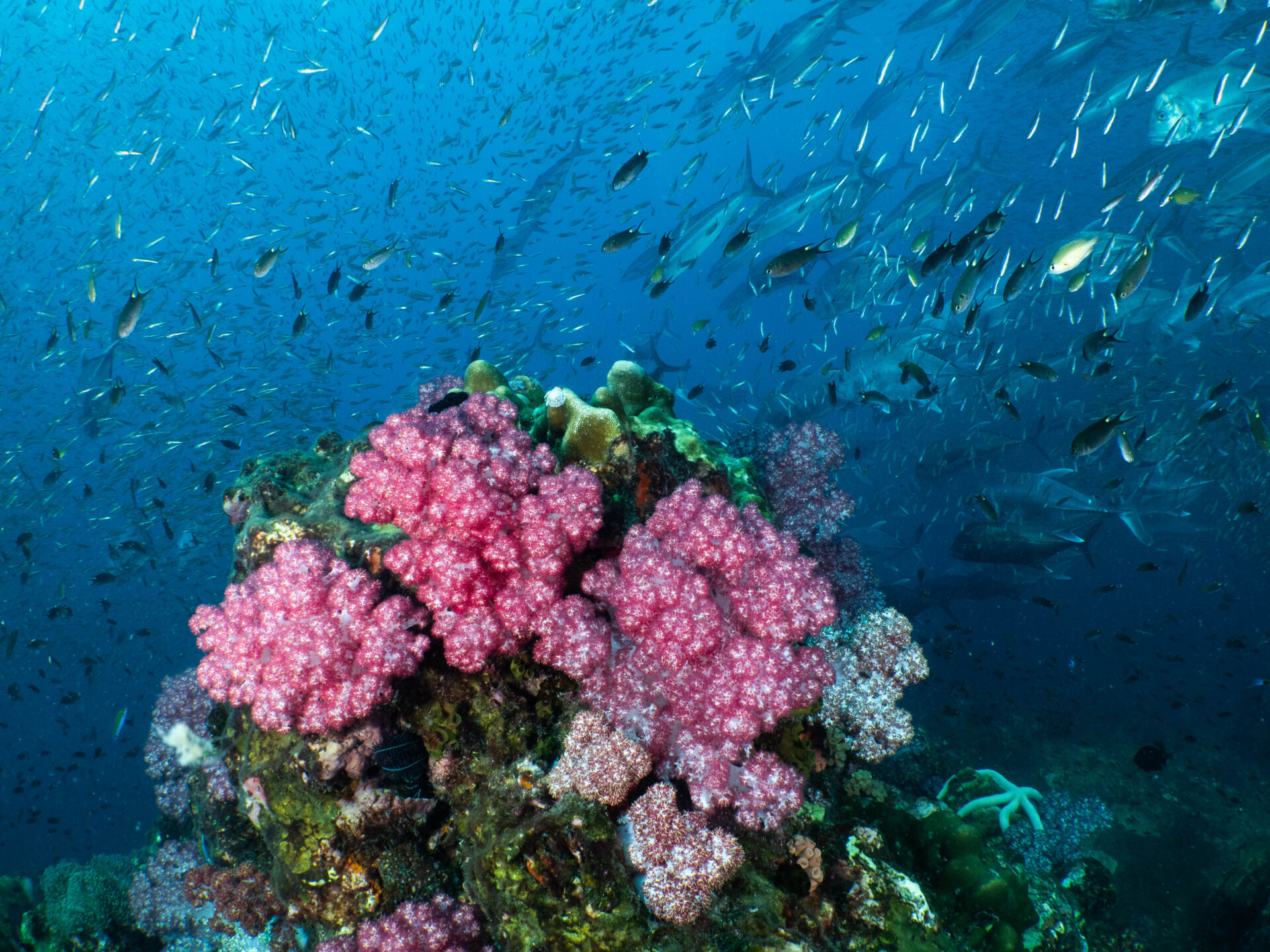
This dive starts calmly, just a little bit of surge in the shallows as we descend. Hand over hand, I descend down the line, as Richelieu rock begins to unfold in front of my eyes. The visibility is fantastic in the shallows today, and the colours of the reef instantly pop against the bright blue hues and morning sun rays.
As I descend further, the limestone structure comes into full view, textured and alive. Soft corals glow and the reef seems to breathe with movement. I feel that familiar sense of anticipation build, the kind that only comes at the start of a truly special dive. Richelieu Rock is dived every day during the season, (except when the waves are significant which can happen any time during the season) and yet it never feels tired or overexplored. Guides know this site intimately, often sharing sightings and discoveries between boats, but every descent still feels unique.
Exploring the Deep Rocks
We begin the dive with our left shoulder to the reef, following the rock down beside the buoy line towards the southeast tip of the crescent. The first thing that stands out is the soft coral, covering almost every surface and glowing as we descend. Using the rock as a visual reference makes the descent easy, allowing us to settle at our planned depth while staying oriented.
Richelieu Rock can be busy, and with so many divers in the water, it is surprisingly easy to drift onto the wrong group. For this reason, we stay close together and recommend being alert and aware of your guide’s position at all times. As the reef drops away, large limestone blocks appear on the seabed, resting just a few metres from the main structure. I glide across the sand between them, already scanning carefully, knowing this area often hides something special.
Tiger-tail Seahorse
Our guide moves slowly, checking large gorgonian sea fans and long sea whips that rise from the deeper rock. Then they stop and turn, eyes bright with excitement. I follow their line of sight to a yellow sea whip, and there, wrapped tightly around it, is a tiger-tail seahorse.
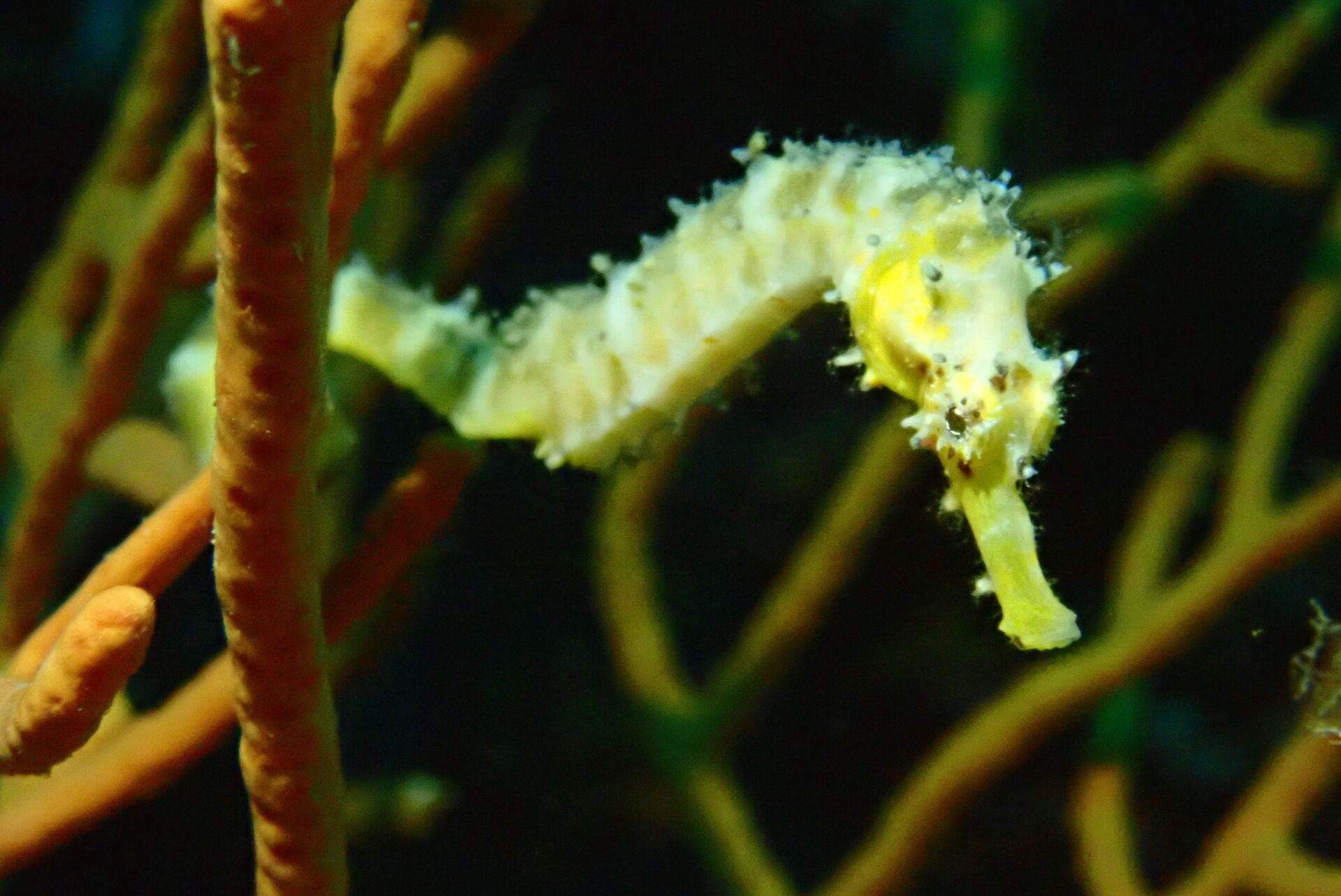
Tiger-tail seahorses are masters of disguise. Their striped bodies perfectly mimic the patterns of whip corals, helping them disappear into the reef. Like all seahorses, it is the male that carries the young. The female transfers her eggs into a brood pouch on the male’s belly, where they develop until he gives birth to fully formed miniature seahorses. Anchored by their prehensile tails, they remain almost motionless in the current, waiting for plankton to drift past.
Because of this, careful diving etiquette is essential. Shining torches directly into their eyes can disorient and frighten them, often causing them to move away from their anchor point. Sudden movement also draws attention, increasing the risk of predation from larger fish such as groupers. When photographing macro life here, a soft, indirect light and steady positioning allow these fragile animals to remain calm and protected in their natural setting.
We continue around the deeper rock at around 28 metres, gently carried by a steady current. Time passes quickly at this depth, and soon we begin working our way back towards the main reef, keeping a close eye on our no decompression limit (NDL). This is a dive site where Nitrox truly makes a difference, allowing us to extend our bottom time and explore more of what Richelieu has to offer. You can read more about the RAID Nitrox course available on board MV DiveRACE Class X here.
Soft Coral Carpets
Back at the main rock, we continue left shoulder around the horse-shoe, weaving slowly through narrow channels and pausing beneath overhangs. Then it hits me. The entire rock is carpeted in soft corals. Hues of pink, yellow, purple and orange flood the scene as the corals sway gently in the surge, revealing layers of marine life sheltering within.

Richelieu Rock is perfectly suited to soft corals. Its exposed position in open water brings constant current, delivering a steady supply of plankton and nutrients. Soft corals thrive in these conditions, feeding directly from the water column and flexing easily with the surge. Hard corals, however, struggle to establish themselves here. The strong, shifting currents and limited stable surfaces make it difficult for them to settle and grow.
Instead, soft corals and anemones dominate the reef, easily anchoring to the textured limestone and covering every available surface. Their movement brings the rock to life, transforming it into a living, breathing landscape that defines Richelieu Rock’s unmistakable character.
During the season, the rock becomes surrounded by schools of glass fish. They are a collection of small fish with silver bodies that reflect the light, giving them the illusion of glass against the reef. At times, their numbers explode, forming a thick, living wall along the rock. Moving in perfect unison, they draw in the larger predators that call Richelieu Rock home.
The Hunters
I move through the glass fish as they explode outward in a sudden burst of motion. Their silver bodies flash in my torchlight, and in an instant the reef comes alive with movement.

A wave of predators sweeps in. A vast, unified school of longnose emperor fish surges forward, intertwined with schools of rainbow runners and bluefin trevally. The school is enormous now, having grown steadily in recent years. They circle the rock day and night, hunting together, moving together, and seemingly energised by the presence of divers.
At Richelieu Rock, a single shift in the reef can trigger a hunt. One longnose emperor breaks formation to investigate, and the rest follow instantly. The attack unfolds across the reef in a rush of speed, colour and precision.
Longnose emperor fish are able to change their body colour while hunting, darkening as they focus on prey. You can hear them underwater as they pass the group, the rush of water marking the moment they strike.
Searching the Overhangs & Crevices
Limestone rock is highly porous, and over time it forms a lattice of overhangs and crevices. These spaces create perfect shelter for small critters such as dancing shrimp, harlequin shrimp, juvenile boxfish, cleaner shrimp, and tiny gobies, offering protection from both predators and strong currents. Hidden within these cracks and shadows, nudibranchs, juvenile fish, and invertebrates thrive, turning every overhang into a miniature ecosystem waiting to be discovered.
I scan through large gorgonian sea fans as we continue left shoulder around the horse-shoe, slowly making our way towards the western side of Richelieu Rock. This is where conditions can change. Currents shift throughout the day as tides turn and water is funnelled around the isolated pinnacle. At times they can build quickly, which is why staying close behind your guide is essential. With multiple dives here on each trip, we adapt to the current each time, always finding a sheltered route and a safe way to explore the site.
Overhangs appear everywhere. Some are small and shallow, others deep and shadowed, and almost all of them hide something. For photographers, Richelieu Rock is a true haven. Even after hundreds of dives, it continues to reveal new details, rare encounters, and moments that make every dive feel different.
Ornate Ghost Pipefish
As I drift past a whip coral, I notice a branch that looks strangely detached. I slow down, changing my angle and moving closer. Something feels off. It looks like a stick, but it has eyes. Floating perfectly still is an ornate ghost pipefish.
Ghost pipefish are close relatives of seahorses and share the same incredible ability to blend into their surroundings. Their bodies mimic algae, debris, or coral, allowing them to remain almost invisible. They rely on camouflage rather than speed, hovering motionless as plankton drifts past. Richelieu Rock is one of the best places to find them, yet spotting one still requires patience and a trained eye.
Pelagic Visitors
As we begin to shallow up, a quiet presence starts to take shape above us. The water darkens slightly, and then the form becomes clear. A vast school of chevron barracuda hangs motionless above the rock, suspended in the blue and watching our moves as they glide past.

Richelieu Rock may be famous for its macro life, but it also draws in much larger visitors. This is the best site in the Similan region to spot whale sharks passing through. Sometimes they remain for hours, feeding in the nutrient-rich water that surrounds the pinnacle. Other times, they appear briefly, cruising past in the distance.
Interestingly, the best chance of seeing one often comes when visibility is poor. When plankton fills the water column, you can see it drifting and moving around you. That same plankton is what draws the giants in.
Oceanic manta rays are also seen here, gliding effortlessly through the blue. Neither encounter is ever guaranteed. But at Richelieu Rock, it always pays to look away from the reef and into open water. You never know what might be passing by. On rare occasions, even marlin have been spotted passing through, drawn in by the dense schools of fish that surround the site.
To the Bay
We begin to shallow up and continue southwest into the inner bay of the dive site. The seabed rises gradually, bringing us up to around 15 metres, enclosed by the curved arms of Richelieu Rock. The rush of longnose emperor fish passes by once again, their movement rippling through the water as the pace of the dive begins to slow.
Our guide remains focused on the reef, scanning carefully along the base of the rock and into small overhangs just above the seabed. This sheltered section of the bay is rich with life, and patience here is often rewarded. With a sudden look of excitement, they turn and usher me forward. Tucked beneath a small ledge, a harlequin shrimp faces outward, methodically feeding on the arm of a sea star.
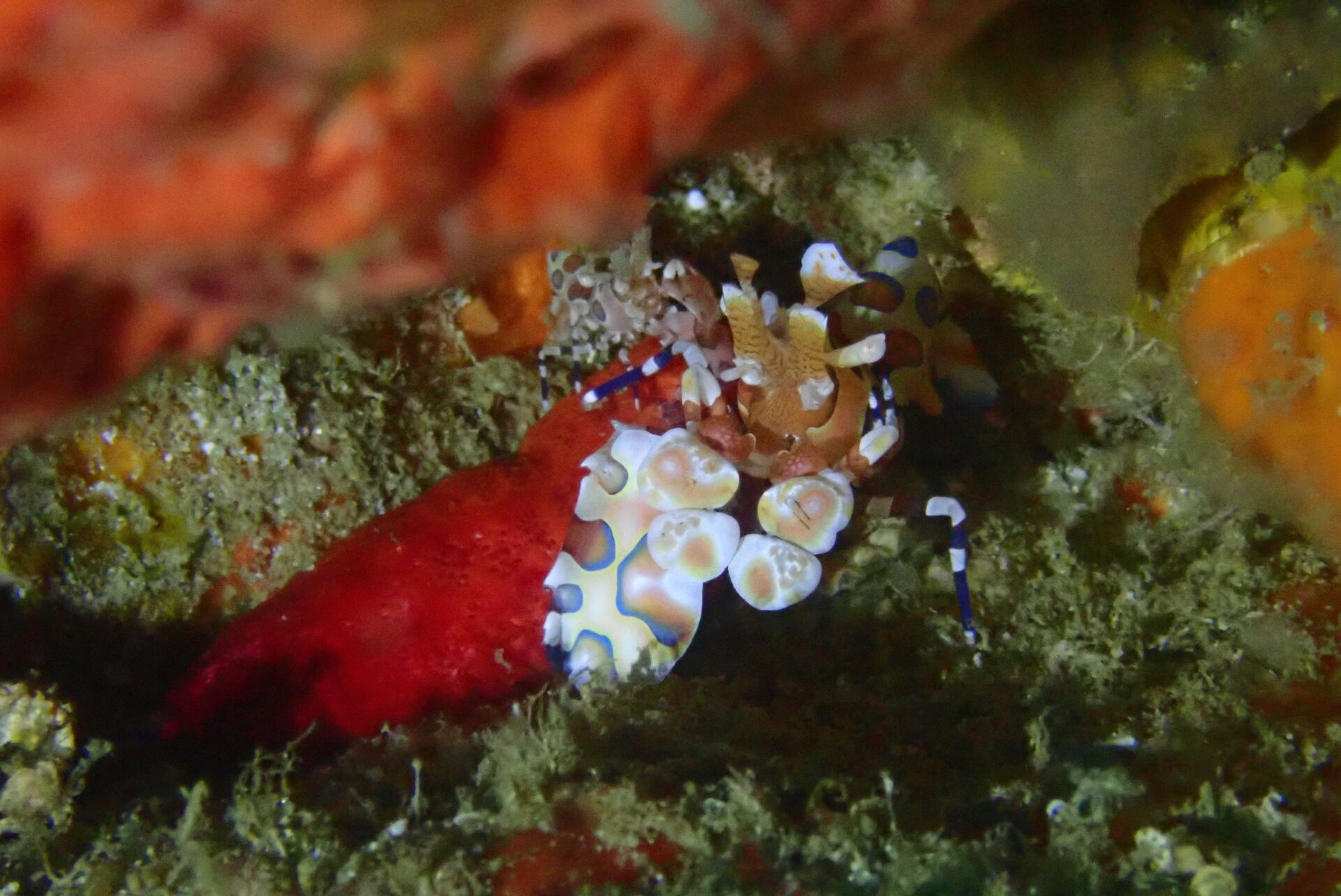
Harlequin shrimps feed almost exclusively on sea stars, working slowly over several days. They often keep their prey alive, turning it carefully as they feed. Usually found in monogamous pairs, they share both hunting and feeding duties, making encounters with them especially memorable.
Just metres away, another small opening in the limestone catches our guide’s attention. From within a narrow burrow, a peacock mantis shrimp peers back at us. Its colours are vivid, almost unreal, flashing greens, blues and reds as it shifts slightly.
Peacock mantis shrimps are famous for their powerful, club-like strikes, capable of breaking shells with incredible force. Despite this, they are cautious and highly intelligent, often retreating quickly into their burrows when they feel threatened.
We continue slowly through the bay, surrounded by calmer water and rich reef life, before gradually turning our attention back towards the shallows.
Ascending the Reef
The dive is slowly coming to an end, but not before we spend time exploring the shallows before beginning our safety stop. As the reef rises towards the surface, Richelieu Rock becomes the perfect place to shallow up while still fully immersed in the dive. With more daylight filtering through the water, the colours of the soft corals intensify, glowing against the blue. I hover there in quiet awe, taking in one of the most beautiful scenes I have ever witnessed underwater.
A myriad of fish covers the rock from top to bottom. Angelfish, damselfish and parrotfish move between the coral, while huge schools of fusiliers stream past in silver waves. It feels like an aquarium, only real; wild and constantly shifting. The water around us pulses with motion, colour and sound.
We follow one of the many shallow channels out towards the outer corner of the reef to complete our safety stop. Slowly, the reef begins to fall away behind us as we turn and swim into the blue, leaving Richelieu Rock just as it disappears from view.
This is the reason we dive. Richelieu Rock is truly out of the ordinary. Though small in size, it is a site that can be dived again and again, each time revealing something new. Every dive brings a different moment, a different encounter, and a renewed sense of excitement.
Like what you read? share it with your friends!
Next on Our Journey
After three exhilarating dives at Richelieu Rock, it is time to sail back towards the mainland. The scenery will change here. The final dive site of our itinerary awaits, offering a different atmosphere altogether. Less reef, more metal, but the same burst of life…
Want to read more? Take a look at our latest posts!
- DiveRACE Safety Series: Marine Life & Environmental Awareness
- Manta Rays in The Similan Islands: Where to See Them and Why They Visit
- Building a Living Reef: Coral Restoration and the Future
- Octopus in Thailand: Clever, Curious and Full of Secrets
- DiveRACE Safety Series: Diving Practices & Underwater Awareness
Related Articles
-
Mergui Archipelago with DiveRACE
The Mergui Archipelago, located in southern Myanmar, is one of Southeast Asia’s…
-
Eat. Sleep. Dive. INFLATABLE FUN!
Diving isn’t the only way to enjoy the waters around Thailand. On…
-
Giant Trevallies at Koh Tachai Pinnacle
Koh Tachai Pinnacle is a top dive site in Thailand, famous for…