
I’ve dived Richelieu Rock more times than I could count, but I still get excited about finding a tiger tail seahorse. They are tiny, incredibly well camouflaged and very easy to swim straight past. Even when someone points one out, it can take a few seconds before your eyes finally register what you’re looking at.
That is part of what makes finding them so rewarding.
Richelieu Rock is famous for its bigger encounters. Whale sharks, barracuda, trevallies and huge schools of fish often get most of the attention. Yet some of my favourite moments here happen much closer to the reef. Slow down around the right areas and another side of Richelieu starts to appear. Tiger tail seahorses are one of those discoveries.
It’s also one of the reasons Richelieu Rock is such an important stop on our MV DiveRACE Class X Similan Islands liveaboard trips. There is always something different to look for here, from the biggest pelagics to some of the smallest reef residents.
Over the years, I’ve learned that spotting seahorses is less about having incredible eyesight. It is more about knowing where to look. At Richelieu Rock, certain areas provide exactly the habitat these seahorses need. Once you understand that habitat, you start searching differently.
And suddenly, a beautiful reef you thought you knew becomes much more interesting.
What Is a Tiger Tail Seahorse?
The tiger tail seahorse is a tropical seahorse found across parts of Southeast Asia. Its scientific name is Hippocampus comes, and Thailand falls within its natural range.
They can grow to around 18 centimetres, although at Richelieu Rock they are more commonly seen at around 5 centimetres long. They are often found in pairs, with their curled tails and irregular body shapes helping them blend into the surrounding reef growth. Their colour varies between individuals and can include yellow, brown, black, and combinations of darker markings, making them remarkably difficult to spot among the coral.
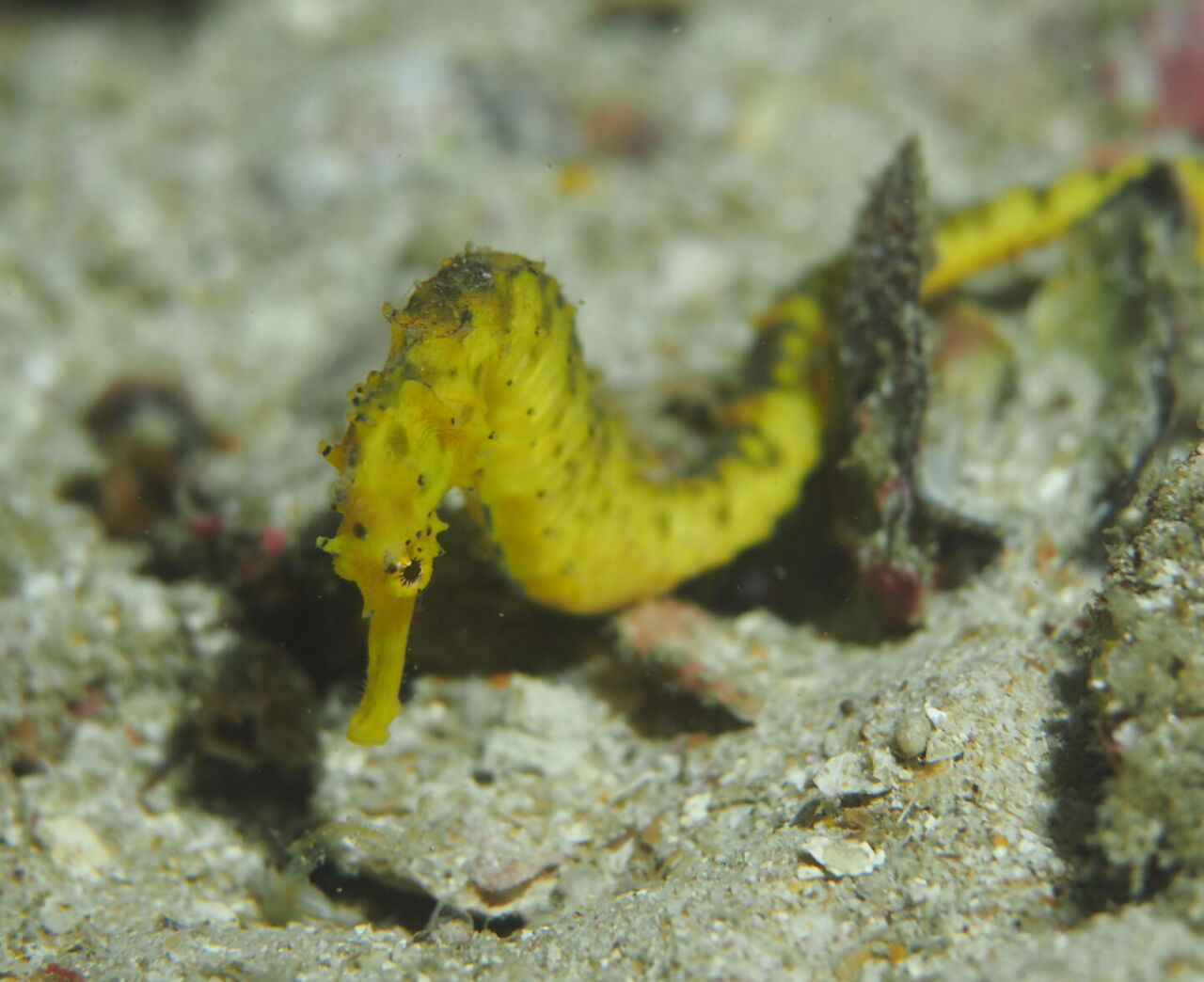
The name comes from the striped pattern often visible along the tail. However, that pattern isn’t necessarily what you notice first underwater. Usually, I notice the shape.
Once you have spent enough time looking for seahorses, your brain starts recognising their outline. A curled tail wrapped around something is often the first clue. Then you notice the head and snout, and the whole animal suddenly becomes obvious. Before that moment, it can look like another tiny piece of the reef.
Tiger tail seahorses are not powerful swimmers. Instead, they spend much of their time holding onto the reef using their prehensile tails. This allows them to remain relatively stable while conserving energy, and becomes particularly useful somewhere like Richelieu Rock, where currents can change quickly.
Why Are Tiger Tail Seahorses Found at Richelieu Rock?
If you dive regularly around the Similan and Surin Islands, you might notice something interesting. Tiger tail seahorses are associated much more strongly with Richelieu Rock than most Similan dive sites. There isn’t one simple reason for this. It comes down to habitat.
Richelieu Rock is an isolated limestone pinnacle surrounded by deeper water. Its underwater structure is covered with soft corals, sea fans, sponges and other complex marine growth. There are cracks, overhangs and protected sections throughout the site. You can learn more about Richelieu Rock here.
For a seahorse, that creates plenty of opportunities to hold onto something and shelter from stronger water movement. Richelieu is also an incredibly productive ecosystem. Nutrient-rich water supports dense reef growth and huge amounts of marine life. That productivity extends all the way down to the tiny organisms seahorses feed upon.
Tiger tail seahorses are ambush predators. Rather than chasing prey, they wait for small crustaceans and other tiny organisms to pass nearby. Their long snouts allow them to suck prey into their mouths incredibly quickly.
Put those factors together and Richelieu provides an unusually suitable combination: food, structure, shelter and attachment points.
Why Don’t We See Them as Often in the Similan Islands?
This is where geography and reef structure become important. Richelieu Rock is part of Mu Ko Surin National Park, rather than the Similan Islands themselves. However, it is regularly included on Similan Islands liveaboard itineraries, including our trips aboard MV DiveRACE Class X.
Many Similan dive sites are characterised by huge granite boulders, open reef slopes and exposed rocky formations. Richelieu Rock has a different structure and exceptionally dense benthic growth.
That doesn’t mean a tiger tail seahorse could never appear elsewhere. Marine animals don’t follow our dive-site boundaries. However, suitable habitat can make particular locations far more favourable than others. It is the same reason we repeatedly find certain species in very specific sections of a reef.
For tiger tail seahorses, Richelieu Rock simply offers a particularly good combination of conditions.
Where I Look for Tiger Tail Seahorses at Richelieu Rock
When I’m looking for seahorses at Richelieu, I don’t scan the entire reef equally. I slow down around areas with dense growth and plenty of small structures. Sea fans, soft corals, hydroids and other attachment points immediately get more attention.

Then I look for shapes that don’t quite belong. A curled tail is an obvious giveaway, but sometimes it is just a tiny head sticking away from the reef. Seahorses can position their bodies alongside whatever they are holding. Their colour and texture make the camouflage surprisingly effective.
Current also matters. Richelieu Rock can experience strong water movement, particularly around exposed corners and sections of the pinnacle. Seahorses generally make use of structures that allow them to hold on and remain protected. So rather than searching the most exposed surfaces, I pay attention to sheltered microhabitats.
It is a completely different way of diving Richelieu. You stop looking across the reef and start looking into it.
The Seahorse You Find Might Still Be There Next Time
One of the advantages of returning to Richelieu throughout the liveaboard season is seeing how localised some animals can become. Seahorses generally have relatively small home ranges. If an individual finds suitable habitat with food and protection, it may remain within the same general area. That means our dive team can sometimes know roughly where a particular seahorse has been living.
Of course, they are wild animals. There is never a guarantee it will be sitting in exactly the same place. Conditions change, animals move and the reef itself is constantly changing. But knowing their preferred habitat gives us a much better chance of finding them. It also changes the experience from simply ticking a species off a list. You begin paying attention to individual animals and the tiny territories they occupy.
Seahorses Are Masters of Staying Hidden
Tiger tail seahorses don’t need speed when camouflage works this well. Their body shape breaks up their outline against the reef. Their colours can also blend remarkably well with their surroundings. Add their habit of remaining relatively still, and they become surprisingly difficult to detect.
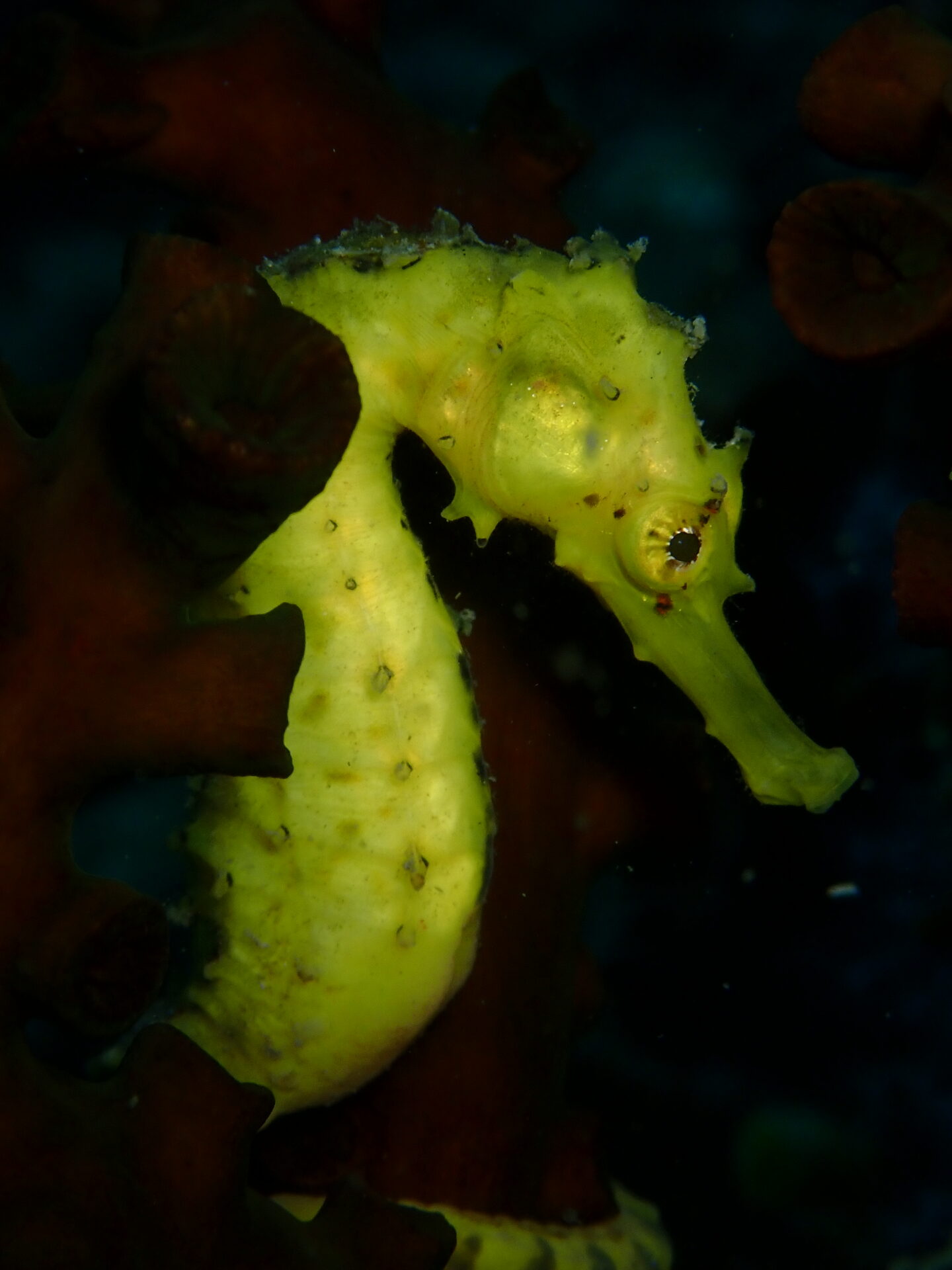
This camouflage serves more than one purpose. It helps protect them from predators, but it also helps them hunt. Seahorses feed using a rapid suction movement. Staying unnoticed allows tiny prey to drift close enough to be captured.
Their eyes can also move independently. That means one eye can watch one area while the other scans somewhere else. For an animal relying heavily on ambush feeding, that is extremely useful. It also gives them a slightly comical expression when you see one close up.
Their camouflage is also one of the reasons divers need to take care when observing them. Once you have spotted a seahorse, we recommend switching off your dive light rather than leaving it shining directly onto the animal. Larger predatory fish, including groupers, can follow the beam and quickly prey on these vulnerable seahorses. We have witnessed this happen many times! So giving the seahorse space and allowing it to blend back into its surroundings is an important part of responsible diving at Richelieu Rock.
Male Tiger Tail Seahorses Carry the Babies
One of the most famous seahorse facts is also one of the most extraordinary. The males become pregnant.
During reproduction, the female transfers eggs into the male’s brood pouch. He fertilises and carries the developing embryos until they are ready to be released. The male eventually gives birth to fully formed miniature seahorses.
This reproductive strategy is characteristic of seahorses and their relatives. However, knowing the biology and actually seeing a heavily pregnant male underwater are two very different things. It is another reason I enjoy spending time with the smaller marine life at Richelieu. There is so much happening within a few centimetres of reef. You just need to notice it.
How to Photograph a Seahorse Without Disturbing It
Seahorses are fantastic photography subjects because they often remain in one area. Unfortunately, that can also make them vulnerable to excessive attention.
I always think the animal’s behaviour matters more than getting the photograph. Good buoyancy is essential. Avoid touching the reef or moving surrounding growth to create a cleaner background. Never manipulate a seahorse into a better position. It is also worth being patient.
A seahorse facing away from you may eventually turn naturally. Giving it space usually creates a more interesting encounter anyway.
Seahorses are also very sensitive to artificial light including strobe lights, video lights and torches, so you should always keep flash photography to a minimum and avoid pointing torches or video lights directly onto the animal.
For photographers, Richelieu Rock offers endless opportunities beyond the obvious wide-angle scenes. Seahorses, ghost pipefish, nudibranchs and other smaller animals can make it just as rewarding with a macro lens.
When Is the Best Time to See Tiger Tail Seahorses at Richelieu Rock?
Richelieu Rock is normally dived during Thailand’s Andaman Sea season, when Mu Ko Surin National Park is open. The easiest way to experience Richelieu alongside the Similan and Surin Islands is by liveaboard. This allows us to reach more remote sites and dive several times each day. On board MV DiveRACE Class X, our Similan Islands liveaboard itineraries take divers through some of the best diving in Thailand. Richelieu Rock is one of the highlights.
There isn’t a specific dive where I would promise someone a seahorse. Wildlife never works like that. Sightings depend on where individuals are living and what our guides have been finding recently. However, experienced local guides make a huge difference. When you dive these sites repeatedly, you build a mental map of the reef. You remember where unusual animals have been found. You also learn which habitats are worth checking.
That local knowledge can turn a tiny patch of reef into twenty minutes of searching. And sometimes, into one very small seahorse.
A Small Seahorse Worth Looking For
Finding a tiger tail seahorse at Richelieu Rock is very different from spotting the site’s larger marine life. There is no dramatic moment when it appears from the blue. Instead, it is often a matter of slowing down, looking carefully and noticing the small details that are easy to miss.
That is what makes finding one so rewarding. Among the coral, movement and colour of the reef, a seahorse can be almost impossible to see until suddenly its curled tail or distinctive shape catches your eye. And once you know where to look, you begin to realise just how much can be hiding in plain sight.
For divers visiting Richelieu Rock, the tiger tail seahorse is a reminder that some of the most memorable encounters are not always the biggest ones. Sometimes, the best discovery is only a few centimetres long.
Join us aboard MV DiveRACE Class X to explore Richelieu Rock, the Similan Islands and the Surin Islands for yourself. Book your next Similan Islands liveaboard with DiveRACE here.
Related Articles
-

The Vanishing Wrecks of the South China Sea
Wrecks have a special pull on divers. They’re time capsules, artificial reefs,…
-
MV DiveRACE Class X
INTRODUCTION We are excited to present our latest liveaboard project – MV…
-
Thank You Class E.
Dear Friends, We want to express our heartfelt thanks to everyone for…