
I’ve lost count of how many times I’ve walked across the bright white beaches of the Similan Islands. They’re spectacular, and I knew that much of the sand originated from the reef. But it’s hard to imagine that connection when you’re looking at millions of tiny grains beneath your feet.
The funny thing is, I’d also seen plenty of parrotfish before. Usually one or two grazing quietly on the reef while I was looking for something else. I’d never really paid them much attention.
That changed on one dive in the Similan Islands…
An unexpected encounter
We’d just come around one of the huge granite boulders when suddenly there they were. Maybe almost 100 parrotfish were spread across the rock face, all feeding together. They moved slowly but with purpose, almost like a flock of birds. Every few seconds, the whole school drifted forwards before stopping to graze again.
Witnessing them together in such a big school was something special, but the thing I remember most wasn’t actually seeing them.
It was hearing them.
The crunching echoed through the water. At first, I couldn’t work out what it was. Then I realised it was dozens of parrotfish scraping the reef at the same time. It was surprisingly loud, and once you noticed it, you couldn’t ignore it. I must have spent five minutes just hovering there, watching them. They weren’t interested in us at all. They simply carried on doing what they do every day, cleaning the reef one bite at a time.
I’d always known parrotfish played an important role on the reef, but watching such a large group feeding together made me appreciate just how much work they do. It made me look at them differently.
They’re far more than another colourful reef fish. They’re gardeners, engineers and, remarkably, one of nature’s biggest sand producers.
The reef’s hardest workers
Parrotfish are some of the most recognisable fish you’ll encounter while diving in the Similan Islands National Park. Their bright colours, large scales and distinctive beak make them stand out on almost every reef, yet they’re often overlooked in favour of sharks, turtles and rays.
There are around 100 species of parrotfish worldwide, with approximately 30 species found throughout Thailand’s Andaman Sea, including the Similan Islands. The steephead parrotfish is one of the largest species regularly encountered here, although divers may also spot bicolour, yellowtail and bridled parrotfish grazing across the reefs.
One thing that surprises many divers is how different parrotfish can look throughout their lives. Juveniles often bear little resemblance to adults, and many species change colour as they mature. Some even begin life as females before changing into males, a natural process known as sequential hermaphroditism.
However, what makes parrotfish truly remarkable isn’t their appearance. It’s the job they carry out every day.
Nature’s underwater gardeners
Coral reefs are constantly competing with algae. A thin layer of algae is completely natural, but without animals to keep it under control, it can quickly spread across the reef. It covers dead coral, prevents young corals from settling and, in some cases, can even outcompete living coral colonies.
This is where parrotfish become so important.
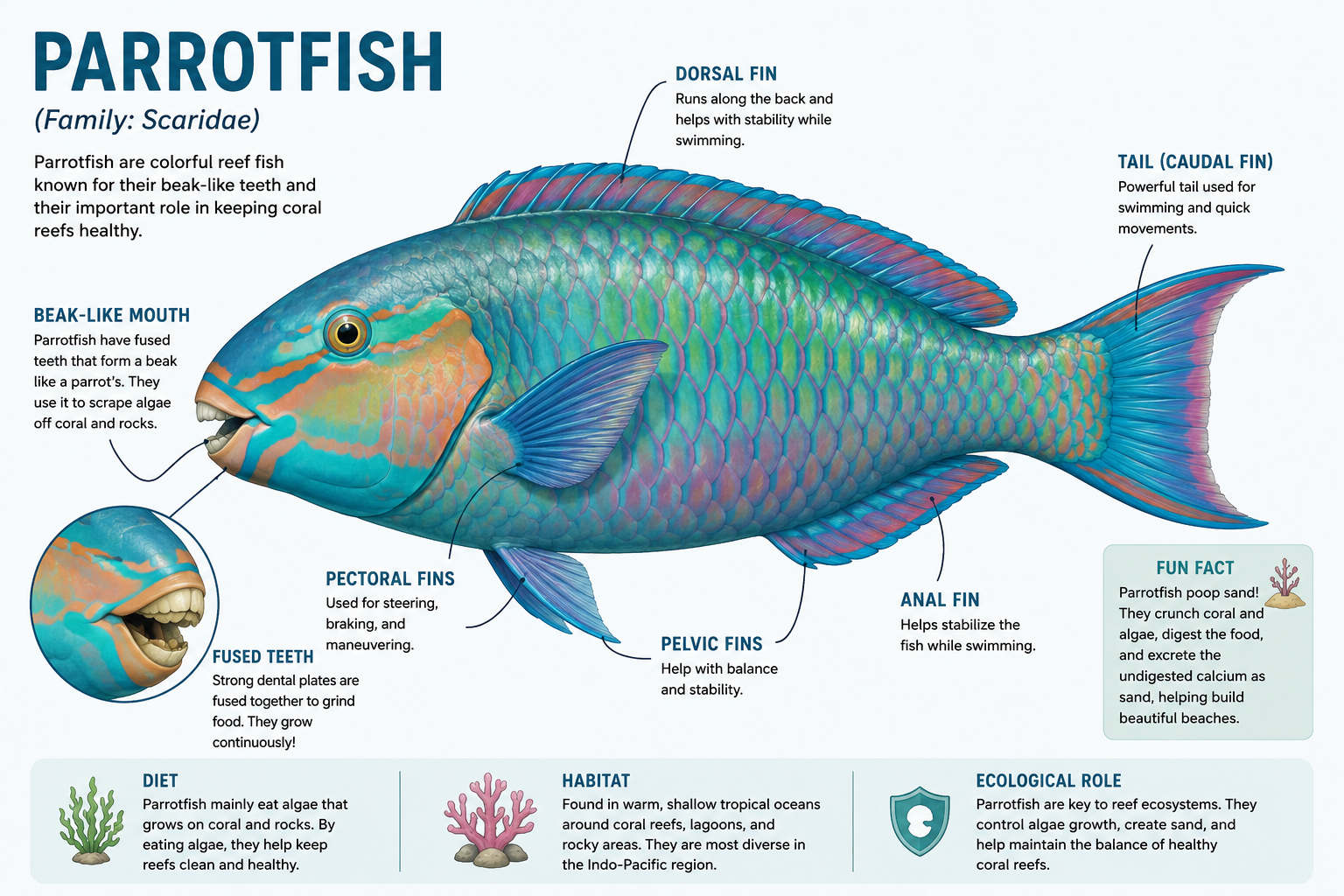
Using their powerful beak-like teeth, they spend much of the day scraping algae from rocks and dead coral skeletons. Every bite leaves behind a clean surface where coral larvae have a better chance of settling and growing. It might seem like a small job, but it’s one of the reasons healthy reefs remain healthy.
Since that dive, I’ve found myself paying much more attention to parrotfish. They’re almost always feeding. Once you notice it, you start to appreciate just how much of the day they spend maintaining the reef while most divers swim straight past them.
Their role has become even more important following recent coral bleaching events in Thailand’s Andaman Sea. As damaged reefs begin to recover, young corals need clean surfaces to establish themselves. Without enough grazing fish, algae can quickly take over those spaces instead.
But parrotfish don’t just help build healthy reefs. They also help build the beaches surrounding them.
The fish that create sand
By now, you’ve probably heard that parrotfish make sand. It’s one of those reef facts that’s repeated so often that it’s easy to overlook just how remarkable it really is.
Before looking at how they do it, it’s worth understanding what tropical beach sand actually is. Unlike many beaches around the world, where sand is made mostly from weathered rock or quartz, much of the soft white sand found around coral reefs is made from calcium carbonate. It comes from broken corals, shells, coralline algae and other marine organisms that have gradually been broken down over time by waves, currents and reef animals.
Parrotfish are one of the reef’s biggest contributors to that process.
While scraping algae from the reef, they also remove tiny fragments of limestone from dead coral skeletons. Hidden deeper inside their throat is another remarkable adaptation: a second set of teeth, known as pharyngeal teeth, which grind those fragments into an incredibly fine powder.
The algae provides the nutrients. The crushed limestone continues through the digestive system. What comes out is fine white sand.
Large species can produce hundreds of kilograms of sand every year, while the giant bumphead parrotfish can produce well over 700 kilograms annually. Smaller species contribute less individually, but together no other fish contributes more to the production of tropical white sand than parrotfish.
Scientists estimate that on some tropical islands, up to 70% of the white beach sand can originate from parrotfish. The exact amount varies depending on local geology, wave action and reef structure.
Which parrotfish can you see in the Similan Islands?
The steephead parrotfish is one of the largest and most recognisable species found in the Similan Islands, and the fish I encountered on that memorable dive. Divers also regularly spot bicolour, yellowtail and bridled parrotfish, along with many smaller species grazing across coral gardens and granite boulders.
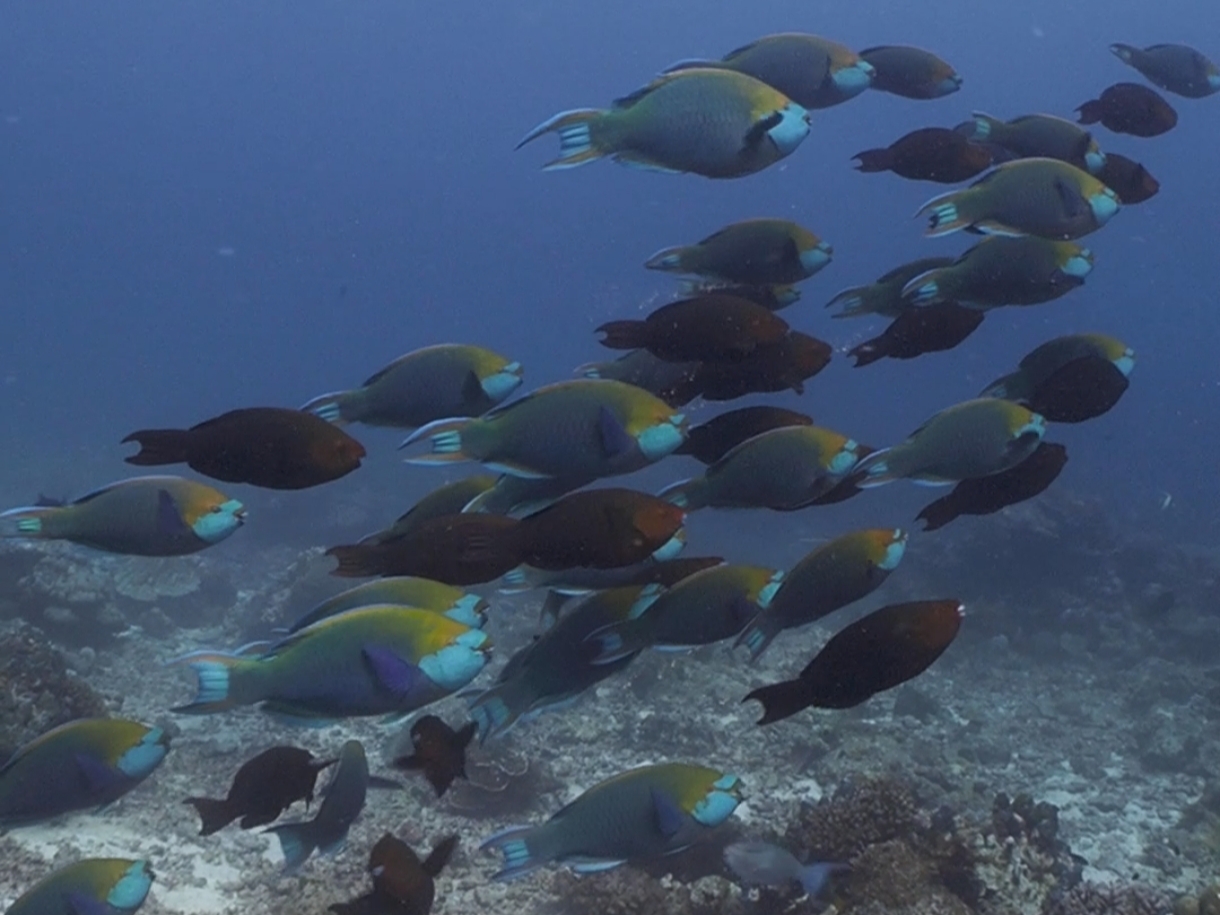
Large feeding groups like the one I encountered aren’t guaranteed, but they aren’t unusual either. When conditions are right, schools can slowly work their way across the reef together, creating an incredible sight and sound for anyone who takes the time to stop and watch.
If you do come across them, try resisting the temptation to swim straight through the middle of the school. Stay still for a few moments instead and watch nature unfold.
Small fish, huge impact
One of the things I love most about diving in the Similan Islands is that every dive teaches you something new. Sometimes it’s a rare animal you’ve never seen before. Other times it’s learning to appreciate a species you’ve swum past hundreds of times without giving it a second thought.
That school of parrotfish completely changed how I look at them. I still get excited when I see sharks, manta rays or turtles, and I probably always will. But now I find myself slowing down whenever I spot parrotfish, simply to watch what they’re doing.
They’re not just feeding. They’re creating space for new corals to grow, helping reefs recover after disturbance and, grain by grain, contributing to the white beaches that make tropical islands so iconic. It’s interesting to think that one of the reef’s most important engineers is also one of its most overlooked.
A secret they only reveal at night
Parrotfish have one final trick that many divers never get to see. Before going to sleep, several species produce a transparent mucus cocoon around their bodies.
Scientists believe this cocoon helps disguise the fish’s scent from predators such as moray eels while also reducing attacks from tiny parasites during the night. By morning, the cocoon has disappeared completely.
We often see this behaviour during night dive dives around the Similan Islands. As tempting as it is to get a closer look, it’s important not to disturb a sleeping parrotfish. If the cocoon is broken, the fish may not have enough time or energy to produce another one that night, potentially leaving it more exposed to predators and parasites for the rest of its sleep.
Looking at the reef differently
On every DiveRACE trip to the Similan Islands, it’s easy to focus on the bigger animals. We all hope for whale sharks, manta rays and turtles, and when they appear it’s an unforgettable experience. But some of the reef’s most fascinating stories are happening right beneath us every day.
The next time you spot a parrotfish, slow down for a moment. Listen for the crunching before you even see the fish. Watch how methodically it grazes across the reef, clearing algae, creating space for new corals and, grain by grain, producing the white sand that surrounds these incredible islands.
Join us in the Similan Islands on board MV DiveRACE Class X, and we’ll help you discover not only the animals everyone comes to see, but also the remarkable stories hidden in plain sight. Sometimes, the most memorable encounters are with the fish you almost swam straight past. Book your next trip here.
Related Articles
-

The Vanishing Wrecks of the South China Sea
Wrecks have a special pull on divers. They’re time capsules, artificial reefs,…
-
MV DiveRACE Class X
INTRODUCTION We are excited to present our latest liveaboard project – MV…
-
Thank You Class E.
Dear Friends, We want to express our heartfelt thanks to everyone for…