
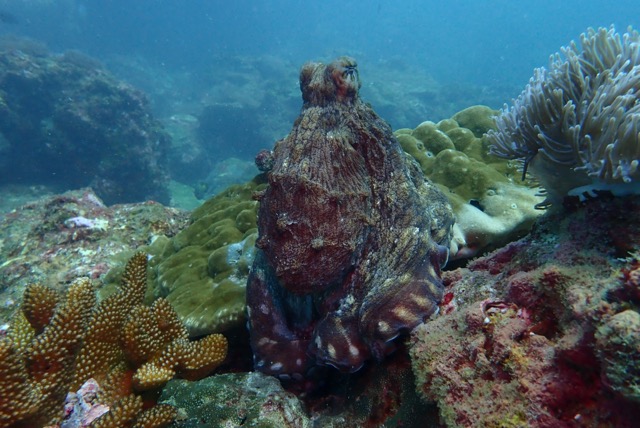
Octopus in Thailand are some of the most fascinating animals you can meet underwater. They’re smart, flexible, shy and bold at the same time – and once you start noticing them, you’ll realise how much is going on in the cracks and shadows of the reef.
This article breaks down, in simple language:
- What kinds of octopus you might find in Thailand
- How their bodies actually work (they’re very different from fish)
- Their behaviour and daily life
- Where they live and how to spot them
- Fun and surprising facts that make them even more impressive
Whether you’re a diver, snorkeller or just ocean-curious, this is your easy guide to getting to know Thailand’s octopus a little better.
Octopus in Thailand: Who’s Hiding in the Reef?
Thailand sits in the heart of the Indo-Pacific, one of the most biodiverse marine regions on Earth. That means a lot of octopus species can be found here, especially in the Andaman Sea (Phuket, Similan Islands, Koh Lipe, etc.).
You won’t always know the exact species, but commonly reported Indo-Pacific octopus that may be seen in Thai waters include:
- Reef octopus – the “classic” brown or mottled octopus that lives on coral and rocky reefs, often seen at dusk or at night.
- Day octopus (big blue octopus / Octopus cyanea) – often active in daylight on healthy reefs.
- Small sand and rock-dwelling species – hiding under rubble, in bottles, shells or crevices.
Most divers in Thailand don’t see octopus on every dive – they’re experts at camouflage – but once your eyes adjust, you’ll start spotting them more often: a watching eye under a ledge, a pile of shells in front of a hole, or a sudden blur of colour as one jets away.
Octopus Physiology: How Their Bodies Work
Octopus look simple at first glance: a soft body, a head, and eight arms. But their physiology is one of the most advanced in the invertebrate world.
Three Hearts and Blue Blood
Inside that soft body, an octopus has three hearts. One pumps blood around the body; the other two pump it to the gills. Their blood is blue, not red, because it uses a copper-based molecule (haemocyanin) to carry oxygen instead of iron-based haemoglobin like ours. This works well in cooler, low-oxygen seawater.
A Brain in the Head – and “Brains” in the Arms
Octopus are famous for their intelligence. They have a large central brain inside the head, but that’s only part of the story. Each of their eight arms contains a dense network of neurons capable of controlling movement and even doing basic processing on its own.
That’s why an octopus arm can explore, feel, and react with surprising independence, even while the rest of the body seems to be doing something else. Some scientists like to say an octopus is “a mind with eight hands”.
Suckers: Hands, Noses and Tongues Combined
The underside of each arm is lined with suckers. These aren’t just simple suction cups. Each sucker can:
- Grip and release with fine control
- Taste chemicals in the water
- Feel texture in detail
When an octopus investigates something – a shell, a crab, a diver’s camera – it is essentially touching and tasting at the same time.
Colour and Texture Change
One of the most impressive features you’ll see while diving in Thailand is the octopus’s ability to change colour and skin texture within seconds.
They do this using:
- Chromatophores – tiny pigment sacs that expand and contract to change colour
- Iridophores and leucophores – special cells that reflect and scatter light, adding iridescence or brightness
- Muscles in the skin – that can create bumps, ridges or smooth surfaces
With these tools, an octopus can go from smooth and pale to dark and rock-textured in the blink of an eye, perfectly blending into coral, sand or rubble.
Octopus Behaviour: How They Live and Hunt
In Thailand, most octopus you see are solitary hunters, not social animals. They spend a lot of time hiding and watching, only moving when they need to feed, mate or relocate.
Night Hunters
Many octopus in Thai waters are most active at dusk and night. On a night dive, you may see them out in the open, sliding over the reef, squeezing into holes or pouncing on crabs and small fish. Daytime encounters are usually quick glimpses as they retreat into a den.
Dens, Doors and Shell Gardens
An octopus almost always has a home base, often a hole in the reef, under a rock or within rubble. Look for:
- An opening just big enough for a soft body to squeeze through
- A pile of shells, crab legs, and bits of food remains outside – like a rubbish heap
- Sometimes, stones or shells arranged like “doors” they can pull closed
These dens are crucial for their safety. Without a hard shell, the octopus relies on hiding and escape, not armour.
Masters of Escape and Problem-Solving
Octopus are well-known escape artists. In lab tests (and aquariums), they:
- Unscrew jar lids
- Navigate simple mazes
- Learn to open latches
- Remember solutions to problems
In the wild around Thailand, divers often notice octopus testing and investigating objects – poking at discarded bottles, rearranging shells, or carefully inspecting a diver’s torch if given the chance.
Habitat: Where to Find Octopus in Thailand
If you want to spot octopus while diving or snorkelling in Thailand, it helps to know where they like to live.
On coral reefs, look in:
- Shaded crevices and ledges on the reef slope
- Areas with rocky structure or bommies (large coral heads)
- Places with small overhangs, holes or rubble piles
On sandy or mixed bottoms, especially in muck or macro sites, look for:
- Lone rocks, bottles or tyres – anything that creates shelter
- Little “chimney” openings surrounded by shells or stones
- Slight movements or colour changes where sand meets rock
If you are lucky, Reef Octopuses can be usually found in the rubble areas in dive sites such as West of Eden and Koh Bon’s north ridge. Keep an eye out for holes that they hide in and their changing colours!
Night dives greatly increase your chances of seeing octopus out in the open. In many Thailand dive sites, octopus are there all along – they’re just too good at staying invisible during the day.
Interesting Octopus Facts (That Make Them Even Cooler)
Here are some easy-to-remember bits of octopus trivia you can share on the boat between dives:
- Short lives, intense lives
Many reef octopus live only one to two years. They grow fast, reproduce once, and die soon after mating or laying eggs. It’s a brief but busy life. - Devoted mothers
A female octopus will guard her eggs tirelessly, blowing water over them to keep them oxygenated and clean. She usually doesn’t feed during this period and dies after the eggs hatch. If you ever see an octopus in a den with strings of eggs, give her plenty of space and no bright lights. - They can’t see colour like we do – but they fake it
Octopus colour vision is still a complex topic in science, but they seem to have limited colour perception and rely heavily on brightness and contrast. Yet they can match colourful backgrounds remarkably well. How they do this so precisely is still being studied. - Soft body = incredible flexibility
With no bones, an octopus can squeeze through gaps much smaller than its head. This makes them excellent escape artists and allows them to reach into tiny spaces to find prey. - Venom and beaks
Octopus have a hard beak like a parrot hidden at the centre where their arms meet. Many species have venom to subdue prey, though most are harmless to humans and prefer to run (jet away) instead of fight.
Meeting Octopus in Thailand: How to Be a Good Guest
If you’re lucky enough to see an octopus while diving in Thailand, there are a few simple ways to make the encounter better for both you and the animal:
- Stay calm and move slowly. Sudden movements or chasing will send it deeper into its den.
- Keep your distance and avoid blocking its escape routes.
- Use gentle, indirect light. Don’t blast a hiding octopus with a bright torch or camera strobe repeatedly.
- Never poke, prod or try to grab it. Remember, this is its home, not a petting zoo.
The best interactions are the ones where the octopus decides you’re not a threat and keeps going about its business while you quietly watch from a respectful distance.
Why Octopus Matter to Thai Reefs
Octopus are more than just fun sightings on a log sheet. They’re an important part of the coral reef ecosystem in Thailand.
As predators, they help control populations of crabs, shellfish and small fish. Their dens create micro-habitats and leftover food becomes meals for scavengers. And their presence is a good sign that the reef still has enough structure, hiding spaces and food to support higher-level predators.
For divers, learning about octopus physiology and behaviour has another benefit: it sharpens your awareness. Once you start looking for dens, shell piles and subtle movements, you become a more observant, more respectful diver – and that mindset helps the reef as a whole.
The next time you join a dive trip in Thailand – whether in the Similan Islands, around Phuket, or beyond – take a little extra time to scan the cracks and shadows. That “rock” might blink, shift colour and slowly reveal eight arms and a curious eye watching you back.
The octopus of Thailand are all around us. We just have to slow down enough to see them.
Related Articles
-
The Vanishing Wrecks of the South China Sea
Wrecks have a special pull on divers. They’re time capsules, artificial reefs,…
-

MV DiveRACE Class X
INTRODUCTION We are excited to present our latest liveaboard project – MV…
-

Thank You Class E.
Dear Friends, We want to express our heartfelt thanks to everyone for…