
When I first started diving, a coral reef looked like one huge explosion of colour and texture. There was so much happening that it was difficult to know where to look.
After spending much more time underwater, I started noticing the smaller details.
Some corals are bright and colourful. Others look pale, patchy or completely white. I might see sections covered in algae beside colonies that appear perfectly healthy. Sometimes, two corals sitting only metres apart can look completely different.
But what am I actually looking at?
Learning how to tell the difference between healthy, stressed and dead coral changed the way I see a reef. It also helps me understand what is happening beneath the surface.
This is something we pay close attention to through the DiveRACE coral restoration project in Phuket, Thailand. When we monitor our restoration site, appearance can tell us a lot. However, colour alone does not always give us the full answer.
What Does Healthy Coral Look Like?
Healthy coral does not have one particular colour. Depending on the species, it can be brown, green, yellow, blue, purple or somewhere in between. Some healthy corals are naturally quite pale. Others can be incredibly vibrant.
At the DiveRACE coral restoration site, one of the first things we look for is the condition of the living tissue.
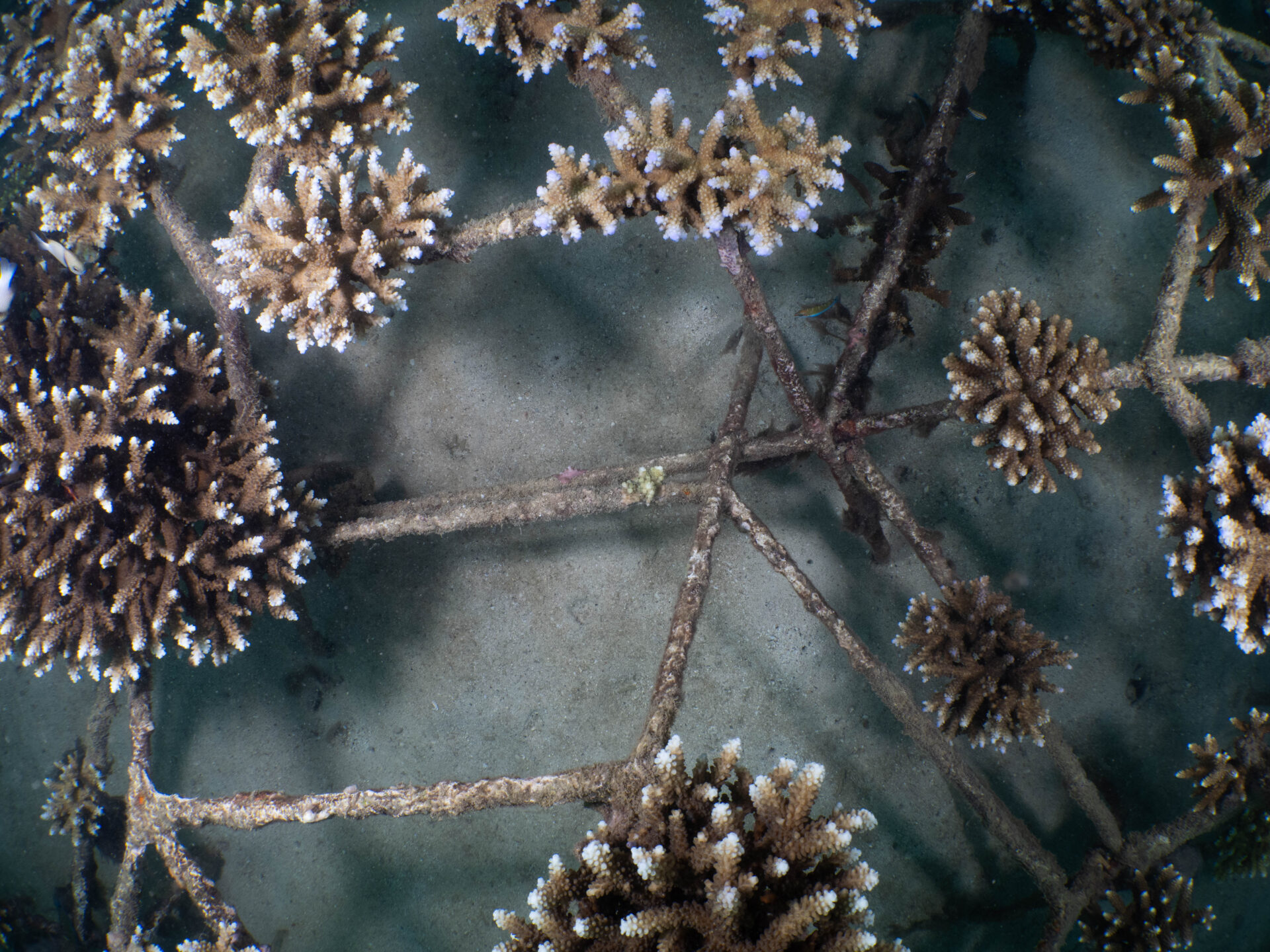
Healthy hard coral usually has continuous tissue covering its skeleton. The surface should look intact rather than bare or heavily overgrown. On some species, we may also be able to see individual coral polyps.
If you spend enough time watching, the reef becomes much more obviously alive. Those tiny polyps are coral animals. They may extend their tentacles to capture food from the water. Many species extend them more noticeably at night, although this varies between corals.
Most reef-building corals also contain microscopic algae called zooxanthellae within their tissues. Through photosynthesis, these algae provide much of the energy the coral needs. They also contribute to the colours we associate with a healthy reef.
So, when we are looking at coral condition, we are not searching for the brightest colony. We are looking at the whole picture: Is the tissue intact? Does the coral appear to be growing? Are the polyps visible? Is algae taking over the surface?
Those clues are usually far more useful than colour alone.
What Does Stressed Coral Look Like?
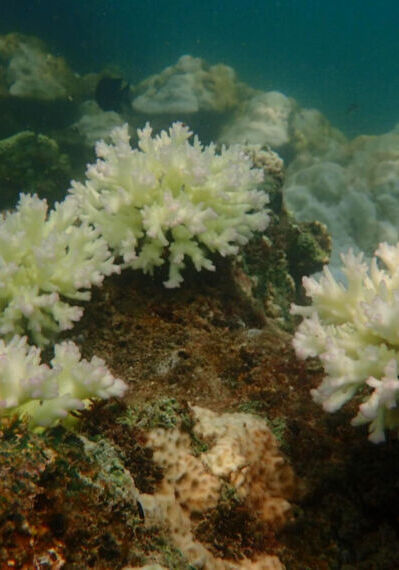
This is where identifying coral health becomes more complicated. A stressed coral is still alive. It may become unusually pale, develop patches of discolouration or begin losing tissue. In more severe cases, it can turn completely white.
One of the most recognisable signs of coral stress is coral bleaching. Bleaching happens when environmental stress disrupts the relationship between coral and its zooxanthellae. The coral loses these algae, or their pigments, and the white skeleton becomes visible through the transparent tissue.
Rising sea temperatures are one of the biggest causes of widespread bleaching. However, corals can experience stress from several environmental pressures. Poor water quality, sedimentation, disease and intense sunlight can all affect coral health. Physical damage can create additional problems.
This is why reef monitoring matters. A single observation gives us a snapshot. Repeated observations help us understand whether a coral is recovering, remaining stressed or deteriorating.
What About White Tips on Growing Coral?
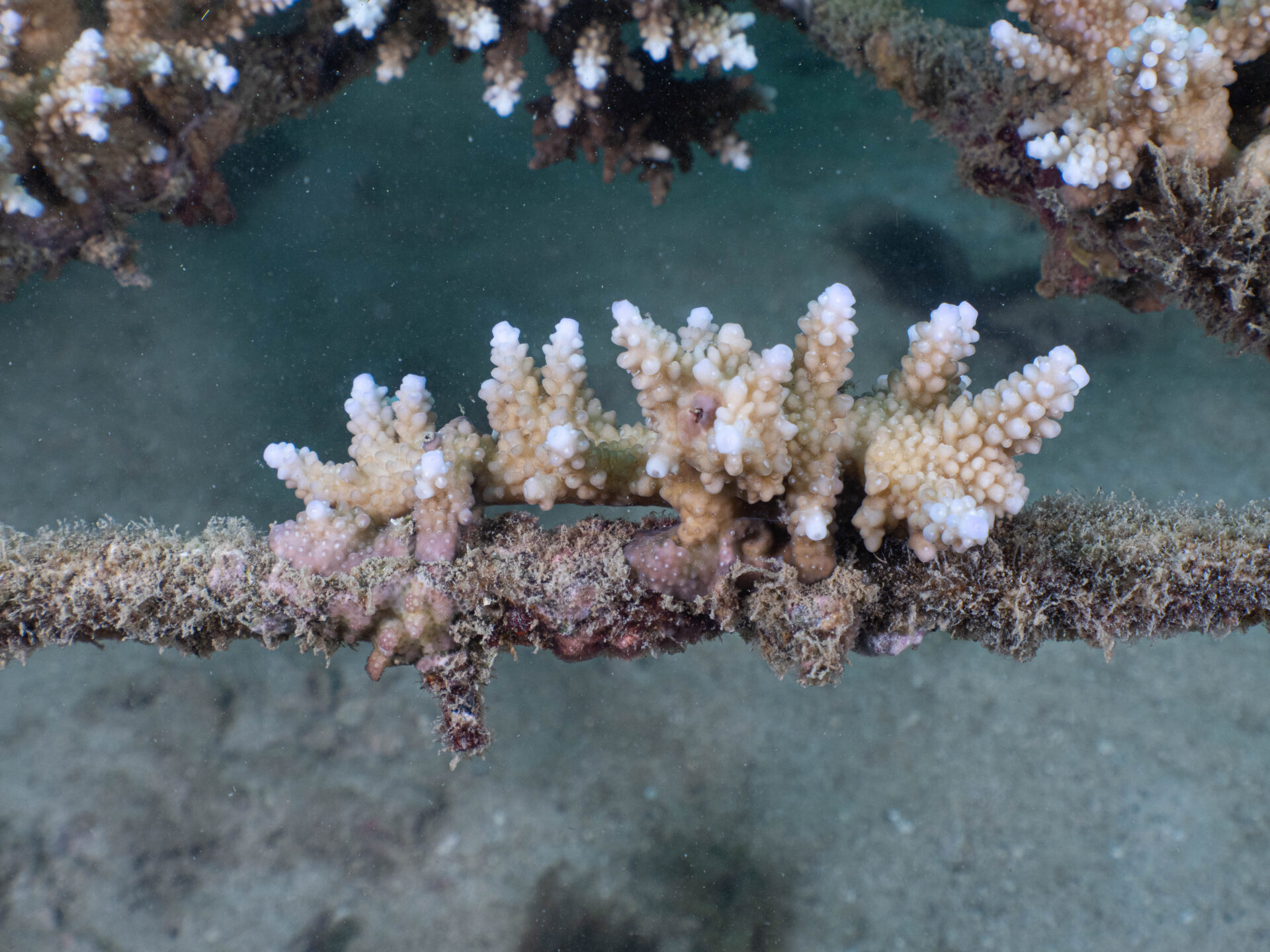
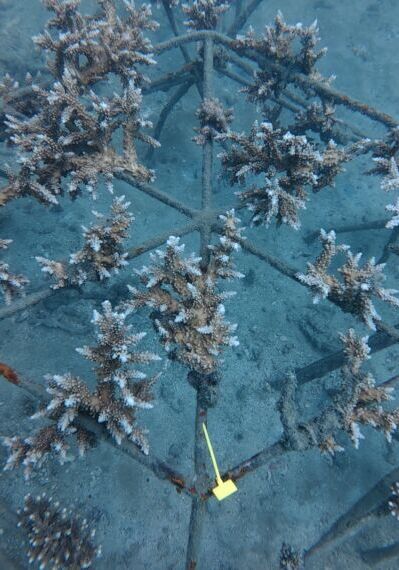
There is another reason you might see white on a coral, and we see this regularly at our restoration site. White or light blue-ish tips are actually a common sign of coral growth. As some branching corals grow, new skeleton forms at the tips faster than it becomes fully populated by zooxanthellae. This can leave the newest growth looking noticeably pale or white.
At the DiveRACE coral restoration site, this is extremely common. We often see healthy fragments with colourful tissue below and bright white tips where new growth is developing. Over time, zooxanthellae become established within the new tissue and the tips gain more colour.
This is very different from coral bleaching.
Growth tips are usually localised to the ends or edges of a healthy colony. Bleaching tends to affect larger areas of tissue and may appear across entire branches or colonies. Context is important too. If a coral has healthy tissue, visible growth and consistent white tips, we may actually be looking at something positive.
It is one good example of why white coral does not necessarily mean dead or even stressed coral. At our restoration site, those little white tips are exactly what we want to see.
If Coral Is White, Is It Dead?
No, and this is probably one of the most important distinctions to understand. White coral is not automatically dead coral.
A freshly bleached coral can look almost brilliantly white. It may appear lifeless, but living coral tissue can still cover the skeleton.
Bleaching is a stress response, not an immediate death sentence. If conditions improve quickly enough, surviving coral can regain its zooxanthellae and recover. The colour may gradually return over the following weeks or months.
That is one reason we do not simply remove coral because it has bleached. During periods of heat stress at our Phuket restoration site, we have seen bleaching affect some of our coral fragments. Where tissue remains alive, those fragments still have a chance. Sometimes the best action is simply to monitor them.
So, What Does Dead Coral Look Like?
Dead coral has lost its living tissue and exposed the calcium carbonate skeleton underneath.
Immediately after death, that skeleton can still look bright white. This is why freshly dead coral and severely bleached coral can be difficult to distinguish at first glance.
The difference often becomes clearer with time. Once the coral tissue is gone, algae and other organisms can begin colonising the exposed skeleton. The surface may become green, brown, grey or darker in appearance.
Eventually, it starts looking less like living coral and more like part of the reef structure. This is also why an old coral skeleton covered in algae is very different from a bleached coral colony. One is no longer alive. The other may still recover.
Healthy vs Bleached vs Dead Coral: The Quick Difference
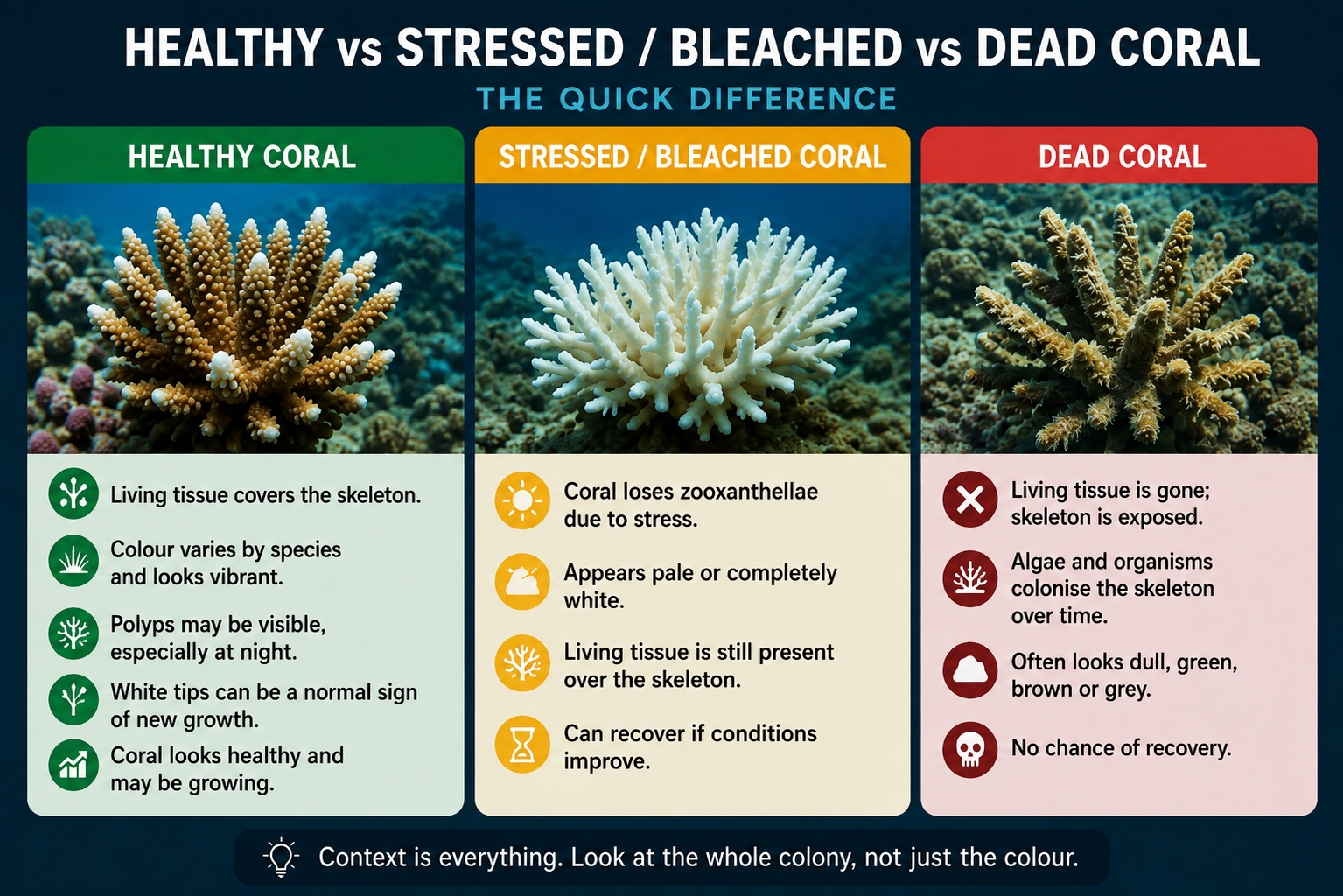
If you are trying to identify coral condition while diving, think beyond colour.
Healthy coral has living tissue covering its skeleton and may show visible polyps. Its colour varies considerably between species. Growing coral can have pale or white tips, particularly on branching species. This can simply be new growth rather than a sign of stress.
Stressed or bleached coral is still alive but may appear unusually pale or completely white. Living tissue remains present.
Recently dead coral may also appear white, but the living tissue has disappeared. Over time, algae and other organisms usually colonise the exposed skeleton. That distinction matters.
Seeing white coral and immediately calling it dead can give a completely inaccurate picture of reef health.
Can Bleached Coral Recover?
Yes, bleached coral can recover. The outcome depends on how severe the stress is and how long it continues. A coral that experiences a short period of thermal stress may survive and regain its colour.
Prolonged or extreme bleaching is much more dangerous. Bleached corals have lost an important source of energy. This leaves them more vulnerable to disease, tissue loss and other pressures. If stressful conditions continue for too long, the coral may eventually die.
Recovery is therefore not guaranteed. But bleaching does not mean the battle is already lost.
For me, this is one of the most interesting parts of monitoring coral restoration. You are not simply counting living and dead colonies. You are watching a constantly changing ecosystem respond to its environment.
What We Look for at the DiveRACE Coral Restoration Site
At the DiveRACE coral restoration project in Phuket, monitoring is an important part of the work. We use our purpose-built ‘Super Stars’ to secure coral fragments to the barren rubble below and give them a stable structure for recovery and growth. But placing coral is only the beginning.
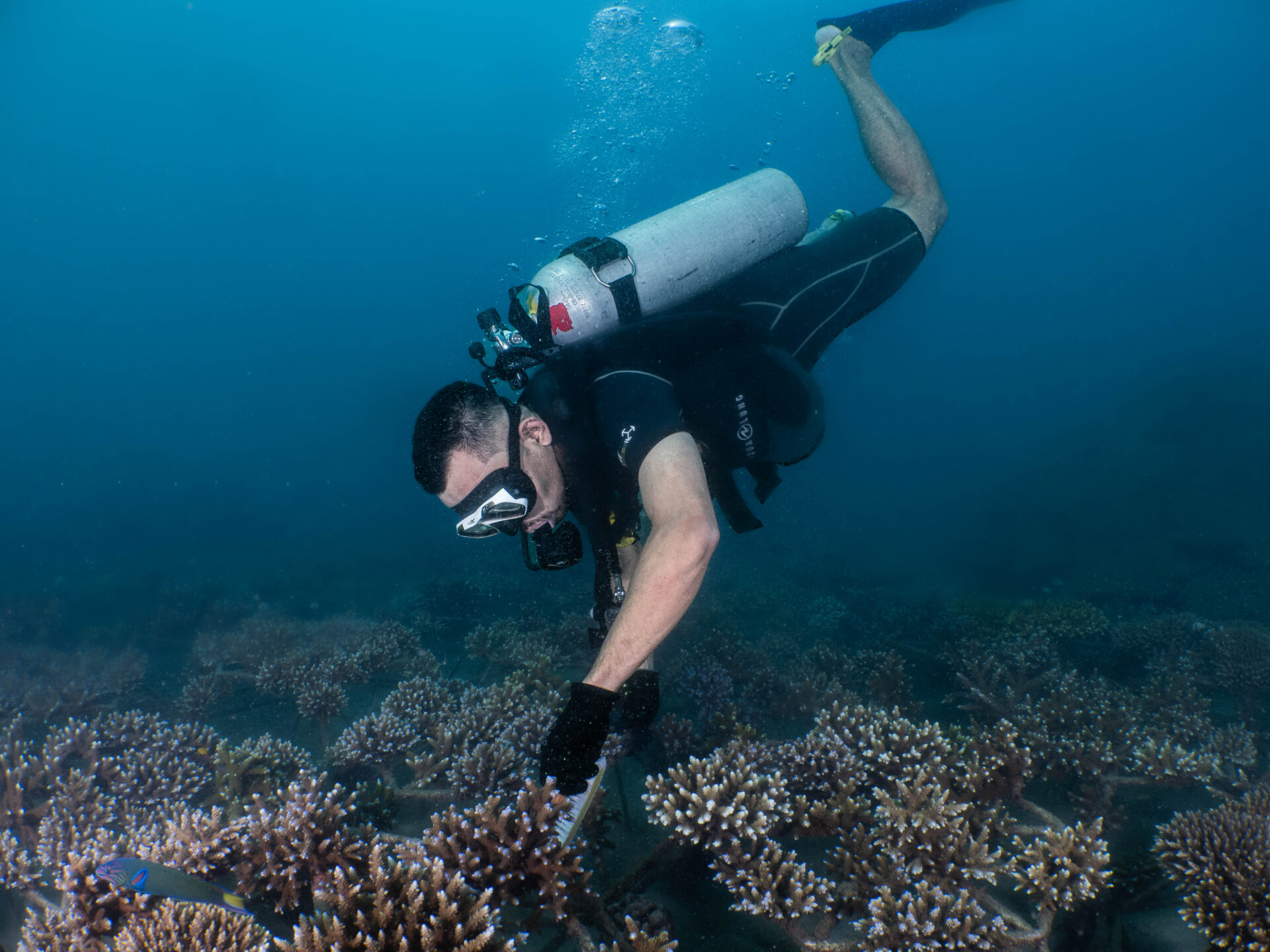
We need to return and see what happens next. We look at whether fragments remain attached and whether living tissue is healthy. as well as monitoring new growth, bleaching, mortality and algae growth. In addition, We also remove dead fragments when necessary while leaving bleached corals that still have the potential to recover.
This becomes particularly important during periods of warmer water. We have already seen how differently individual corals can respond to the same conditions. One fragment may remain healthy while another nearby begins bleaching. Another might be actively growing, with those characteristic white tips appearing along its branches.
That is a useful reminder that reef restoration is not simply about planting coral. It is about understanding what survives, what struggles and why.
Get first-hand experience in coral restoration by joining our low-season workshops on board MV DiveRACE Class X. A unique liveaboard itinerary blending ocean conservation, education, and exploration. Learn more here.
Why Learning to Recognise Coral Health Matters for Divers
You do not need to be a marine biologist to start noticing changes on a reef. In fact, divers are in a unique position. We spend time underwater in places most people never see firsthand. If you regularly dive the same reef, you may begin noticing changes between seasons or even individual trips.
Once you know what you are looking for, the reef becomes much more interesting. You notice fresh growth, recognise bleaching, see where algae has colonised old coral skeletons and you might even notice a colony recovering after previously appearing pale.
It also gives more context to what coral reefs are facing. A reef is not simply healthy or dead. There is an enormous amount happening between those two extremes.
The next time you dive, look a little closer. That white coral might not be dead at all. It could be stressed and trying to recover. Or, sometimes, those white tips could mean it is doing exactly the opposite. It could be growing.
Interested in learning more? Support the DiveRACE coral restoration project and find out how you can get involved here.
Related Articles
-

Climate Change & Corals: How Extreme Weather and Warming Seas Shape Our Reefs
In recent years, Southeast Asia has experienced increasingly unpredictable and severe weather…
-
Corals in Thailand: How You Can Help with DiveRACE
When people talk about scuba diving in Thailand, they almost always mention…
-
Acropora Corals in Thailand: The Science Behind Our Restoration Work
Why We Use Acropora Corals in Our Thailand Restoration Project If you’ve…