
Ghost pipefish are one of my favourite marine animals to find underwater. There is something especially satisfying about spotting one yourself. You can swim straight past them without noticing anything unusual. Then, once your eyes finally recognise the shape, you wonder how you ever missed it.
I think that is what makes finding ghost pipefish in the Similan Islands so rewarding. They are strange, delicate and incredibly well camouflaged. You really have to slow down and know what you are looking for.
Over the years, I have found them at several dive sites around the Similan Islands and northern Andaman Sea. West of Eden, Christmas Point, Koh Bon and Richelieu Rock are all places where I know it is worth keeping an eye out. Once I know one has settled somewhere, I also remember that exact spot for the next trip.
What Is a Ghost Pipefish?
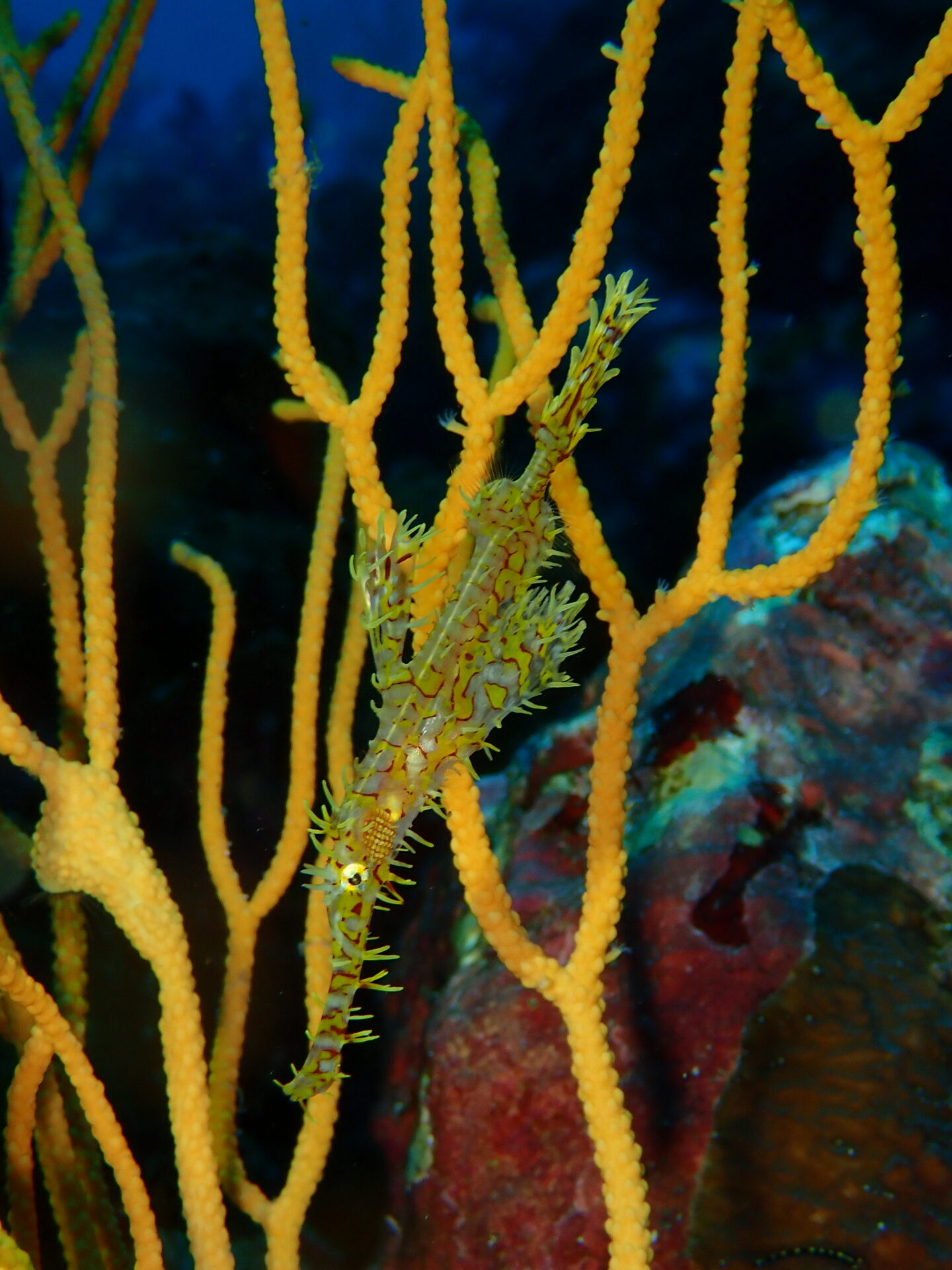
Ghost pipefish belong to the family Solenostomidae and are relatives of seahorses and pipefish. There are several species, but the ornate ghost pipefish (Solenostomus paradoxus) is probably the one most divers recognise.
They have an unusual body shape, with long snouts, elaborate fins and thin bodies. Some look almost impossibly delicate. Their appearance can also vary dramatically depending on their surroundings.
That variation is one reason ghost pipefish are so good at disappearing into the reef.
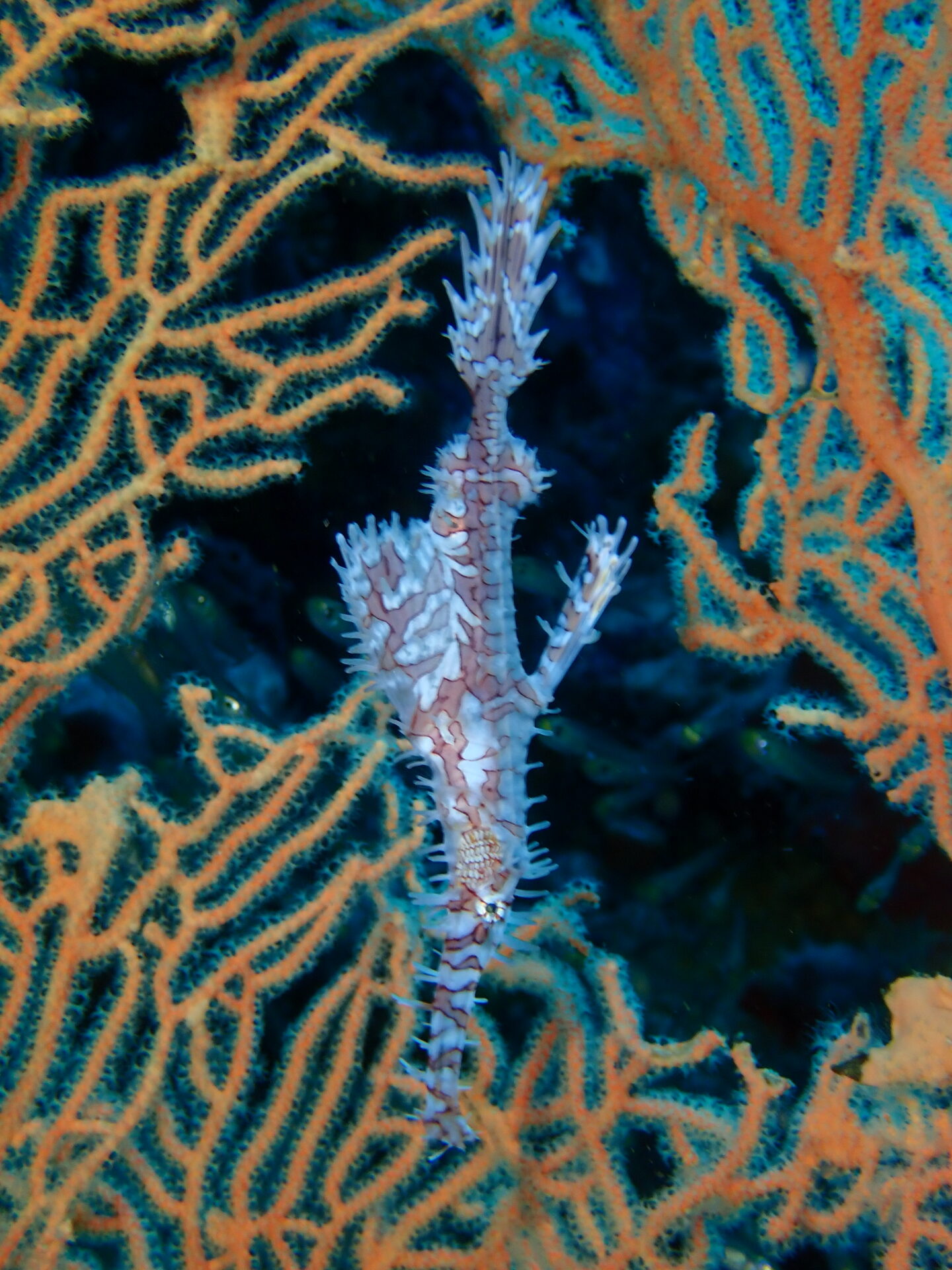
Ornate ghost pipefish are often found around crinoids, soft corals, hydroids and other complex reef structures. Their colours can include red, yellow, orange, black, white and translucent shades. Rather than standing out against the reef, their markings help break up their outline.
They feed on tiny crustaceans and other small planktonic prey, using their long, tube-shaped mouths to suck them in. It is another similarity they share with their seahorse and pipefish relatives.
When Is Ghost Pipefish Season in the Similan Islands?
Ghost pipefish are generally considered seasonal visitors rather than permanent reef residents. They spend the early part of their lives in the open water before settling onto the reef as adults. This means sightings can vary considerably between months and even between individual dive sites.
In the Similan Islands, our diving season runs from October until May, and ghost pipefish can be encountered during this period. There is never a guarantee that a particular individual will be there. However, once I find one that has settled onto the reef, it is always worth checking the same place again.
They often remain around a very small area once settled, provided they are not disturbed and currents are mild. That makes repeat visits particularly interesting. I can return to the same section of reef on another MV DiveRACE Class X trip and search for an individual we found previously.
Sometimes it is still exactly where we left it!
Why Are Ghost Pipefish So Difficult to Spot?
Finding ghost pipefish is mostly about knowing what not to look for.
If you are searching for the obvious outline of a fish, you will probably miss them. Instead, I tend to look for something that does not quite match the surrounding pattern. Sometimes it is a fin moving differently from the crinoid arms around it. Other times, it is the straight line of a snout hidden among much more irregular shapes.

Once you find your first few, it becomes easier. Your brain seems to learn the pattern.
I spend a lot of time looking carefully around crinoids when I dive the Similan Islands. Rather than swimming directly over one, I slow down and look around its edges and underneath. I also look closely at anything that seems slightly different from the surrounding structure.
It is worth checking the entire area carefully once you find one. Ghost pipefish are often seen in pairs, so the first animal you spot might not be alone.
This slower style of diving reveals things that are incredibly easy to miss. Sometimes the difference between seeing a ghost pipefish and swimming straight past is only a few seconds of extra attention.
Do Ghost Pipefish Change Colour?
Yes, and this is one of the most fascinating things I have personally watched happen over the course of a few weeks!
Ghost pipefish can change their colouration over time to better match their surroundings. This is not an instant transformation like the rapid colour changes we associate with an octopus. Their appearance changes more gradually as they settle into a particular habitat.
I have actually watched this happen across several of our trips. We found one ghost pipefish that was a very dark, almost black shade when I first saw it. Because they often remain in the same area once settled, I knew exactly where to look when we returned.
A few trips later, the same ghost pipefish was still there, but it had changed dramatically. It was now white.
Being able to return repeatedly made the change especially interesting to see. Instead of simply knowing ghost pipefish can alter their colour, I could watch that adaptation happen to an individual over time.
Their markings, body shape and behaviour all add to the effect. They can resemble crinoids, soft corals and other reef life so closely that their outline almost disappears. It is one of the best examples of camouflage you can find while diving in the Similan Islands.
Where Can You Find Ghost Pipefish in the Similan Islands?
I have a few places where I automatically switch into “ghost pipefish mode.”
West of Eden
West of Eden is probably one of my favourite places to search for them. The site has exactly the kind of structure that makes looking for smaller marine life interesting. There are granite formations, coral growth and plenty of smaller places to investigate between the bigger scenery.
I pay particular attention to crinoids and areas with plenty of cover. If I see a crinoid sitting in a good position, I usually give it a proper look rather than swimming past.
Sometimes there is nothing there. Sometimes a tiny shape suddenly separates itself from the background, and there is your ghost pipefish.
Once we find one, I also try to remember the surrounding reef structure. Because settled ghost pipefish can remain in the same small area, that spot immediately goes onto my mental checklist for future dives.
Christmas Point
Christmas Point is another Similan dive site where it is worth slowing down and looking carefully.
The dramatic boulders and swim-throughs usually grab your attention first. However, there is plenty of smaller marine life tucked into the reef as well.
When conditions allow, I like taking my time around areas with crinoids and dense reef growth. Ghost pipefish rely heavily on camouflage, so the busier parts of the reef often deserve a second look.
This is also why having good buoyancy makes such a difference. You need to be able to stop and observe without touching the reef or disturbing the animal.
Koh Bon
Moving north from the main Similan Islands, Koh Bon is another place where I keep an eye out for ghost pipefish.
There are sections of reef here where crinoids and other complex growth create ideal places for them to disappear. I tend to search slowly rather than scanning a large area. Once you understand how little these animals can move when settled, looking carefully at individual sections becomes much more effective.
If we have found one on a previous trip, I will always check that spot again.
That is one of my favourite things about diving the same sites throughout a season. You begin to recognise not only the dive site, but individual little areas where certain animals have settled.
Finding Ghost Pipefish at Richelieu Rock
If I had to choose somewhere to search for unusual marine life, Richelieu Rock would always be high on the list.
There is so much life packed into a relatively small area. Soft corals cover the rock, crinoids are everywhere, and almost every section deserves a closer look. It is exactly the type of environment where a ghost pipefish can completely disappear into its surroundings.
I spend time checking crinoids and sheltered sections of the rock, particularly where there is enough structure for a tiny fish to blend in.
Richelieu is one of those places where slowing down really pays off. You could swim past the same section of rock several times without noticing what is hiding there. Then somebody points out a ghost pipefish, and suddenly it seems obvious.
Until you look away and have to find it all over again.
Another Unusual Ghost Pipefish Trait
There is another reason ghost pipefish are particularly interesting: the female carries the eggs. This is the opposite of their seahorse relatives, where the male famously carries developing young.
Female ghost pipefish use their modified pelvic fins to form a brood pouch. The eggs are held there during development. Females are generally larger than males, and a pair can sometimes be seen hovering close together around the same piece of reef.
It is a small detail most divers would never notice during an ordinary encounter. Yet it makes an already strange little fish even more unusual.
How to Spot a Ghost Pipefish While Diving
The biggest thing I have learned is simply to slow down.
You can cover an enormous amount of reef on a dive and still miss what is sitting directly in front of you. Ghost pipefish reward the opposite approach.
Look closely at crinoids rather than glancing at them. Check around soft corals and complex reef growth. Pay attention to shapes that seem slightly too straight or movements that do not match everything around them.
If your guide points one out, look at the surrounding habitat before focusing entirely on the animal. Learning where it was hiding makes finding the next one much easier.
Photography can be useful too. Looking through a macro lens forces you to pay attention to details you might normally ignore. Just remember that these are small animals living among delicate reef structures, and are sensitive to artificial light. Be aware of your torch lights, video lights and strobes, and no not shine lights directly at the animal, especially when predators are around.
Good buoyancy and careful fin positioning are far more important than getting the shot. Ghost pipefish may remain in one place for some time, so we want to leave them exactly as we found them.
Why I Still Love Finding Them
Even after finding quite a few ghost pipefish over the years, I still get excited every time I spot one.
Part of that is the challenge. They do not make it easy for you. You have to slow down, really look at the reef and notice details that would otherwise disappear into the background.
Returning to the same dive sites throughout the Similan season makes it even more interesting. Sometimes we can revisit an individual across several trips, see whether it has moved, or even notice changes in its appearance.
For me, that makes them much more than something to tick off a marine-life list. Finding one feels like discovering a tiny resident that most people would swim straight past.
Find Them with Us on MV DiveRACE Class X
During the Similan Islands diving season, we explore these sites aboard MV DiveRACE Class X, with multi-day liveaboard itineraries through the Similan Islands and northern Andaman Sea.
West of Eden, Christmas Point, Koh Bon and Richelieu Rock all give us opportunities to search for ghost pipefish. Of course, wildlife sightings are never guaranteed. That is part of what makes finding them so rewarding.
And if we find one early in the season, you can be fairly certain I will be checking that same little section of reef every time we return. Because sometimes the best way to find a ghost is to know exactly where it likes to hide.
Book your next Similan Islands liveaboard with MV DiveRACE Class X here.
Related Articles
-

The Vanishing Wrecks of the South China Sea
Wrecks have a special pull on divers. They’re time capsules, artificial reefs,…
-
MV DiveRACE Class X
INTRODUCTION We are excited to present our latest liveaboard project – MV…
-
Thank You Class E.
Dear Friends, We want to express our heartfelt thanks to everyone for…