
The trip continues as we ride the gentle waves towards Koh Tachai, an island further north within the Similan Islands National Park. This island marks the final northern point of the national park, where the landscape transitions back to the familiar granite boulders seen further south.
As we approach the island, our vessel slows to a steady halt beside a lonely buoy floating in the open ocean. This single buoy marks the location of our next dive site — Koh Tachai Pinnacle. It’s one of our most exhilarating dives, and today, we’re going to find out why!
Preparing for the Drop
Koh Tachai Pinnacle lies roughly 500 metres south of Koh Tachai Island, rising from the deep seabed to a shallow top beginning at 12 metres below the surface. Because it sits in the open ocean, unprotected by nearby islands, it is exposed to strong currents that can make it one of the more challenging dives in our itinerary.
The buoy line connects to the top of the pinnacle, acting as both a reference and a descent line. On strong current days, it’s vital for divers to descend holding the rope in order to conserve air and energy. Even when conditions appear calm, we always drop close to the buoy and hold on immediately — preparation and positioning are everything here.
Time to Dive
We board the dinghy, checking our gear one final time. In high-current zones like this, readiness is key. Masks defogged, hoses streamlined, fins on. Any delay on the surface risks being swept away from the buoy — and the dive itself.

“Three, two, one — back roll!”
We enter the water and immediately kick toward the line, gripping the rope that tails on the surface just behind the bouy. The current is a medium strength at this point, and one-by-one, we begin to descend. The current presses against my regulator and mask as I grip the rope gently. I angle the mouthpiece of my alternate air source into the current to prevent it from freeflowing — a small but important habit.
Descending hand-over-hand, the top of the pinnacle comes into view at 12 metres on the southeast side. The water grows calmer between the boulders, offering shelter. We pause, regroup, and prepare to explore.
Into the Current
Pinnacles are natural magnets for marine life. Standing alone in the blue, they act as oases for fish seeking protection or feeding grounds. Large schools of fusiliers, trevallies, and bannerfish gather here — a living current of motion and colour.
The current is currently coming from the east and our guide leads the way into the flow. We move carefully between the boulders, staying close to the rock and keeping fins elevated to protect delicate corals. The water around us shimmers with drifting plankton, revealing the direction and strength of the current.
Finally, we reach the split — where the current first hits the pinnacle and divides around it. The boulders here are steep, providing a natural shelter of calm where we can rest just in front where the current spilts, watching the ocean’s theatre unfold.
The Action Begins
Why go against the current, you may be wondering?
First, the pinnacle is small, about 80 metres long. If we started down-current, we’d finish too soon, ending on the west side with limited room to explore when the currents are too strong to make it back around, especially over a longer distance.
Second, it’s safer to tackle the strongest flow at the beginning, while our tanks are full and our energy high.
And third — this is where the action often happens.
Filter-feeding species like fusiliers and bannerfish thrive in moving water, hovering almost effortlessly and darting around as nutrients rush past. Their presence attracts predators — trevallies, jacks, and barracuda — that rush in and out of the current, launching lightning-fast ambushes. When a predator strikes, the school flashes silver and blue, scattering in a single synchronized burst.
I hover motionless, entranced. This is one of my favourite views underwater; the sunlight cuts through the blue, illuminating a scene of organised chaos — nature’s perfect choreography.
Time to Explore
As minutes pass, the current begins to ease. In the Similan Islands, tidal currents shift with the moon, changing direction and intensity several times a day — even mid-dive. It’s another reminder of why following your guide is essential here.
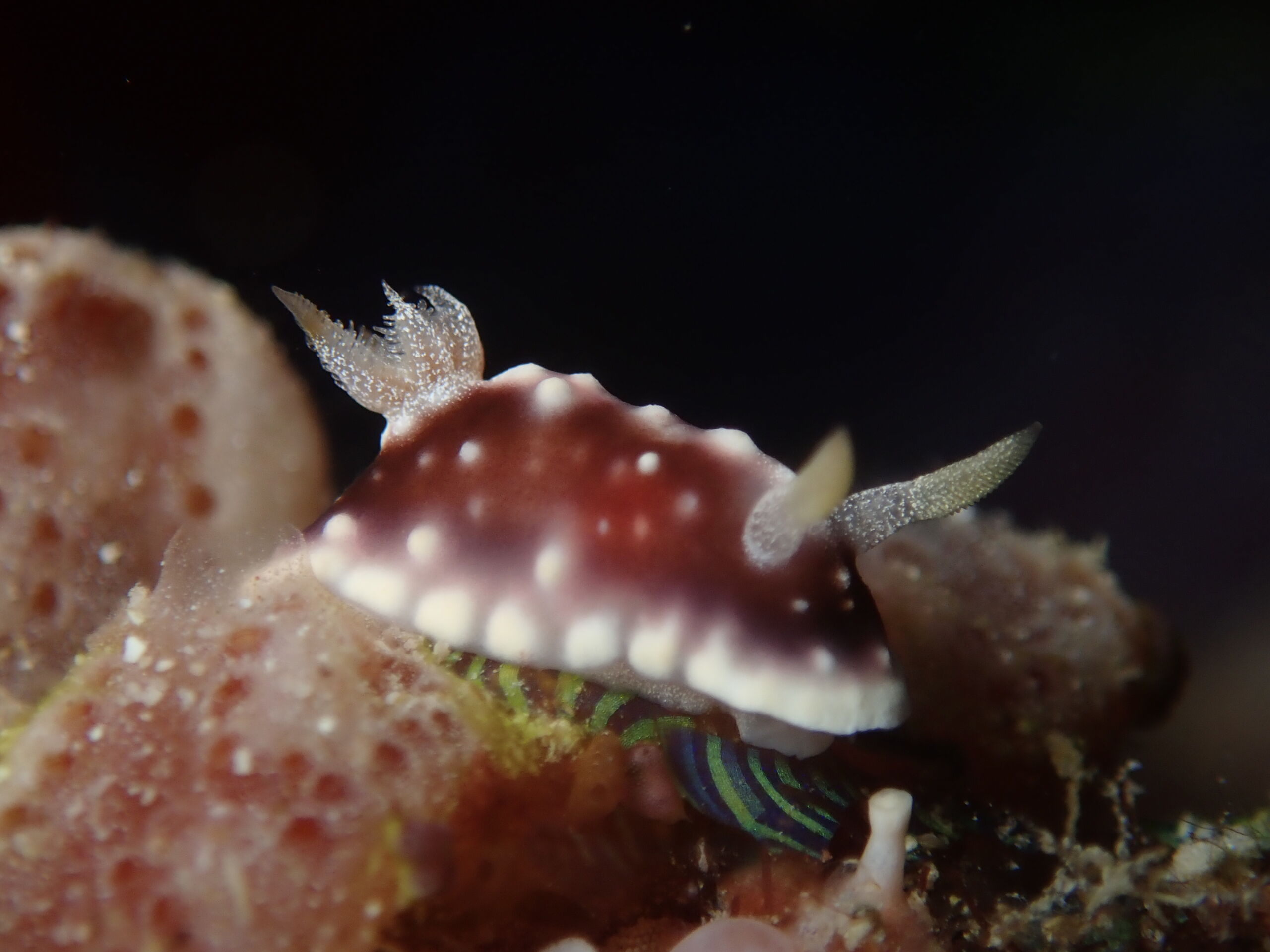
We move left shoulder around the pinnacle, weaving through boulders and coral outcrops. Every overhang hides a secret: cleaner wrasses tending to groupers, shy moray eels peeking from crevices, and vivid nudibranchs moving slowly over sponges.
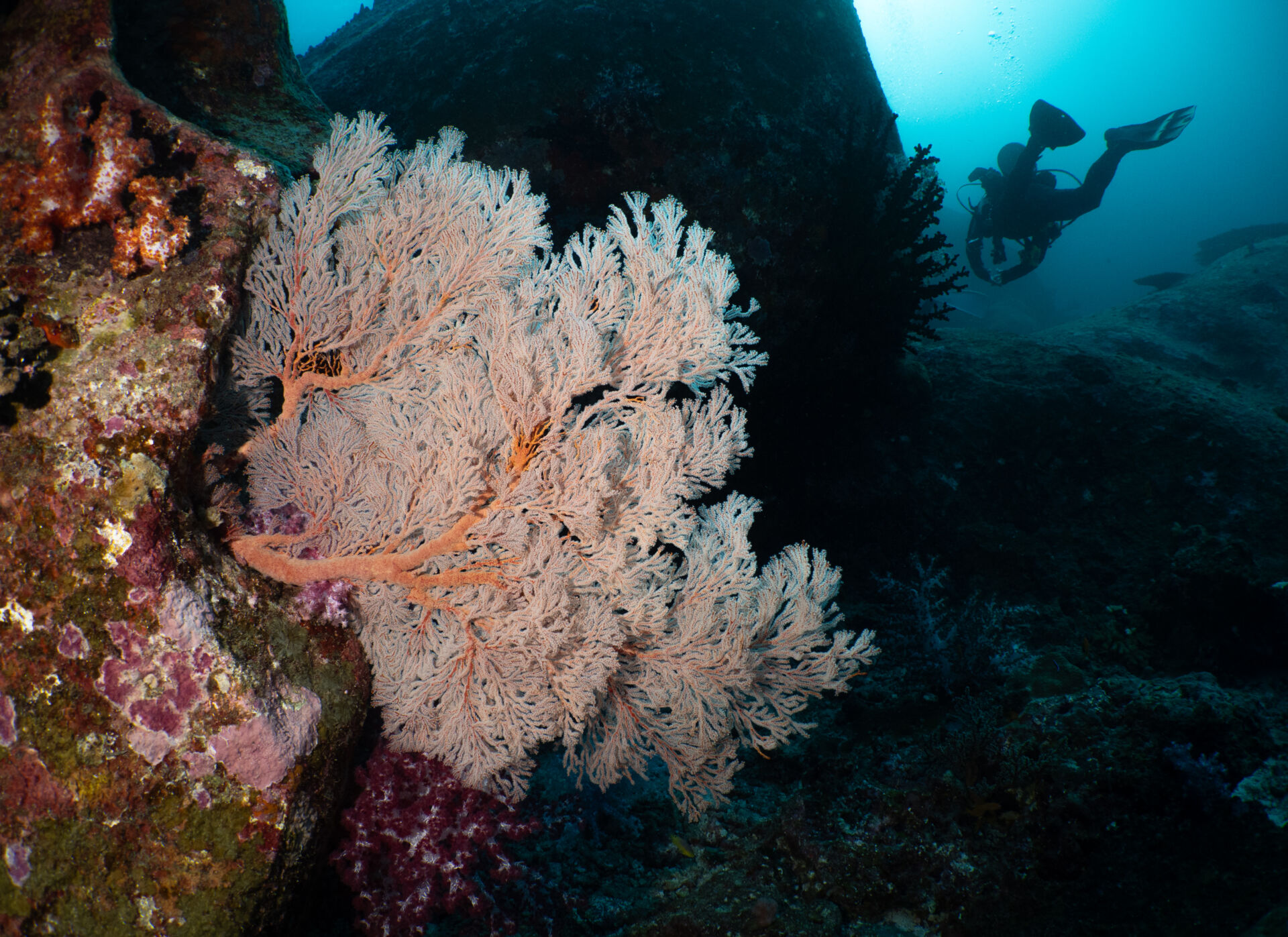
The formation of Koh Tachai Pinnacle is breathtaking. Its dome-shaped top at 12 metres gives the site its alternate name, The Dome. From here, boulders cascade into the deep, some forming walls that drop to 35–40 metres. Gorgonian sea fans sway from coral heads, filtering nutrients from the rich currents. Often a cold thermocline sweeps through — a reminder of the deep Andaman upwellings that sustain this vibrant reef.
The Second Pinnacle
It’s worth mentioning that Koh Tachai actually has a second pinnacle, located about 50 metres north of the main dome. This smaller formation rises from around 30 metres at its base to about 18 metres at the top, and though it lacks a buoy or mooring line for descent, it can be reached during a single dive when current conditions allow. The underwater swim takes roughly two to three minutes, crossing a sandy channel that gently slopes between the two structures.
Compared to the main pinnacle, the second dome feels quieter and more secluded, offering a peaceful contrast to the bustling marine life of the first. Hard corals and sea whips cover its granite surface, and the visibility across the sandy channel often reveals unexpected visitors. During this crossing — and around the sandy outskirts of both pinnacles — divers sometimes encounter leopard sharks resting on the seabed, or even of large Jenkins’ whiprays and marbled rays hiding in the sand.
Coral Bommies and Hidden Residents
As we ascend to 15–18 metres on the northwest side, we reach a patch of shallower coral bommies, bursting with life. Among them lives a large family of spiny lobsters, their long white-striped antennae waving gently from cracks between corals.
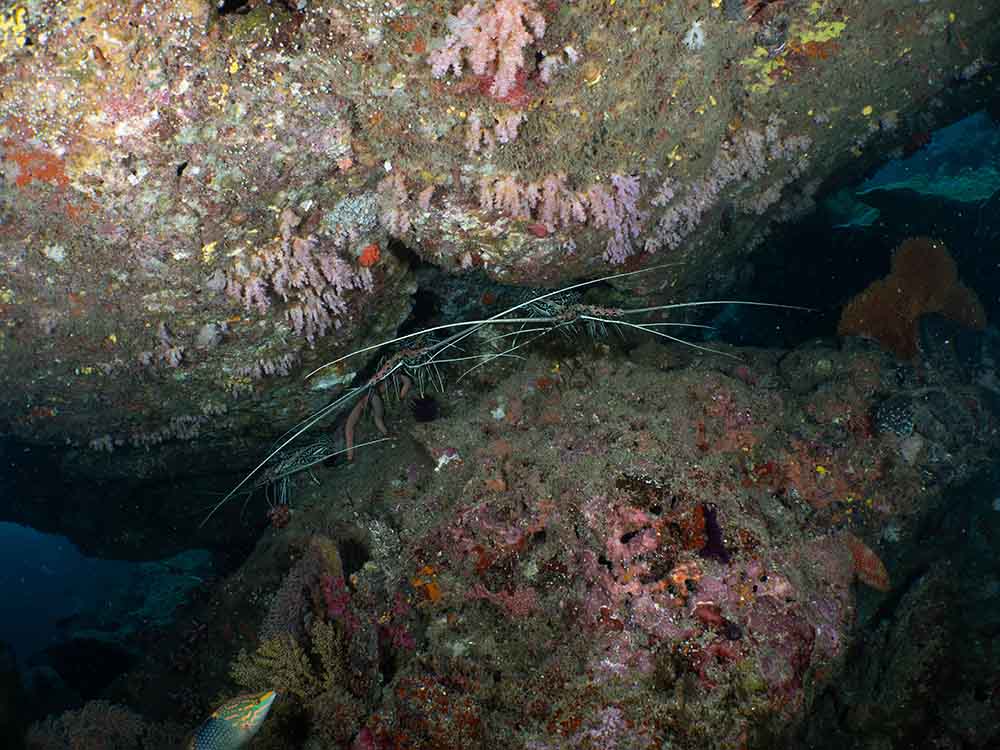
Spiny lobsters, or Panulirus versicolor in Thai waters, are nocturnal crustaceans that feed mainly on molluscs and small invertebrates. During the day, they rest in tight clusters under ledges for protection. Their long antennae help them detect movement and communicate with each other, while their powerful tails allow rapid backward escapes when threatened. These lobsters are an essential part of the reef ecosystem, contributing to its complex food web and nutrient cycle.
The closer we look, the more colourful the boulders become. Soft corals in shades of pink, yellow, and lavender cling to the granite walls. Butterflyfish, angelfish, and bannerfish dart through the bommies, feeding on algae in the shifting light.
Suddenly, our guide signals excitedly, pointing into the blue…
Pelagic Visitors
Koh Tachai Pinnacle is a magnet for pelagic giants. The site acts as a cleaning station for oceanic manta rays, drawn by the abundance of cleaner wrasses near the coral heads on top of the dome. These graceful visitors glide effortlessly through the current, circling the pinnacle as small fish nibble away parasites.
We watch in slow motion as two manta rays pass above us, looping and dancing together before fading into the blue. Encounters like this are unforgettable — a perfect reminder of how alive and interconnected this ecosystem is.
Whale Sharks – Gentle Giants of the Andaman
If luck is truly on our side, we might meet an even larger visitor — the whale shark. These gentle plankton feeders can grow over 10 metres long, though typically younger and smaller in the Similan Islands, and are the largest fish on Earth. Despite their size, they pose no threat to divers, gliding slowly as they filter-feed on plankton clouds.
In Thailand, whale shark sightings are seasonal and unpredictable. Historically, they were more common around the Similan and Surin Islands, but their appearances vary with changing ocean conditions. They tend to follow nutrient-rich thermoclines and plankton blooms, which explains why years with stronger upwellings bring more sightings.
To the Dome
The current has calmed now. We drift gently toward the top of the dome, scanning for the small and the spectacular alike.
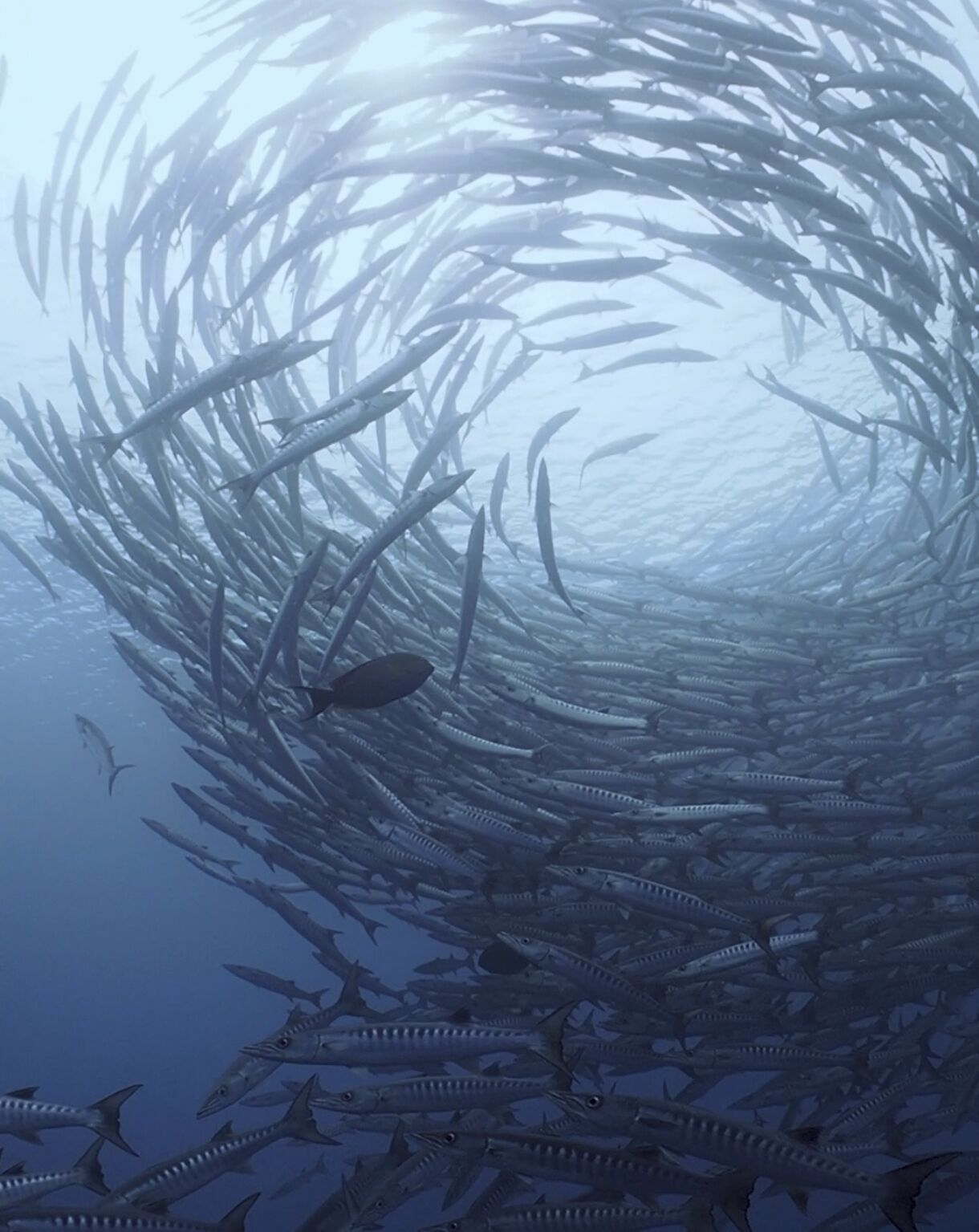
Then — a shadow begins to loom above.
Hundreds of chevron barracuda swirl in the sunlight, circling in perfect formation. Their silvery bodies catch the rays as they twist and spiral — forming a breathtaking barracuda tornado.
Barracuda form these dense schools for protection and hunting efficiency. In a group, they can confuse predators and ambush prey more effectively. Their synchronized movement also conserves energy as they ride each other’s slipstreams. When conditions align — current, light, and timing — this behaviour transforms into a mesmerising natural display, and Koh Tachai Pinnacle offers one of the best chances in the world to witness it.
The End of the Dive
Our tanks are running low, and it’s time to ascend. The top of the pinnacle sits shallow, around 10 metres, making buoyancy control essential as we begin our safety stop. The current gently carries us away as the granite fades below.
Our guide inflates the SMB (surface marker buoy), signalling our position to the dinghy waiting above. The waves can rise quickly here, so safety and coordination are key. One by one, we surface, greeted by warm sea spray and a bright tropical horizon.
This dive has been one of the most thrilling of our journey so far — a perfect mix of challenge and reward. From the barracuda tornadoes to the manta rays and colourful bommies, Koh Tachai Pinnacle delivers something new every time. Each dive here tells a different story — shaped by currents, moon, and the endless rhythm of the ocean.
Like what you read? share it with your friends!
Next en route on board MV DiveRACE Class X:
Next up on our journey, we’ll slow things down with a more relaxing dive site… stay tuned for the next adventure in our Dive With Us series.
Want to read more? Take a look at our latest posts!
- DiveRACE Safety Series: Diving Practices & Underwater Awareness
- Purpose-Built Workboats: The Support Heroes of MV DiveRACE Class X
- Symbiosis in The Similan Islands: 10 Intriguing and Disturbing Examples
- Acropora Corals in Thailand: The Science Behind Our Restoration Work
- Dive With Us in The Similan Islands: #12 Boonsung Wreck
Related Articles
-
Mergui Archipelago with DiveRACE
The Mergui Archipelago, located in southern Myanmar, is one of Southeast Asia’s…
-
Eat. Sleep. Dive. INFLATABLE FUN!
Diving isn’t the only way to enjoy the waters around Thailand. On…
-
Giant Trevallies at Koh Tachai Pinnacle
Koh Tachai Pinnacle is a top dive site in Thailand, famous for…