
The next part of our journey takes us further north in the Andaman Sea. We leave behind the Similan Islands National Park and enter the Surin Islands National Park, as we head towards the island chain located roughly 25 kilometres north of Koh Tachai. The islands sit close to the Myanmar border, remote and wild, and the sea around them feels open and untouched.
Here, the underwater landscape changes slightly from the Similan Islands. The water is usually a little cooler, often by one or two degrees depending on the season. Exposed sites can experience strong currents, and the surrounding water is deep, allowing nutrient-rich upwellings to sweep across the reefs. These conditions feed an enormous amount of life but also shift the overall look and feel of the underwater scenery.
Descending onto Ao Pakard
We usually do two dives in the Surin Islands. The main dive site is Ao Pakard, a large bay on the eastern side of Koh Surin Nuea. It offers protection from wind and waves, making it a dependable and calm site with minimal current to a relaxed drift dive.
We enter the dinghy and sail towards the island’s edge. I backroll into the still water, the sun beginning to drop behind the islands and painting the sky in warm oranges and reds. The glow spreads across the surface, highlighting the deep blue beneath me.
As I begin to descend, I instantly notice the difference in the reef structure compared with the Similan Islands. A tapestry of healthy corals unfolds below, but the texture feels different. Surin reefs are dominated by massive Porites bommies, tabulate Acropora species, large patches of encrusting Montipora, and broad fields of lettuce corals. There are fewer branching corals than in the Similans, and the variety of pastel colours is not as pronounced.
The reef feels different here. It is one of the healthiest reef systems in Thailand, yet it is not as vibrant as the Similans. Many corals are naturally brown, tan, or beige due to the dominant species present and the high concentration of symbiotic algae living within their tissues. These algae thrive in nutrient-rich water, creating darker pigmentation. The result is a reef that is incredibly healthy, but with a more muted, earthy palette.
Venturing Beyond the Reef
As we continue to descend, the reef gives way to wide sandy plains deeper at 18–20 metres. The water is full of nutrients, which sustain the lush coral communities in the shallows, but these same nutrients create a soft green haze over the deeper areas. It feels mysterious, almost untouched.
The Surin National Park is known for larger pelagic encounters. The cooler, nutrient-rich waters attract sharks, rays, and visiting open-ocean species. Ao Pakard is one of the best sites in the park to spot them.
I scan the sand for movement. A strange silhouette appears, resting motionless. Its body is flat, with long dorsal fins extending along its back and tail, rising higher than expected. It looks like a ray… or a shark… or something in between. I approach slowly, careful not to spook it.
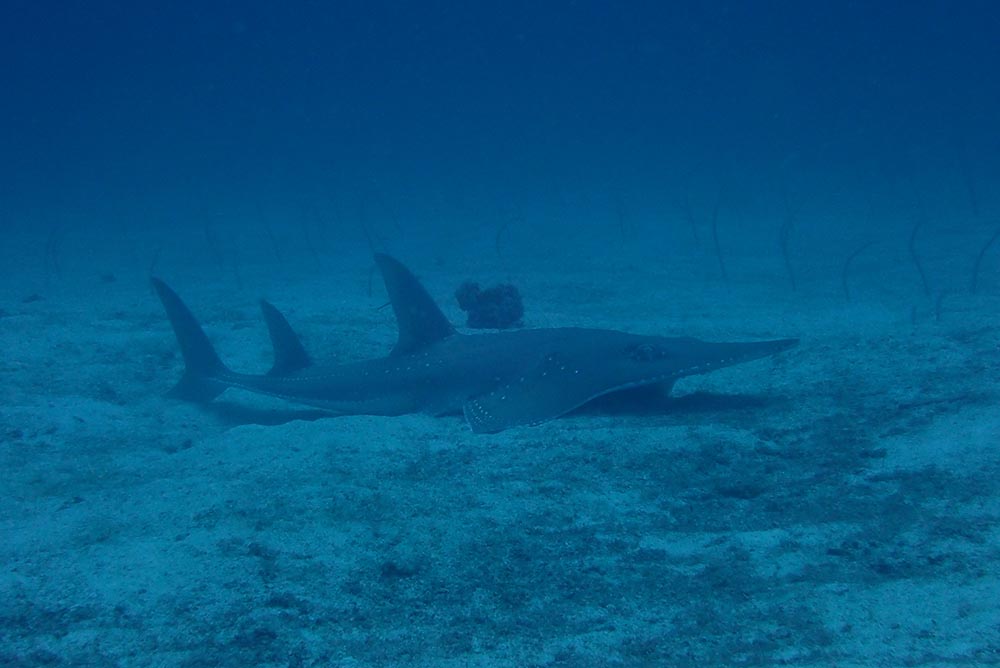
It’s a guitarfish, a unique type of ray. Guitarfish belong to the Rhinobatidae family, sharing features with both sharks and rays but classified as rays. Their bodies are flattened like rays, adapted for resting on sand, but their long, pointed snouts and extended dorsal fins give them a shark-like profile. Many people call them “guitar sharks” or “shark-rays” for this reason. They have tough, smooth skin more similar to sharks, and their eyes sit high on their heads, allowing them to watch for predators while mostly buried. They feed on small fish, shrimp, and crustaceans, using their powerful jaws to crush shells. Guitarfish are shy, making any encounter feel special.
Searching the Sand
We continue across the sandy bottom, scanning the haze for life. Kuhl’s maskrays burst from the sand as we pass, leaving small circular imprints behind. A larger tail spine catches my attention — the cowtail stingray, a broad, oval ray with a distinctive black tail ending in a long white tip. These rays are strong swimmers and often rest during the day before hunting at night.
We drift across a patch of hydroids, delicate branching creatures that resemble soft corals. Hydroids are actually colonial animals related to jellyfish, and their polyps carry stinging cells. Many nudibranchs feed on hydroids, storing the stinging cells in their own bodies as defence.
As expected, we begin searching for small critters. One of the favourites here is the Pikachu nudibranch, a bright yellow nudibranch with black-tipped rhinophores and gills. Its colours mimic the famous cartoon character, and its tiny size makes finding one feel like discovering a treasure.
Back to the Reef
We’ve spent a while exploring the sand, and although the depth isn’t extreme, we keep an eye on our NDL, especially when diving on air.
We return to the reef edge and begin to shallow up. This is where the beauty of the Surin corals becomes obvious. Large lettuce corals cascade down the slope, forming wide plates and delicate folds. The colony structures are dense and ancient, shaped by centuries of slow, steady growth. You can see the history in every ridge and contour.
Despite the muted coral colours, fish life adds vibrancy everywhere. Parrotfish bring bright greens, blues, and pinks, grazing constantly and scraping algae from the coral. Their feeding keeps the reef clean and healthy. Wrasses dart through the corals, their bodies covered in neon stripes. Cleaner wrasses tend to client fish, while larger wrasse species weave between coral heads in fast, colourful bursts of motion.
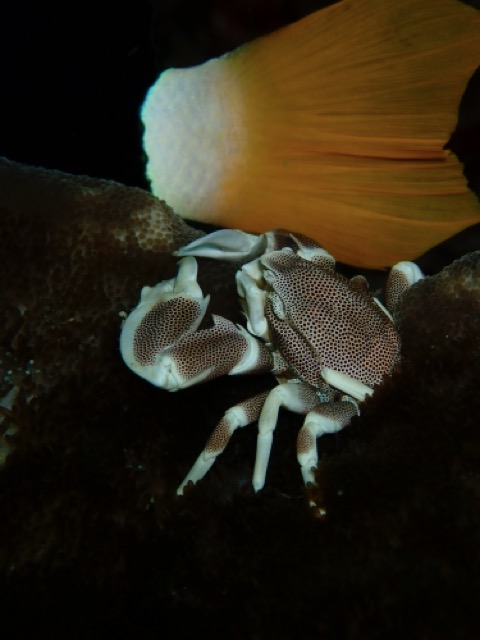
There are many anemones here, home to false clown anemonefish and Clarke’s anemonefish. In these anemones, it is common to find porcelain crabs, tiny filter-feeding crustaceans that live permanently within the tentacles. Their flat bodies and enlarged claws help them anchor themselves, and they wave delicate feeding fans through the water to catch plankton. This is a perfect example of reef symbiosis—protection for the crab, cleaning and water movement for the anemone.
As we move along the shallows, I scan the reef for octopus, turtles, and both blacktip and whitetip reef sharks. All are commonly seen here, patrolling the edges of the coral.
Ascending to the Sunset
The sun sinks behind the Surin Islands, and the water begins to darken as we ascend. The surface glows with deep orange, purple, and red tones. It’s a peaceful moment, suspended between ocean and sky.
This dive has been a calm and rewarding exploration. It feels different from the Similans — less bright, perhaps—but rich with life, mystery, and quiet beauty. The reef here tells a story of resilience and age, shaped by cooler water, strong currents, and the endless flow of nutrients. Every dive offers something unexpected, whether a rare ray or a tiny nudibranch glowing against the sand.
Like what you read? share it with your friends!
Next on our journey
Our adventure continues within the Surin National Park as we travel toward one of our favourite dive sites, and one of the most celebrated sites in the world…
Want to read more? Take a look at our latest posts!
- DiveRACE Safety Series: Diving Practices & Underwater Awareness
- Purpose-Built Workboats: The Support Heroes of MV DiveRACE Class X
- Symbiosis in The Similan Islands: 10 Intriguing and Disturbing Examples
- Acropora Corals in Thailand: The Science Behind Our Restoration Work
- Dive With Us in The Similan Islands: #12 Boonsung Wreck
Related Articles
-
Mergui Archipelago with DiveRACE
The Mergui Archipelago, located in southern Myanmar, is one of Southeast Asia’s…
-
Eat. Sleep. Dive. INFLATABLE FUN!
Diving isn’t the only way to enjoy the waters around Thailand. On…
-
Giant Trevallies at Koh Tachai Pinnacle
Koh Tachai Pinnacle is a top dive site in Thailand, famous for…